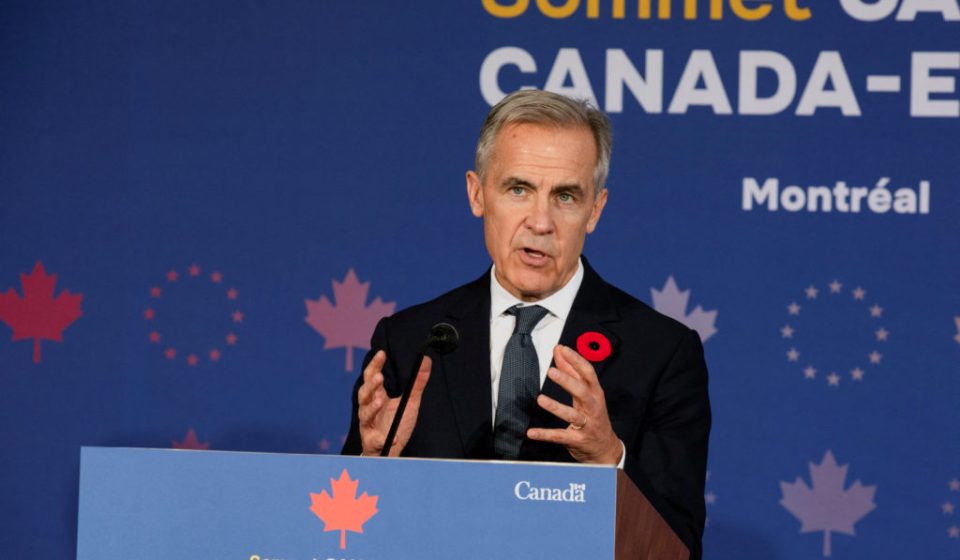
Canada’s Carney reports progress in US trade talks, Trump raises ‘concept’ of deal

TORONTO (AP) — Canadian Prime Minister Mark Carney said Sunday he had a constructive conversation with U.S. President Donald Trump about a possible trade deal, with negotiators ready to work toward an agreement in the coming weeks as the countries seek to resolve their bitter trade dispute just days before the U.S. midterm elections.
Trump then said the two sides had “the concept” of a mutually beneficial deal.
READ MORE: Canada takes steps to become first associate member of the European Union
Carney said the conversation built on recent discussions on the outlines of a deal that would create jobs, reduce costs for families and protect Canada’s languages, culture and sovereignty.
“Our teams will now work in the coming weeks to achieve this result,” Carney wrote on social media.
Hours later, after landing in Iowa for a rally, Trump said, “We have the idea of a really good deal with Canada.”
“We’ve been losing money for many years with Canada, many years,” he said. “So we have – we are now very close to an agreement.”
The US president mentioned speaking with Carney on Saturday and said the eventual deal “will be great for our farmers, great for our country, and it will be good for Canada.”
Trump said the negotiations focused on building the Keystone XL pipeline and whether the deal could wipe out tariffs paid by U.S. farmers on Canadian products.
“Part of the agreement is that our farmers will not have to pay any customs duties,” he said, although his comments also clarified that the final details had not yet been worked out.
Still, the two leaders’ optimistic assessment marks a change from August, when Canada withdrew from negotiations after rejecting U.S. demands that Carney said threatened Canadian sovereignty, protection of the French language and the auto industry. Trump responded by imposing 50% tariffs on approximately $20 billion in Canadian goods, provoking retaliation from Canada.
Carney said last week that trade talks had resumed because Washington was moving closer to Canada’s position.
Also on Wednesday, Carney said the countries were not yet able to reach an agreement before Tuesday’s midterm elections.
The two sides have discussed possible relief from U.S. tariffs on Canadian steel and automobiles, although no details on a potential deal have been announced.
READ MORE: Prime Minister Mark Carney says US is trying to break up Canada as Alberta votes on separation path
Trump’s trade war with Canada has become an issue in Tuesday’s elections, particularly in Michigan and Maine, where crucial Senate runoffs are taking place. Michigan Republican Senate candidate Mike Rogers has called for an end to the tariff war.
Daniel Béland, a political science professor at McGill University, said recent U.S. tariff adjustments affecting Canada showed the White House recognized the political risks of its trade war, particularly in border states.
Robert Bothwell, a historian at the University of Toronto, said Carney’s conversation with Trump was unlikely to affect Tuesday’s election and cautioned against reading too much into the improved tone.
He likened the apparent thaw to a passing weather system bringing “five minutes of variable sunshine. Rain later.”
Trump’s trade war and repeated threats to make Canada the 51st U.S. state have pushed Carney to reduce Canada’s dependence on its southern neighbor. Canada and the European Union launched a new alliance Friday, with Carney seeking to make Canada the bloc’s first “associate member” and double its exports to countries other than the United States over the next decade.
Canadian Conservative Opposition Leader Pierre Poilievre urged Carney on Sunday to strike a trade deal, saying Canadians could not afford to wait.
“It’s time for Mr. Carney to stop the rhetoric and get real results,” Poilievre said.
A free press is the cornerstone of a healthy democracy.
Support trusted journalism and civil dialogue.
Gn headline