In a cascade of rulings issued days before Tuesday’s election, federal judges rejected the Trump administration’s efforts to take control of state voting processes, pressure state and local election officials to comply with their demands and turn the midterm vote into another opportunity for immigration control.
In Northern California on Friday evening, U.S. District Judge Trina L. Thompson granted unions representing California poll workers a sweeping order barring the Trump administration from a range of election-related actions, including requiring those workers to spoil the ballots of voters whose eligibility the administration has questioned, and threatening them with criminal penalties if they refuse to do so.
“Election Day is fast approaching. Ballots have already been distributed. Americans have already started voting. Workers have already begun processing ballots,” Thompson wrote. “Given the consequences of inaction, the Court sees no reason to delay its decision. »
A Justice Department spokesperson criticized Thompson for ruling “without even waiting to hear from the United States,” and said his decision was part of a “two-track system of justice” in which other federal judges delayed the Trump administration’s “own urgent election demands” until after Election Day.
“The ministry is reviewing the order and evaluating all options,” the spokesperson said.
State officials remain concerned about election interference from the Trump administration next week, as evidenced by a remarkable letter Gov. Gavin Newsom sent Saturday to U.S. district court judges across the state. Newsom wrote that he “has serious concerns that federal agents will seek search warrants to seize ballots and voting materials before election results are certified,” and urged judges not to grant such requests — because “the stakes for democracy and the rule of law are too high.”
But they were reassured by their accumulation of recent victories.
Thompson’s ruling follows three others — one in Los Angeles District Court and two in the 9th U.S. Circuit Court of Appeals — in which federal judges blocked the administration’s efforts to force California elections officials to immediately throw out the ballots of 20,000 voters who the administration said might be noncitizens, instead setting a timetable for further investigation into the matter after the polls closed.

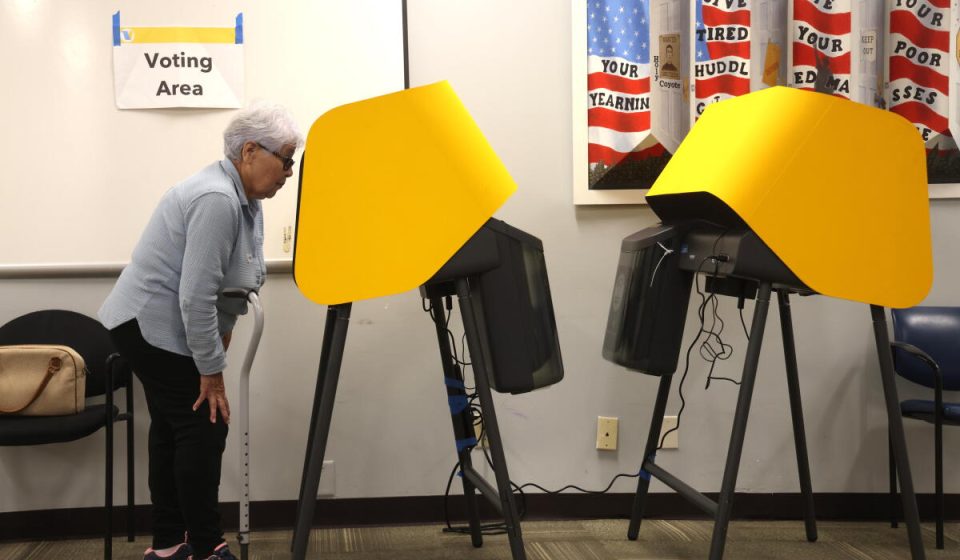
Maria Plaza, 78, votes Friday at the Coalition for Humane Immigrant Rights’ flexible voting center in Los Angeles.
(Genaro Molina/Los Angeles Times)
That followed a ruling in a separate case in Washington, D.C., in which a federal judge demanded that the Trump administration turn over its list of suspected non-citizen voters to advocacy groups including the Los Angeles Coalition for Immigrant Human Rights. Data analysts with the UCLA Voting Rights Project wrote in court Saturday that their review of the provided list found it “contained numerous errors” and included citizens and thousands of others who were not on California’s voter rolls.
And it came around the same time as Friday night’s decision by the full 9th Circuit not to reconsider a three-judge select panel’s decision upholding an earlier decision by U.S. District Judge Araceli Martínez-Olguin in Oakland. It had barred federal immigration agents searching for non-citizen voters from conducting door knocks, traffic stops and other field interviews in California and eight other states.
The administration’s losses — in high-profile cases and with real-world implications in an election that will determine control of Congress — are the result of legal challenges from a coalition of liberal states like California, localities like Los Angeles County, and immigration, voting rights and labor groups.
But they are also the product of a bipartisan group of federal judges — including judges appointed by President Trump — who have called the administration’s efforts unconstitutional and a threat to one of the most essential functions of American democracy.
These judges weighed this threat against the Trump administration’s alleged threats to election integrity from non-citizen voters, and found the former to be greater than the latter.
“Of course, competing public interests are at stake. There is a public interest in maintaining election integrity. But as discussed, the district court found that the risks of noncitizens voting are, at best, uncertain, and also tempered by California’s established voter eligibility procedures,” wrote the 9th Circuit majority — one Trump appointee, one President Biden appointee — who refused to block the 20,000 votes. “On the other hand, there is a significant risk that granting the requested relief to the United States will result in disenfranchisement and jeopardize the entire county election.”
Those within the coalition who resisted the government’s efforts celebrated the decisions and praised the courts.

Screens show equipment in a ballot sorting area at an Orange County Registrar of Voters facility in Santa Ana.
(Apu Gomes/Getty Images)
“The judicial crackdown on Trump’s illegal efforts to undermine our elections continues,” wrote California Atty. Gen. Rob Bonta, whose office has argued several cases, in response to Thompson’s ruling Friday night in favor of the unions. “Trump is racking up defeat after defeat as he enters the final agony of this election and desperately and savagely attacks the will of the voters.”
“4 DAYS UNTIL ELECTION DAY. Remember: your vote counts. Don’t be intimidated. Continue to vote as normal,” wrote Senator Alex Padilla (D-Calif.), in response to the same decision. “The courts respect the rule of law and it is the states – not Donald Trump – that run our elections. »
“We said we would not let the Trump administration intimidate election workers, and today we obtained a critical court order blocking those threats,” said SEIU International President April Verrett. “This decision is a victory for the workers who make our elections possible and the communities they serve. »
This wave of rulings was driven in part by the administration itself, as Justice Department officials scrambled to rush cases through the courts at breakneck speed in search of relief before Election Day.
The 9th Circuit has already ruled twice on the case involving California’s 20,000 ballots, for example, because Justice Department lawyers appealed the case before the district court ruled, on the grounds that U.S. District Judge David O. Carter was taking too long to make a decision.
When the 9th Circuit rejected that attempt and sent the case back to Carter, he issued one of the most striking decisions of the week.
“Constitutional rights and our democracy are at stake. The public interest favors their protection. Individuals who have met the requirements of California’s voter registration laws should not be deprived of a fundamental right simply because of unfounded allegations arising from a process fraught with uncertainty and error,” Carter wrote. “The public interest also favors the protection of election officials, who work diligently to ensure that all citizens can vote. »
When the Trump administration appealed that decision again to the 9th Circuit, the same majority of the panel — Mark J. Bennett, a Trump appointee, and Gabriel P. Sanchez, a Biden appointee — slapped him down again. They wrote that the administration’s arguments were legally flawed in several respects, including in that they sought clearly unconstitutional executive power to intervene in an election.
“We decline the United States’ invitation to violate the Elections Clause by undermining the plain text of the Constitution,” they wrote.
Trump weighed in Saturday, claiming without evidence on social media that top assistant U.S. Attorney. Bill Essayli, the top federal prosecutor in Los Angeles who argued the case before Carter and vehemently defended it online, had “intercepted a massive number of illegal votes, 20,000, but potentially hundreds of thousands, and perhaps even millions,” and condemned the courts for dismissing the allegations.
However, Essayli and other Justice Department officials have remained surprisingly silent. The administration missed a deadline to request that the three-judge panel’s decision be reviewed by the full appeals court. She did not immediately appeal to the U.S. Supreme Court. And neither the Justice Department nor Essayli’s office responded to requests for comment.
Gn headline