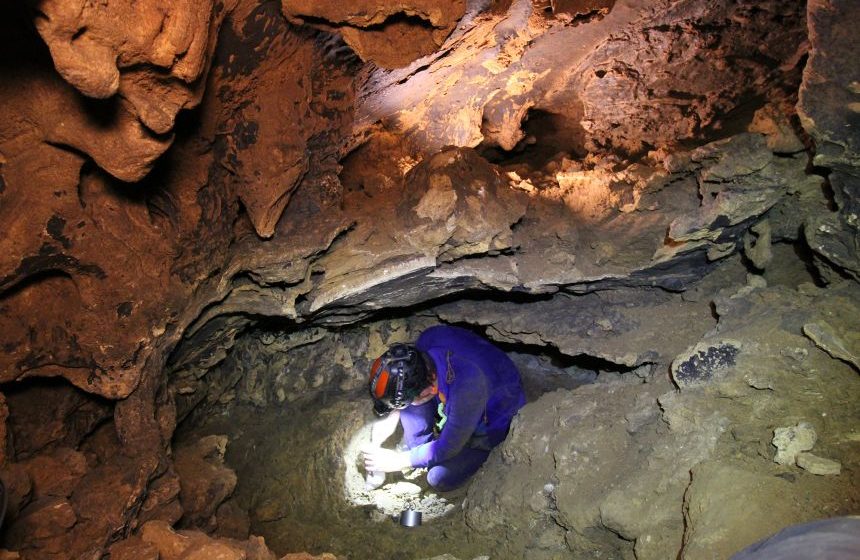
A distant human ancestor known as Homo erectus roamed long distances and lived in dense, overcast rainforests as recently as 184,000 years ago, according to new studies of teeth discovered in two caves in southern China.
Evidence that this enigmatic species was able to thrive in a harsh environment that researchers previously believed to be the sole domain of our own species, Homo sapiens, is changing the way scientists view Homo erectus. The first archaic human to leave Africa and cross continents, Homo erectus ultimately roamed the planet for nearly 2 million years before disappearing. The species may have been much smarter than scientists thought, the latest research suggests.
“Although it is increasingly recognized that our own species, Homo sapiens, adapted to tropical forests around the world between 100,000 and 13,000 years ago, this is the first clear and direct evidence we have of another hominid living in these habitats,” Patrick Roberts, a professor at the Max Planck Institute for Geoanthropology in Germany, said in a press release. Roberts is co-author of one of two tooth studies published Wednesday in the journal Nature.
The team of Australian, Chinese and European researchers studied nine hominid teeth and animal fossils discovered in two caves 15 kilometers (about 9 miles) apart in the limestone karst of southern China’s Guangxi province, a spectacular landscape of steeply sloping rock hills, flat valleys and chasms.
Scientists identified eight teeth as having belonged to Homo erectus by analyzing their bumps and grooves. The team also recovered molecular information from the tooth enamel of four teeth suggesting a link to proteins found in Homo erectus teeth earlier this year. With little genetic material available to study until recently, the species remains a major mystery in human origins.
Scientists determined the age of the fossils using five dating techniques applied to teeth or sediments and mineral formations from surrounding caves.. Together, the results revealed that Homo erectus lived in what is now southern China between 324,000 and 184,000 years ago, a time when the species was thought to have already disappeared from that region – and most other places around the world. The youngest Homo erectus fossils were discovered in Indonesia and date back to 108,000 years ago.
The team also studied the teeth’s chemical signatures, called isotopes, to understand how Homo erectus moved across the landscape. By analyzing strontium, a chemical that reflects local geology, in tooth enamel, researchers found that some individuals may have spent their childhoods – when teeth were forming – moving through forested karst regions over surprisingly large areas, perhaps covering distances of up to 250 kilometers (about 155 miles).

It’s a “fascinating discovery because it confirms the presence of Homo erectus in a place we didn’t expect and at a time we didn’t consider,” geochronologist and co-lead author Kira Westaway said in the release. Westaway is a professor at Macquarie University in Sydney, Australia. “This has huge implications for the timeline of Homo erectus as we try to understand the causes of its extinction.”
Proposed explanations for the eventual demise of Homo erectus include a failure to adapt to new and rapidly changing environments, said Ben Utting, a research scientist affiliated with the University of Connecticut’s department of anthropology, who was not involved in the research. “But this study demonstrates that Homo erectus was much more behaviorally flexible than previously thought,” he said.
Fossils of Homo erectus found in Java, Indonesia, suggest the species lived in open forests around 108,000 years ago, raising the question of whether the encroachment of closed-canopy forests at that time contributed to the species’ disappearance, the research shows.
“Tropical rainforests are among the most difficult environments for humans to live in, especially without agriculture,” Utting said by email. “The findings of this study suggest that Homo erectus was capable of inhabiting these demanding environments much earlier in human evolutionary history than previously thought. More broadly, this raises the possibility that tropical rainforests played a much more important role in deep human history than we have traditionally considered.
Equally fascinating, Utting adds, is the fact that Homo erectus traveled such long distances: “Travels of this scale would have required a sophisticated understanding of the surrounding terrain, including regional landscape features and river networks that change with the seasons.” »
The team was unable to positively identify the ninth tooth discovered in the caves. Its shape was distinct from that of the teeth of Homo erectus, Homo sapiens and Neanderthals, the last of which died out around 40,000 years ago but was not thought to have lived in East Asia. The tooth also did not contain the same molecular signature as proteins recovered from teeth identified as Homo erectus.

It is possible that the tooth belongs to another ancient human population known as the Denisovans. — Homo longi — or offspring of Denisovan-Homo erectus, said Ryan McRae, a paleoanthropologist at the Smithsonian National Museum of Natural History in Washington, D.C., who was not involved in both studies.
Both species are now known to have inhabited the same region around the same time, one of Nature’s studies noted, calling the overlap “intriguing.” In research published earlier this year, scientists recovered ancient proteins from six Homo erectus teeth discovered in China that, for the first time, revealed a molecular link between Homo erectus and later human species such as Homo longi.
“One of the nine teeth discovered could be Denisovan, or a hybrid tooth, rather than Homo erectus. They’re not really committing to calling it that, but they’re definitely hinting at it,” McRae said via email.
on human origins at the Natural History Museum in London, agreed that this was a possibility. “Recent research suggests that there has been interbreeding between erectus And longi/Denisovan, and the new evidence increases the likelihood that this will happen, at least on occasion,” Stringer said in an email. He was also not involved in the research.
Homo erectus was the first human species to have body proportions similar to Homo sapiens. These distant human ancestors were tall, had an upright posture, a large face with a protruding forehead and no chin.
Fossil evidence of Homo erectus has been found in Africa, Asia and Europe and spans more than 1.5 million years, far longer than the 400,000 years of Homo sapiens’ existence, making this ancient species by far the oldest surviving species of any human relative, according to the Natural History Museum in London.
Homo erectus the more we realize they’re not that different from us,” McRae said.
Gn world