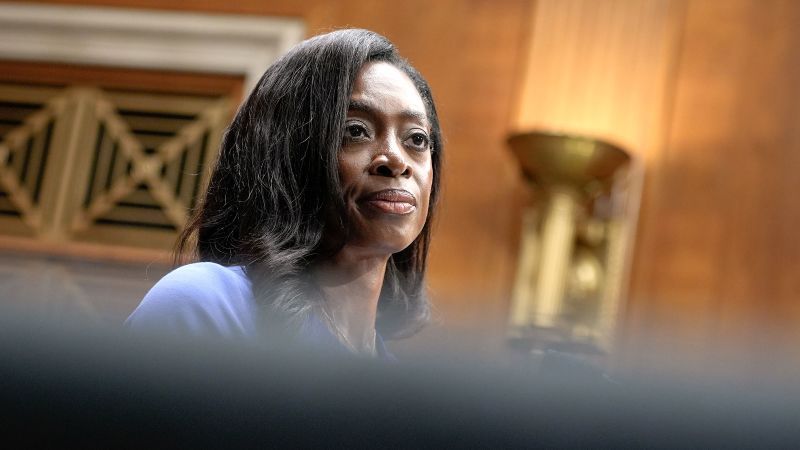
The U.S. Centers for Disease Control and Prevention will not fundamentally change its response to measles outbreaks even if the United States loses its measles elimination status this month, CDC Director Dr. Erica Schwartz told Reuters on Tuesday.
Global health experts convened by the Pan American Health Organization will determine in the coming days whether the United States has “lost its official status as a measles-free state, a hard-won public health feat since 2000.”
Many disease experts say that is likely to be the case as the country battles the highest number of infections in more than three decades. Thousands of Americans have contracted measles since early 2025, when the Trump administration took office.
Schwartz said she expected a decision from OPS early next week.
“Let’s say we lost our measles elimination status. We’re going to do the exact same thing we did today, which is work with the states,” Schwartz said in an interview.
The CDC will ensure that “we help them raise awareness about measles, emphasizing, reaffirming that the primary way to prevent measles is the MMR (measles, mumps and rubella) vaccine,” she said.
Schwartz, confirmed as CDC director in August, inherited a measles outbreak that has worsened since last year. There have been nearly 5,200 confirmed cases in 2026 — up from 2,289 for all of 2025 — and 11 deaths reported by state health departments since the start of last year.
U.S. Health and Human Services Secretary Robert F. Kennedy Jr., who oversees the CDC as well as other health agencies, has for years questioned the safety and effectiveness of the MMR vaccine. As the nation’s top health official, he has sought to reduce the number of childhood vaccinations. Medical experts said his speeches and actions fueled “declining vaccination rates.”
Schwartz pointed out that “closely knit communities” were the primary source of measles infection in the United States. Several outbreaks have emerged among religious groups where vaccination rates are lower than the general population, including the Amish in Pennsylvania.
“These communities generally don’t vaccinate their children. … Their families were making decisions about the MMR vaccine 20 to 30 years ago, and we’re just now seeing the results of those decisions,” Schwartz said. “The real concern is why we are not looking into these close-knit communities to make sure they understand that the number one way to prevent measles is the MMR vaccine.”
In August, shortly after Schwartz’s confirmation, President Donald Trump and Kennedy unveiled an executive order calling for splitting the MMR vaccine into three separate shots. Pharmaceutical companies said it could take years, while doctors said it would cause more confusion among families.
Schwartz also rejected reports suggesting that Kennedy and her top deputies had pressured her or the agency. She said she was in daily communication with Kennedy.
“What is very clear to me is that the secretary has acknowledged that I am the director of the CDC, and these decisions and the direction we go with the CDC rest on my shoulders,” Schwartz said. “At the end of the day, he recognizes that the reason I’m sitting in this chair is because the CDC needs a leader.”
Gn Health