Skip to content
-
Subscribe to our newsletter & never miss our best posts. Subscribe Now!
Today's News. Tomorrow's Perspective. Today's News. Tomorrow's Perspective.

Deliver fast, factual, and easy-to-understand news covering global events, technology, business, science, AI, health, entertainment, and lifestyle.

Today's News. Tomorrow's Perspective. Today's News. Tomorrow's Perspective.

Deliver fast, factual, and easy-to-understand news covering global events, technology, business, science, AI, health, entertainment, and lifestyle.

  • Home
  • Breaking News
  • Business
  • Sports
  • Health
  • Politics
  • Technology & AI
  • World
  • Home
  • Breaking News
  • Business
  • Sports
  • Health
  • Politics
  • Technology & AI
  • World
Close

Search

Subscribe
Centuries-old cemetery points to colder climate as a factor in childhood vitamin D deficiency in industrial England

Health

Centuries-old cemetery points to colder climate as a factor in childhood vitamin D deficiency in industrial England

Stephen Atcheler
By Stephen Atcheler
November 8, 2026 3 Min Read
Comments Off on Centuries-old cemetery points to colder climate as a factor in childhood vitamin D deficiency in industrial England

In 18th and 19th century England, children were very common with rickets, and most explanations point to factory smoke, crowded cities, and poverty. A new study in Frontiers in Environmental Archeology adds another factor that researchers rarely consider: climate itself.

Centuries-old cemetery points to colder climate as a factor in childhood vitamin D deficiency in industrial England
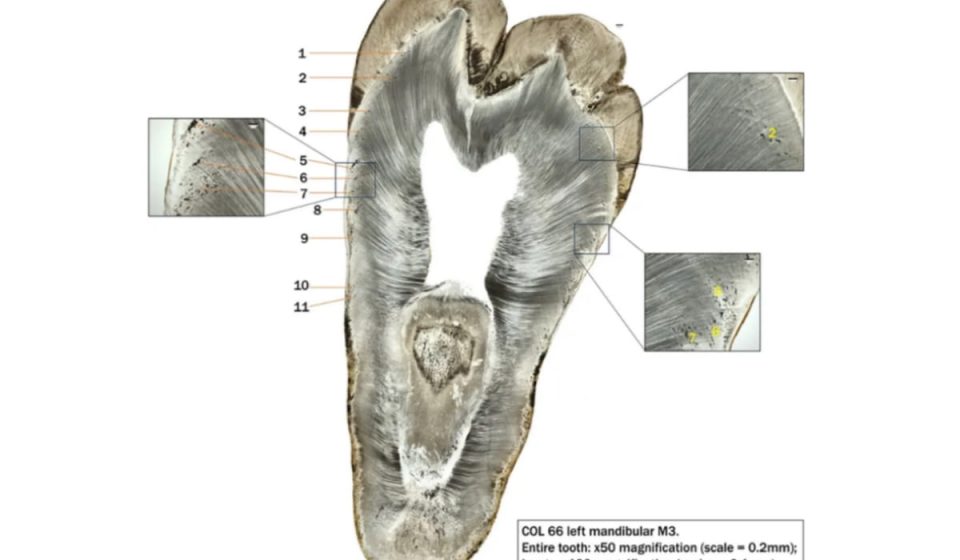
Multiple scattered bands of dark scalloped defects along the entire length of the tooth are visible. They indicate voids in which tissue has formed poorly due to vitamin D deficiency. Credit: Kendall et al., Frontiers in Environmental Archeology (2026)

Researchers from Durham University studied Coach Lane, a Quaker cemetery in North Shields, northeast England. People were buried there between 1711 and 1829, as the town transformed from a fishing village to an industrial port. An excavation carried out in 2010 revealed 236 burials. The team studied 30 teeth from 21 people whose names were unknown.

Teeth keep a trace of childhood. Dentin, the inner layer, hardens on a fixed schedule as the child grows. When it doesn’t cure completely, it leaves behind defective spots. Some defects are normal. Defects that repeat at regular intervals with healthy dentin between them indicate a vitamin D deficiency. Coach Lane’s teeth had many such defects, and some people had braces that repeated every year, suggesting a seasonal pattern. The differences appeared from early childhood to early adulthood, but especially during early childhood.

Teeth alone gave ages, not calendar years. The team therefore turned to the cemetery’s burial register. Quakers kept careful records and the register lists the ages and years of death of many of the 197 people named in it. Subtracting the age from the year of death yielded estimated birth years for 109 of them. The graves did not have markers, so researchers could not associate a record entry with a specific skeleton. Instead, they treated the cemetery as one community.

Centuries-old cemetery points to colder climate as a factor in childhood vitamin D deficiency in industrial England
The image shows several scattered bands of dark scalloped defects along the length of the tooth, which indicate voids where tissue has formed improperly due to vitamin D deficiency. Credit: Kendall et al., Frontiers in Environmental Archeology (2026)

Birthdates aligned with cold, dark times. Of the 109 people, 91 were born within 10 years of a major volcanic eruption, and 41 were born when low solar production and volcanic activity overlap. All this happened during the Little Ice Age, a long period of cooling between the 13th and 19th centuries, brought on by erupting volcanoes and a quiet sun. Less sun means less UV rays, and skin needs UV rays to produce vitamin D.

The team also compared Coach Lane with other European sites, some industrial and some not. Rates of mineral defects in teeth and bones did not clearly correlate with industrialization, latitude, city size, or social class. Sites with many burials before 1800, however, tended to have more defects. This phenomenon can be explained by the colder climate, since it started before the factories.

The authors do not claim that climate trumps pollution or poverty. They argue that vitamin D deficiency arises from several causes acting together, and that the combination has changed with time and place. Their advice to bioarchaeologists is to consider climate records as part of the basic context when reading skeletons for signs of disease.

The study has limitations. Without headstones, the team couldn’t link a person’s dental record to a year of birth, so they couldn’t check whether defects across multiple years corresponded to the worst years of the chill. The sample is also small. Cutting teeth to study dentin destroys them, and the work is expensive and requires special equipment. Scans that leave teeth intact and chemical tests could soon enable larger studies. Future work should use samples with known dates and life histories, and should examine other signs of poor health, such as stunted growth in children.

Lead author Ellen Kendall says climate instability seems like a modern problem, but people have faced it before and learning how they’ve dealt with it can help us prepare.

Publication: Kendall, E.J., Sohler-Snoddy, A.M., Kendall, R., Koon, H., Gowland, R., Weale, M.C.,…Edwards, S. (2026). “The bright sun has gone out”: metabolic health and vitamin D status in a Little Ice Age (18th-19th centuries) population in north-east England. Frontiers of Environmental Archeology, 5(1909791). doi:10.3389/fearc.2026.1909791

Gn Health

Views: 13
Stephen Atcheler
Author

Stephen Atcheler

**Stephen** is a staff journalist at **DailyVoxa**, specializing in business, finance, technology, artificial intelligence, and global markets. He is committed to delivering timely, accurate, and insightful reporting that helps readers understand the forces shaping the global economy and the rapidly evolving digital landscape.Drawing on in-depth research and credible sources, Stephen covers breaking developments, industry trends, and emerging innovations with a focus on clarity, balance, and factual accuracy. His reporting is designed to provide readers with reliable information, practical context, and thoughtful analysis without sensationalism.As a member of the DailyVoxa editorial team, Stephen follows the publication's Editorial Policy, Fact-Checking Policy, Corrections Policy, and Ethics Policy. Every article is carefully reviewed to ensure it meets the highest standards of journalistic integrity, transparency, and editorial independence.

Follow Me
Other Articles
Kylie Kelce, Jason Kelce's Wife, Weighs In on the Idea of ​​Baby No. 5
Previous

Kylie Kelce, Jason Kelce’s Wife, Weighs In on the Idea of ​​Baby No. 5

College Football Week 10 Winners and Losers: Ohio State-Michigan Set to Air on Cartoon Network
Next

College Football Week 10 Winners and Losers: Ohio State-Michigan Set to Air on Cartoon Network

Deliver fast, factual, and easy-to-understand news covering global events, technology, business, science, AI, health, entertainment, and lifestyle.
  • About Us
  • Accessibility Statement
  • Advertise With Us
  • AI Usage & Transparency Policy
  • Contact us
  • Cookie Policy
  • Corrections Policy
  • Meet Our Team
  • Privacy Policy
    • Disclaimer
    • DMCA & Copyright Policy
    • Editorial Policy
    • Ethics Policy
    • Fact-Checking Policy
  • Terms and Conditions
Copyright 2026 — Today's News. Tomorrow's Perspective.. All rights reserved.