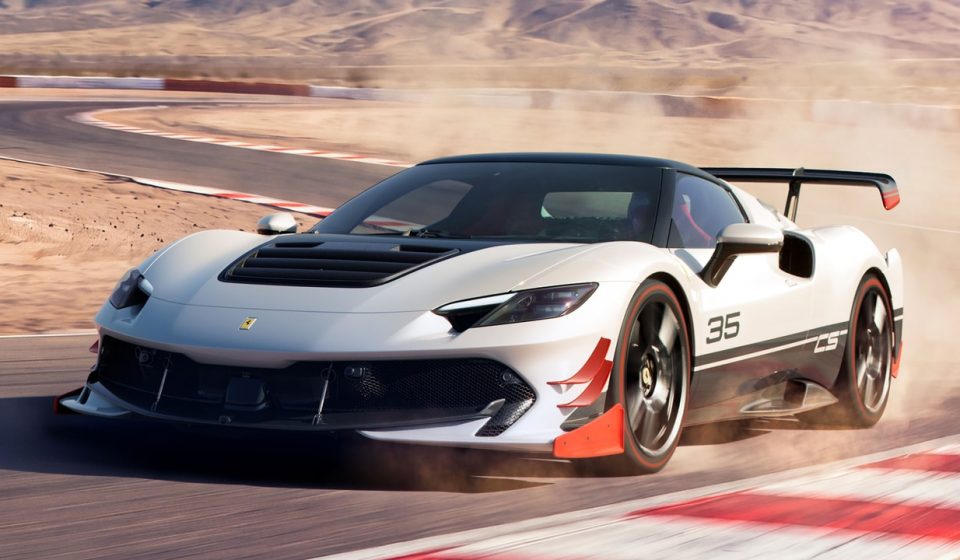
And it’s not a rarity in limited production either. Welcome to the coolest 296 yet
Lighter, harder, faster, louder, wingier. And no hybrid. Just when you thought this was a standard approach to making a Ferrari faster, here comes the latest nugget.
The 296 Challenge Stradale is combustion only. Ferrari removed the electric motors and battery, reducing weight by 140 kg and power by almost 200 hp.
There’s a lot going on here. Traditionally, Ferrari only builds one special version of its mid-engined cars. But this is the second derivative of the standard 296 GTB. Last year we had the 868 hp Speciale, now we have the 670 hp Challenge Stradale.
And there’s one more good news: this isn’t a limited edition model only made available to a handful of Ferrari’s top collectors. This is a full production model. And – relatively speaking of course – it will be a bargain, priced almost exactly in line with the entry-level 296 GTB, at around £260,000. A throwback to the good old days when the stripped down car was the cheap car.
And it was deleted. It was released alongside (and developed with) a newly improved 296 racing car, the Challenge Evo, used for one-make racing. Externally, the most obvious differences are the exterior mirrors and plexiglass windows.
Neither is pretty. The smooth, elegant curves of the 296 GTB have been lost, hidden behind all sorts of bolt-on fins, vents, films and foils. The rear wing is a thumper, responsible for 270 kg of downforce alone.
For a car that boasts a claimed performance balance of “80% road, 20% track”, that’s a bit OTT. Elegance has been sacrificed on the altar of aero.
Total downforce is 617 kg at 250 km/h. At the same speed, Porsche’s GT3 RS would weigh around 640 kg. They weigh about the same too. Porsche quotes a wet weight of 1,450 kg, Ferrari a dry weight of 1,330 kg.
But here’s something different. Ferrari managed to keep the front trunk, where Porsche did not. Granted, it’s half the size, just 67 litres, a narrow gutter flanked by air channels that bring hot air from the radiators through the bonnet. I wouldn’t put the ice in there for long. But it’s there, indicating that Ferrari appreciates that this car is usable, something it forgot at its price with the luggage-free SF90.
Removing the hybrid required numerous engine adjustments. From increasing the torque curve at the bottom to improving power delivery above 8,000 rpm. The Challenge Stradale uses the engine from the Speciale, with titanium connecting rods and a nitrided steel crankshaft, but power has been increased by 7 hp to 670 hp.
That’s the same power as the 2015 488, but from a smaller two-cylinder, one-liter engine.
It should sound good too. The new exhaust promises to improve harmonics and the 296’s sound tube, bringing noise back into the cabin, has been recalibrated. As fierce and shrill as the GT3 RS’s nat asp flat six? Let’s not get carried away.
It will be faster than the Porsche. The promise is 62 mph in 2.8 seconds, 124 mph in 7.9 seconds. The Porsche’s times are 3.2 and 10.6. As far as sibling rivalry goes, it matches the 296 Speciale to the first marker, with a second delay to get to the last one. Around the slopes, it’s another story. “On Fiorano and other twistier circuits, the Challenge Stradale is faster,” says Matteo Turconi, senior product manager of Challenge Stradale, “on high-speed circuits like Monza, the Speciale is faster.”
Fortunately, Magneride is capable of small miracles
The most radical change to the suspension is to the springs – the main spring is now almost twice as stiff, so Ferrari added a softer auxiliary spring – a solution taken straight from the Evo racing car.
Damping is still done with the adaptive Magneride system, but for the first time on a Ferrari there are actually two bumpy road settings instead of one. What we can deduce from this is that the ride quality is… without compromise. Fortunately, Magneride is capable of small miracles.
There are carbon-ceramic brakes, you can have the carbon wheels as an option (saving 2kg per corner) and the track widths are a little wider (13mm front, 22mm rear), just helping to pack the arches and offer a little more lateral grip.
According to Turconi, “It’s not a car for everyone. If you want to slide, you don’t want this car. It’s like going back 30 years, it’s more precise, more demanding, with less assistance. It’s harder to drive. The brake pedal is firmer and has less travel, the accelerator spring is stiffer and the steering is heavier.”
You can tell from the moment you enter. The carbon door panels have some shape, but no covering material, just like the center console. You sit lower on carbon racing seats borrowed from the F80 – smaller seats are available. You don’t have to have racing harnesses either.
Soundproofing has been removed as part of all the weight savings, but there are some things that even Ferrari can’t dodge – the hardcore Challenge Stradale still has adaptive cruise control, lane keeping, sign recognition and driver drowsiness detection. The last one shouldn’t be necessary. Or others come to think about it.
Ferrari can be trusted to make this a stunning driver’s car. Fair play to them for not making this a special limited edition and charging the earth for it. But more than that, it signals diversification at Ferrari. And it looks like they took lessons from Porsche’s 911.
This, we feel, will help stabilize the ship.
The Speciale now seems to be positioned like the 911 Turbo: the same basic experience as the standard car, just improved, more power, luxury and user-friendliness. In this story, the Challenge Stradale follows the GT3 more closely. It’s a sensible thought: the Porsche GT cars are much less powerful than the Turbos, but that has never slowed them down, they are rawer, more exciting.
The timing is also interesting. 2026 has been a torrid year for Maranello. This gave us the Luce. We kicked him in the plums. The Dodici Cilindri Manuale was supposed to relieve pain, only for people to turn around and complain that it’s not a proper manual. It is well known that the 296 does not sell well. The Challenge Stradale therefore closely follows the Speciale.
This, we feel, will help stabilize the ship.
Gn tech