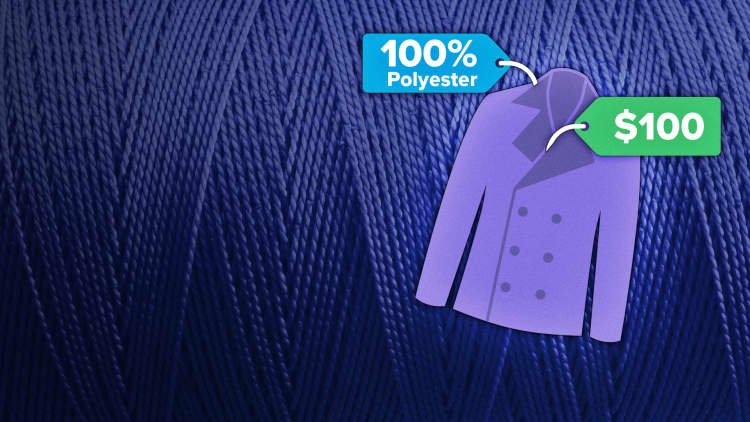

Clothes aren’t being made the way they used to be, and more and more buyers are noticing.
The composition of clothing imported into the United States has changed in recent years. In 2010, around 60% of clothing was mainly made of cotton. Today, that total is around 45%, while predominantly synthetic fabrics like polyester and nylon make up the majority of imports.
Clothing prices generally fell in the two decades before the pandemic, according to the Consumer Price Index. Since 2020, they have reached record levels.
This is starting to change consumer habits as they pay more for food, gas, rent and other necessities. As shoppers pay more for clothes, they become increasingly confident that the clothes are worth it.
The 2026 Consumer Confidence Index from consultancy AlixPartners, which surveyed more than 9,000 shoppers, found that consumers are scrutinizing labels more closely and rejecting cheap materials sold at a higher price.
“If it’s not a natural material, if it’s not a private label that passes it off as what it is, it really becomes less present in consumers’ minds,” said Sonia Lapinsky, head of fashion at AlixPartners.
The shift towards polyester
Fast fashion brands like Forever 21 and H&M exploded in popularity in the early 2000s and 2010s, quickly bringing trendy clothing to shelves at low prices. Then came super-fast fashion, with brands like Shein and Fashion Nova releasing new clothes at even faster speeds and lower prices – made possible in part through the use of cheap synthetic fabrics.
“We’ve gotten to a point where the pendulum has swung too far in this direction. And we’ve actually started to see a reversal,” said Janine Stichter, consumer analyst at US Bancorp BTIG. “Quality matters a lot more…in the last three or four years than in the previous 10 or 20.”
But quality, which buyers often associate directly with the material, can come at a higher cost.
The average unit price of clothing imported into the United States between January and August was $2.64 per square meter for clothing made primarily of synthetic fibers, such as polyester and nylon, compared with $3.67 for items made primarily of cotton, according to data from the U.S. Commerce Department’s Bureau of Textiles and Apparel.
Comparing these 2026 figures to those from 2010, import costs for synthetic fiber clothing have increased by approximately 11%, while costs for cotton clothing have increased by 21%.
“If you’re appealing to a more value-sensitive customer, you either reduce quality, negotiate with suppliers to try to share some of the cost, or maybe absorb the cost…and maybe hope to produce a greater volume of product to compensate,” said Aneesha Sherman, senior retail analyst at Bernstein Research.
Even though polyester is cheaper, experts point out that that’s not necessarily a bad thing. This can help clothes maintain their shape and wick away sweat.
Polyester product workshop at a factory of Jiangsu Hengke New Materials Co. in Tongzhou district, Nantong city, Jiangsu province, China, 15 September 2026.
CFOTO | Future publications | Getty Images
Sherman believes that the sports and leisure boom is a primary factor in the transition to polyester. She said that between 2015 and 2025, sportswear grew 4.9% in the United States, compared to 2.6% for all clothing and footwear, according to Euromonitor data.
“There’s probably a decline in quality there, too,” Sherman said. “But I think these two trends are confused.”
However, negative reactions to synthetic materials are growing. Generation Z even reused the word “polyester” as an insult usually means low quality or fake.
Environmental and human health concerns have also increased regarding petroleum-based clothing, as more research indicates that microplastics can leach from polyester clothing during washing.
This has caused consumers to re-examine the materials used in their clothing.
Manufacturing movements
Clothing prices rose in the wake of the pandemic as demand outstripped supply and allowed companies to raise prices, BTIG’s Stichter said. Tariffs and the war in Iran followed, raising costs for businesses – and prices for consumers.
Petroleum is the basis of many synthetic products fiber and oil prices have soared since the start of the war in Iran.
The same factors that helped drive up clothing prices – Covid, tariffs and war – have also affected clothing quality.
“Companies have had to change their supply chains in the post-Covid period,” Stichter said. “They had to find ways to cut costs, and that sometimes meant using cheaper fabrics.”
These factors have compounded a shift away from manufacturing in China that has lasted more than a decade.
Sheng Lu, a professor of fashion and apparel studies at the University of Delaware whose research focuses on the economics of the global textile industry, said China’s well-established history of clothing production means it has more skilled workers, advanced equipment and better materials management compared to emerging manufacturing destinations such as Bangladesh, Sri Lanka and Cambodia.
“They mainly serve the value market and the mass market. And I think why they’re not prepared to make higher quality luxury and high-end products really reflects the kind of skills you can expect when you’re sourcing from these countries,” Lu said.
AlixPartners’ Lapinsky said those countries that manufacture more cheaply sometimes still have to ship raw materials from China, which can extend the time it takes to make clothing. That means taking bets earlier on trends, then making discounts if products aren’t selling well.
“If you have to discount that product because the consumer doesn’t want it as much, your net margin might actually be worse than if you were to just invest in quality in the first place,” said BTIG’s Stichter.
And as material costs rise for synthetic fibers, Stichter also said she thinks that could provide more incentive for companies to use more natural fabrics in the future.
A 100% merino wool sweater from Abercrombie & Fitch.
Natalie Rice | CNBC
Who benefits?
Companies that prioritize quality win in this environment.
by Ralph Lauren the stock is up about 85% over the past two years. About 90% of its clothing is made primarily from cotton, leather, wool, viscose, cashmere or silk, according to its 2026 sustainability report. In its 2026 fiscal year, the company said it sold more products at full price and reduced markdowns.
Meanwhile, direct-to-consumer clothing brand Quince, which centers its brand identity around natural materials, hit a $10 billion valuation this year.
The brand climbed 16 spots to rank third for best resale value in online consignment retailer ThredUp’s 2025 report. Organic cotton retailer Pact jumped 20 places on this list to No. 8, illustrating the potential role materials play in brand recognition.
Alternatively, the AlixPartners 2026 report, which ranks brand sentiment across different retail categories, reveals that shoppers perceive some fast fashion brands less favorably. Shein and Zara fell three places – fifth and seventh, respectively – in terms of sentiment in the specialized young adult category.
Imen Ben Youssef | Afp | Getty Images
Shein passed on higher tariff costs to shoppers in 2025, then blamed slowing sales on those higher prices. The fast-paced fashion retailer saw its year-over-year share of U.S. clothing, accessories and footwear card spending decline in the fourth quarter of 2025 and the first two quarters of 2026, according to Consumer Edge.
Shein did not immediately respond to a request for comment.
Even though Zara fell in the AlixPartners Consumer Confidence Index, the company continued to increase its sales and profits year over year. Still, Lapinsky said deteriorating consumer sentiment is something to watch, even though the company is doing well.
“What we’ve found over the years with this consumer confidence index is that it’s sometimes a leading indicator of what’s going to happen,” said AlixPartners’ Lapinsky. “I’m not saying this will be true for Zara, but I think it’s something we’ll be watching over the next few quarters and into 2027.”
Gn bussni