
Millennials across America (at least in our minds) have plenty of reasons to complain: graduating into a job market ravaged by the 2008 financial crisis, crippled by murky predatory student loan schemes, and eternal guilt over association with silly music and “awesomesauce” memes. But there is at least a glimmer of hope.
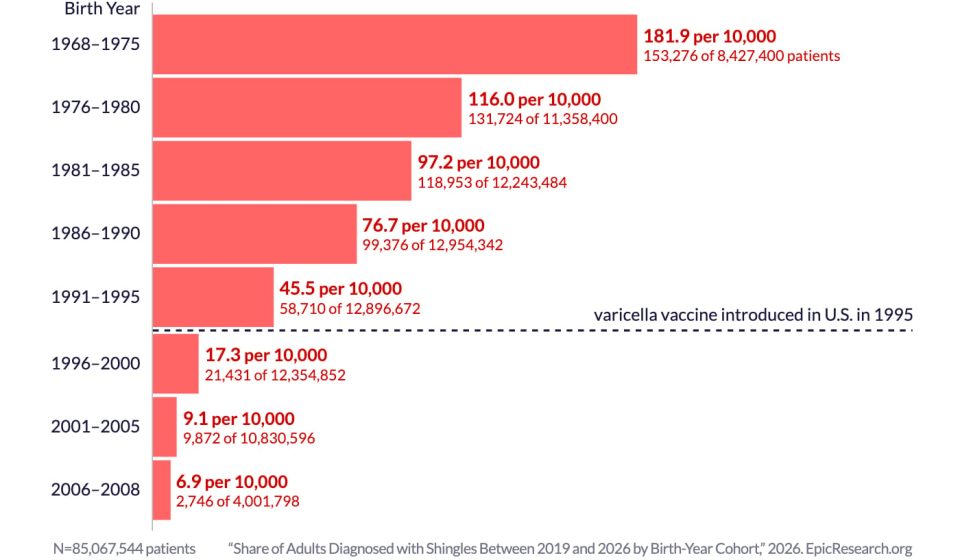
A large review of the medical records of more than 85 million U.S. adults, conducted by medical professionals and data scientists at the Epic Health Research Network, documented a sharp decline in shingles cases among adults younger than 35 years old. Researchers at Epic, a public benefit corporation, attributed this generational divide on the disease — essentially a reactivation of the same varicella-zoster virus that causes chickenpox in children — to the U.S. chickenpox vaccination program instituted in 1995. The program worked.
The oldest cohort examined by Epic researchers, Gen more than half to reach 76.7 cases per person. 10,000 people. But the sharpest decline occurred just as the 1995 U.S. policy became the norm for newborns. In what is undoubtedly good news for Gen Z as well, the rate dropped at that time, in the mid-90s, to just 17.3 cases of shingles per 10,000 people.
“This pause coincides with the first birth cohorts eligible for routine childhood varicella vaccination, although we did not assess whether patients received the childhood varicella vaccine,” the Epic team noted.
The right move
Epic researchers, including physician Sam Butler of the group’s clinical informatics division and data scientist Joe Deckert, attributed the sharp decline in shingles cases among people born just before the 1995 vaccination policy took effect to the flexibility with which the policy was implemented.
“Because the 1995 rollout also offered catch-up vaccination to susceptible older children, this was a gradual transition rather than an abrupt cutoff by year of birth,” Butler, Deckert, and their coauthors explained. Thus, they noted that the benefits extended to “a lesser effect on somewhat older groups, including some of the 35 to 39 age group.”
But the drastic nature of the decline for people born in 1995 and after is nevertheless remarkable. The decline in shingles cases between the 1991-1995 and 1996-2000 age groups, where the rate fell from 45.5 to 17.3 per 10,000 – a 62% drop – was “more marked than the change between all other adjacent cohorts,” they noted.
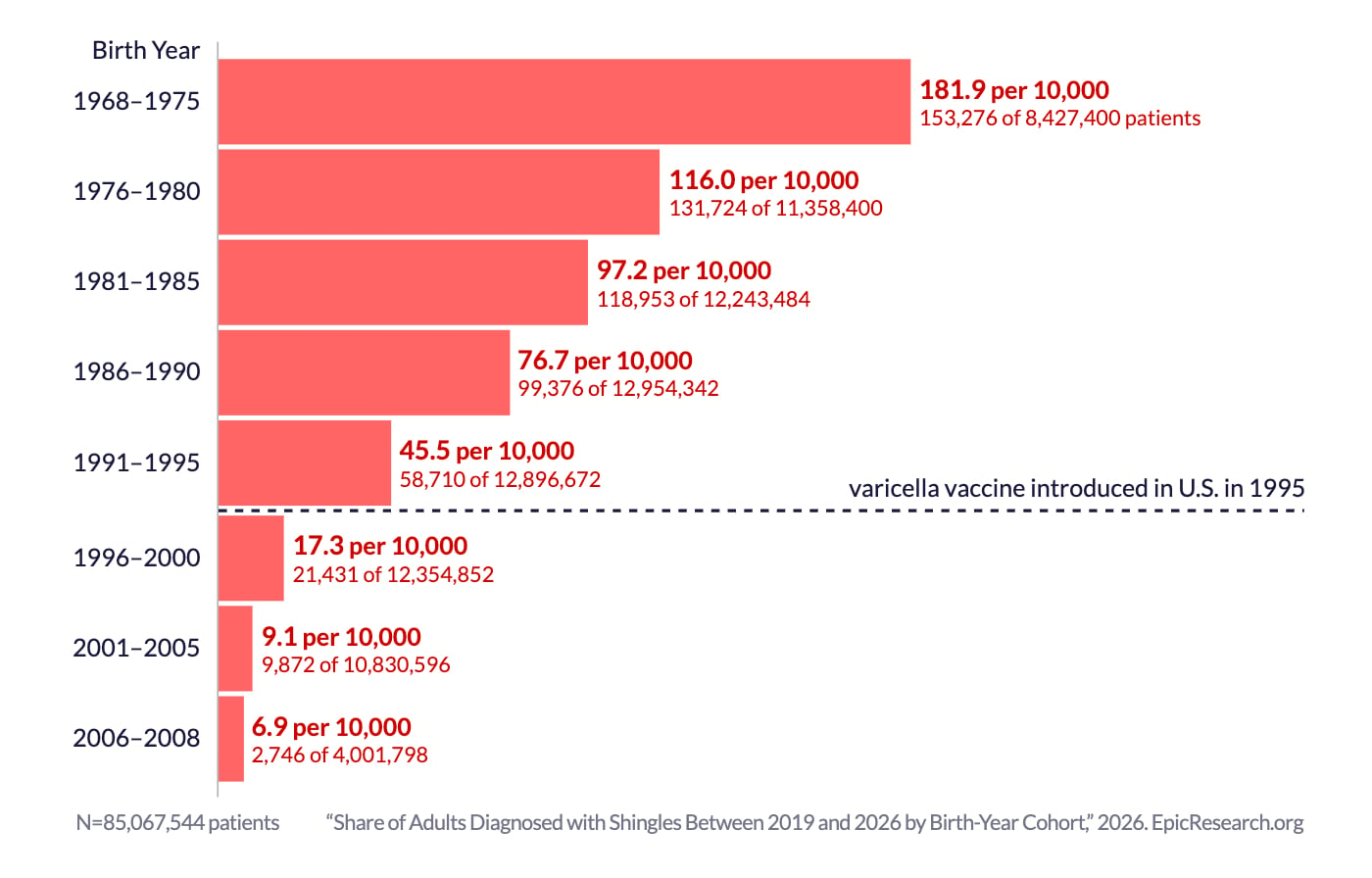
In other words, it convincingly supports the theory that early childhood vaccinations against chickenpox carry a lower risk of catching shingles later in life than natural immunity acquired the hard way, via infection with the virus in the wild.
rash decisions
Clearly, Epic’s findings are welcome data for those hoping to maintain U.S. medical policy on early childhood vaccinations. An attack of shingles can lead not only to painful, burning rashes and blisters, but also potentially to long-term nerve pain and other chronic conditions. And that childhood immunization program has been under threat since Robert F. Kennedy, Jr. — anti-vaccine activist, denim sportswear proponent, and U.S. Secretary of Health — last year convened a vaccine recommendation committee that voted against routinely combining measles, mumps, rubella, and varicella (chickenpox) vaccines for children under four years of age.
To be sure, a U.S. district judge in Massachusetts ruled against RFK Jr.’s Department of Health and Human Services (HHS) last March, preserving that child policy in response to a lawsuit against HHS led by the American Academy of Pediatrics. But it is equally clear from court filings that the ministry has no intention of backing down.
As HHS spokesperson Andrew Nixon said last spring: “HHS looks forward to this judge’s decision being overturned, as are his other attempts to prevent the Trump administration from governing. »
Gn Health