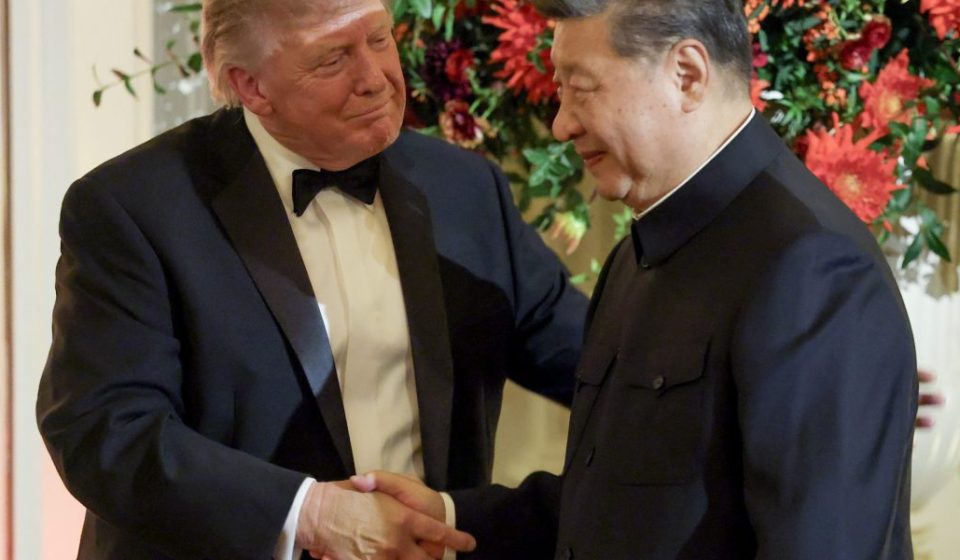

After President Donald Trump rolled out the red carpet for his summit with China’s Xi Jinping last week, the United States and China agreed to cut tariffs on $30 billion worth of goods in each direction. The Chinese side covers 1,619 U.S. products — ranging from beef and seafood to cosmetics and medical equipment — but it leaves out one politically sensitive import: soybeans.
While soybeans, soybean meal, and soybean processing byproducts have received tariff relief, the raw soybeans that U.S. farmers sell in bulk to China — those at the heart of U.S.-China agricultural tensions — have not.
Why soy is important
Soybeans are one of the country’s main agricultural exports, and China is the main buyer. The United States exported $16.5 billion worth of soybeans last year, making it the second-largest agricultural export after corn, according to the U.S. Department of Agriculture. China buys more soybeans than any other country because it has limited arable land.
This dependence has made soybeans vulnerable to fluctuations in trade policy between the United States and China. In the years before Trump’s first trade war in 2018, the American Soybean Association estimated that 28% of all U.S. soybean production was shipped to China. When Beijing then imposed retaliatory 25% tariffs on U.S. soybeans in 2018, the USDA estimated that farmers absorbed $9.4 billion in soybean losses, costing Iowa $1.2 billion and Illinois $1.3 billion.
The Midwest is bearing the brunt of this pressure. Illinois and Iowa are the two largest soybean producers in the country, followed by Minnesota, Indiana and Nebraska. North and South Dakota, Missouri, and Ohio are also major producers. With soybeans traded in export and domestic markets, weaker Chinese demand can hurt farmers by lowering the cash prices they receive at local grain facilities.
This partly explains why Trump focused on soybeans in his negotiations with Beijing. In November, he reached an agreement with Xi under which China committed to purchasing at least 25 million tons of soybeans in 2026, 2027 and 2028. After meeting with Xi in May, the first time a U.S. president visited China since 2017, the White House announced that China had agreed to purchase at least $17 billion worth of agricultural products in addition to its previous soybean commitments.
China has options
For all the importance of soybeans to American farmers, China has another supplier: Brazil.
Unlike products like beef, which vary in quality depending on country of origin, bulk soybeans are interchangeable and ultimately end up ground in troughs for livestock feed, according to Ker Gibbs, former president of the American Chamber of Commerce in Shanghai. “They go into pig feed, so it’s not like pigs will really see much difference between American soy and Brazilian soy,” he said. Fortune.
Brazil had already overtaken the United States as China’s largest soybean supplier more than a decade ago, but recent trade tensions have widened the gap. The USDA said 71% of China’s soybean imports came from Brazil, and its agricultural attaché in Beijing reported last year that Brazil’s share had continued to grow “at the expense of the United States,” helped by lower prices.
“They really want to keep Brazil warm and so they don’t want to suddenly move everything to the United States,” Gibbs said. Fortune on China excluding commodity soya from the list. “They leave the door half closed.”
Save the soy for another round
Leaving raw soybeans out of the tariff relief program also gives Beijing a holstered weapon, according to Usha Haley, a professor at Wichita State University who has studied Chinese trade strategy.
“It gives China a bargaining chip for subsequent negotiations and, of course, it’s a matter of leverage,” Haley said. Fortune. “They offer enough to demonstrate that they are moving forward, that they are present, but they always reserve something economically and politically for the next round.”
China does not need to completely stop buying U.S. soybeans for this pressure to work, since it purchased 1 million tons before the Trump-Xi summit.
“Commercial buying and negotiating levers can work simultaneously,” Haley said. She “said” that China simply needed to keep access to its soybean market uncertain and costly for farmers operating on low margins. “Uncertainty also has a cost.”
Gn bussni