
Beijing
Two giant pandas have left China on a flight to their new home at an Atlanta zoo, the latest emissaries in Beijing’s long tradition of using “panda diplomacy” to strengthen ties with other countries.
They left Chengdu, in southwest China, at 2:55 a.m. local time (2:55 p.m. ET Saturday), China’s official Xinhua news agency said. The flight took place just a day after Chinese leader Xi Jinping concluded a state visit to Washington.
During the visit, which aimed to address growing tensions between the United States and China, Xi and U.S. President Donald Trump extended a trade truce and agreed to establish an AI hotline between the two countries.
A Xinhua video shows supporters holding signs as trucks carrying the pandas head toward the airport from the giant panda breeding research base in Sichuan province. The vehicles then towed two crates to the plane before being transported there ahead of their journey, which is expected to take around 15 hours.
China has also arranged for several veterinarians and breeders to stay at Zoo Atlanta while the pandas enter quarantine upon arrival, the agency added.
The Atlanta Zoo team and the Chinese team held “numerous online and offline meetings to conduct in-depth discussions on the modernization and transformation plan” of the place that houses the pandas, which will be on loan from the Chinese government, according to Xinhua.
Rare, fluffy and irresistibly cute, pandas are loved all over the world. The animals once roamed a vast swath of China, as well as parts of northern Myanmar and Vietnam, but human encroachment and climate change have reduced the bamboo-eating bears’ habitat to just six mountain ranges above the Sichuan Basin in the heart of China’s hinterland.
Hailed in imperial times as the “land of heavenly abundance,” Sichuan is today better known as the “birthplace of pandas.” The mountainous province is home to a network of nature reserves and panda breeding centers, all built in recent decades as China – and the world – raced to save this millions-year-old “living fossil” from extinction.
Chengdu, the provincial capital – a sprawling metropolis known for its spicy hot pots and old teahouses – sits at the foot of snow-capped mountains with misty ancient forests where wild pandas still roam.

The city’s panda breeding base is the largest in the country, housing more than 240 bears, a third of the world’s captive panda population. The sprawling facility attracts up to 11 million visitors a year, on par with Shanghai Disneyland.
Lending pandas has long been a tool of Chinese diplomacy, following decades of government efforts to transform them from a little-known animal into a cultural icon and national symbol. For more than half a century, Beijing has sent these charismatic animals abroad to consolidate alliances, repair ties and woo new partners.
“The giant panda has been a messenger of friendship between the Chinese and Americans,” Xi said Thursday, referring to the half-century during which pandas lived in American zoos on loan from the Chinese government. This tradition was started by Chairman Mao Zedong in 1972, shortly after Richard Nixon became the first American president to visit China after the Communist Party came to power in 1949.
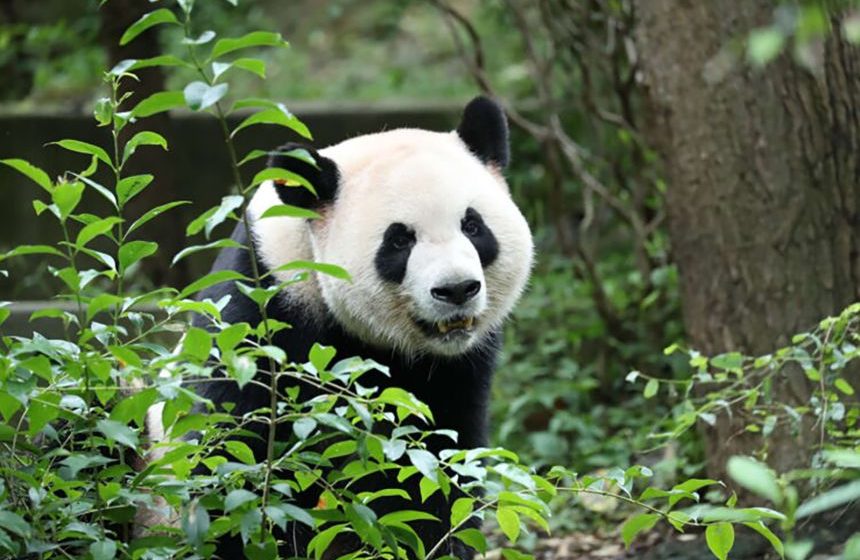
One of the Atlanta-bound pandas even has the same name – Ping Ping, meaning “peace” – as the very first panda gifted by Mao to the Soviet Union in 1957. He was born on March 17, 2020, has large black spots around his eyes and is particularly good at climbing trees, according to China’s National Forestry and Grassland Administration.
The other panda, Fu Shuang, which means “double blessing”, was born seven months later, on October 18. She has a small tuft of fur on the top of her head, a slightly protruding forehead and finds food very easily, the administration said.
In a report ahead of their upcoming trip, Chinese state broadcaster CCTV asked their guard to describe the two men.
Ping Ping “is brave and gentle,” Fu Jia said. “During training sessions, when he sees me holding an apple, he makes soft whines, eager for the treat.”
Fu Shuang, meanwhile, “is crazy about honey,” she said.
Zookeepers from the Chengdu Giant Panda Breeding Research Base selected the pair after taking into account their age, health, genetics and personality.
“They should be docile and like each other, and hopefully be able to mate naturally,” deputy park director Li Mingxi told Chinese state broadcaster CCTV.
They are expected to arrive in Atlanta early Sunday morning local time. The zoo has already welcomed several pandas. Another couple, Lun Lun and Yang Yang, had seven children there between 2006 and 2016 before returning to Chengdu.
Zoo Atlanta said earlier this year that it would be “thrilled and honored” to welcome the two pandas.
A banner displayed Saturday at the zoo read “The future home of Ping Ping and Fu Shuang.”
A representative for Zoo Atlanta said the facility would not share information about Ping Ping and Fu Shuang’s expected arrival date, and declined to comment further.
Chinese officials and Zoo Atlanta “will conduct in-depth academic and cultural exchanges to continuously strengthen mutual understanding and friendship between the Chinese and American people,” Xinhua said.
Panda diplomacy has brought some relief to the tensions that have increasingly shaped relations between the United States and China in recent years, as the two countries engage in an AI arms race and engage in a spiraling trade war.
Two giant pandas arrived in San Diego in June 2024, the first time China has allowed new pandas to travel to the United States in more than two decades. A second pair visited the National Zoo in Washington later that year.
In preparation for the move, Ping Ping and Fu Shuang were quarantined for a month with a roster of live-in caregivers, Li said. The pandas were also trained for their long flight, getting used to their cage and loud noises.

On Saturday evening, Chinese Ambassador to the United States Xie Feng shared photos of the two pandas on his X account and said they were on their way.
“Get ready to greet our two fluffy stars!” » he wrote.
Their departure would be sad for Fu, their guardian.
“After taking care of them for so long… It’s like raising your own children,” she told CCTV.
“They weighed just over 100 grams at birth, and we fed them until they got big and heavy. I won’t be able to see them for quite a while, so it’s hard to say goodbye to them.”
CNN’s Xiaoqian Lin, Farida Elsebai, Rebekah Riess, Eduardo Cuevas and Mitchell McCluskey contributed reporting.
Gn usa