China’s Shenzhou 24 mission takes off and transports first foreign astronaut to its space station

China launched the Shenzhou 24 spacecraft on Wednesday with three astronauts – two Chinese and one Pakistani – sending the first foreign crew member to his space station.
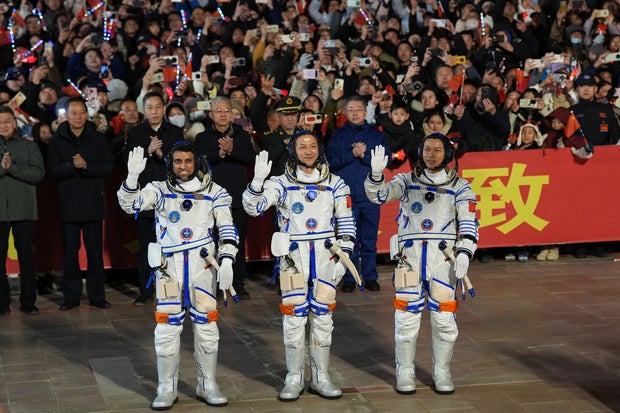
Pakistani astronaut Muhammad Zeeshan Ali, 40, flies alongside Chinese astronauts Tang Hongbo, 51, and Wu Yi, 39, after the craft took off from the Jiuquan Satellite Launch Center in northwest China on Wednesday morning. It successfully separated from a rocket and entered its predetermined orbit.
This is the first joint flight involving Chinese and foreign astronauts in the history of China’s manned space program.
Hours earlier, crowds of people had attended a farewell ceremony, many of them holding up their phones to capture the moment.
Andy Wong/AP Photo 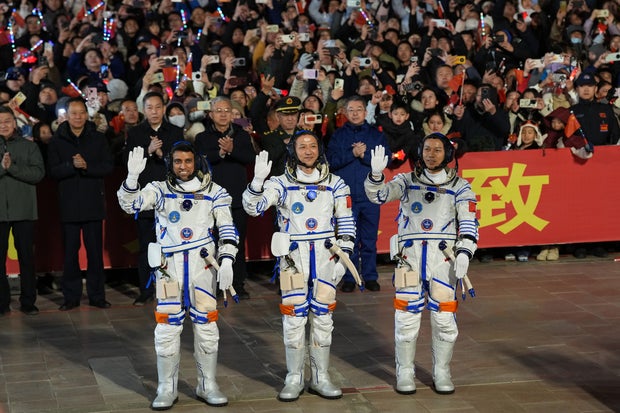
The crew will conduct more than 90 scientific experiments and technological tests during their mission, China’s official Xinhua news agency reported earlier. Ali will conduct a photosynthetic experiment on cyanobacteria in orbit during his short-term mission before returning to Earth aboard the Shenzhou 23 spacecraft, it said.
Pakistani Prime Minister Shehbaz Sharif extended his best wishes to the astronauts ahead of their mission.
“The friendship between Pakistan and China goes beyond the heights of the Himalayas on its journey to space,” he said on X on Tuesday.
The joint flight is part of an agreement signed by China and Pakistan in February 2025.
Although this is Ali and Wu’s first spaceflight, Tang has completed two previous missions and is expected to become the first astronaut to board the Tiangong space station three times, national broadcaster CCTV said.
At a news conference Tuesday, Tang said differences in language, culture and psychology made it more difficult to learn to collaborate on this mission, but that the efforts of both sides were paying off.
In front of journalists, these efforts were reflected in Ali’s fluency in Mandarin. He cited a line of Chinese poetry about climbing a higher floor to see further.
“It’s like my daily training. Day after day, reaching new heights,” he said in Mandarin.
Speaking in English, he said he hoped the next chapter of space cooperation between the two countries would move from one astronaut in a single flight to multiple joint flights and to the Moon, Mars and beyond.
In May, China launched Shenzhou 23which carried three astronauts, including a crew member who was expected to stay in space for about a year.
China getting ready for its first crewed moon landing by 2030. The United States is widely seen as China’s main space rival, with NASA aiming to terrestrial astronauts on the lunar surface in 2028.
Gn world