
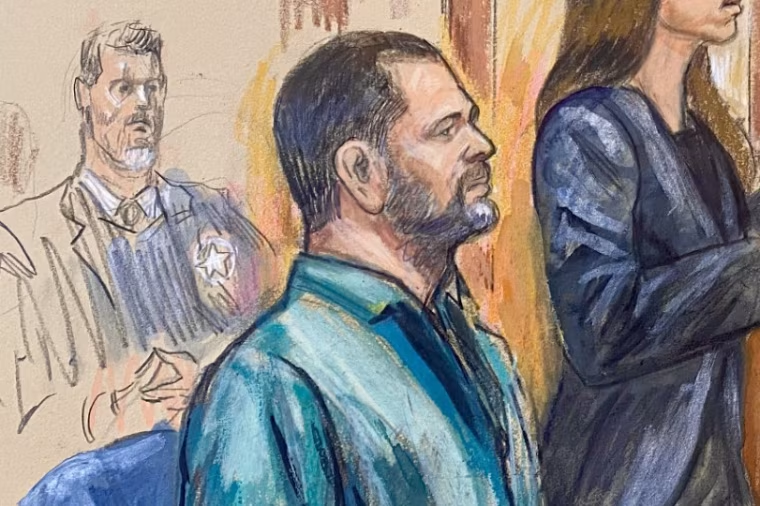
CIA officer arrested with gold bars admits revealing secret intelligence source to foreign official

ALEXANDRIA, Va. — A high-ranking CIA officer arrested after federal agents found about 600 pounds of gold bars hidden in his home also disclosed details to a foreign official about a secret U.S. intelligence source, prosecutors said Tuesday at his plea hearing.
David Rush admitted to one count of wire fraud under a deal with federal prosecutors and faces 20 years in prison when he is sentenced Jan. 28.
In a plea document, Rush admitted that in late 2025 he disclosed “certain descriptive information about a clandestine U.S. Government human source” that could “endanger the safety and lives of the human source and U.S. Government agents working with that source” as well as jeopardize America’s “ability to recruit human sources, who rely on the U.S. Government’s assurance of absolute secrecy.”
Rush’s lawyers declined to comment.
He has been in prison since his arrest on May 19, after investigators said Rush fabricated details about his educational background and military service, misleading the nation’s top spy agency for years.
As a senior officer in the CIA’s Science and Technology Directorate, Rush had access to the nation’s most secret programs — and he used it to his advantage, prosecutors said. Rush worked as a liaison to the Pentagon on sensitive military programs and worked closely with the Defense Department’s powerful second-in-command, Steve Feinberg, people familiar with the job told NBC News.
The case has sparked a wave of shock and anxiety among lawmakers and within the island spy agency. How was someone able to deceive the highest levels of government for decades, and how was he able to circumvent what is considered a rigorous selection process to join the CIA? The intelligence community watchdog is investigating separately, according to a U.S. official and a person familiar with the investigation.
Learn more about the David Rush case
Until Tuesday, the former officer, who had been placed on leave some time before his arrest and then fired, had only been formally charged. with one count of theft of public funds, accused of falsifying his payroll records. His trial was postponed for several weeks while his lawyers and the government worked on a possible plea deal. U.S. District Judge Michael Nachmanoff approved the plea deal Tuesday.
Assistant U.S. Attorney Kevin Hakala said Rush used his position at the CIA to create an elaborate plan intended to facilitate his “maximum personal enrichment at the expense of the United States.”
He acted alone, using his manufactured good faith to create trust in his work, according to court documents.
Rush funneled tens of millions of dollars of government money to himself using a fake, highly classified program that was structured so that few people knew the details, and he manufactured a separate sensitive program. to finance his personal purchases of luxury real estate in Florida, prosecutors say.
“Rush effectively acted as his own approving official, allowing him to spend substantial sums of the U.S. government’s money without extensive review,” according to court documents.

During their search of his home, investigators seized about 300 gold bars, federal officials said, as well as about $2 million in U.S. currency and 35 luxury watches. Initially, investigators estimated it was 303 bars, but revised that figure Tuesday to 298 bars.
The gold was for what Rush claimed was an official business purpose, and he said they were being distributed — the spy agency uses all sorts of unusual methods in its work.
Rush, federal prosecutors allege, also fabricated a classified special access program and told associates he needed luxury real estate in South Florida for it. He had $145 million transferred to a holding company for four luxury properties and vehicles.
He lied to his associates, telling them that high-ranking government officials knew of the need for the real estate and approved the transaction.
The case also shed light on Rush’s relationship with Feinberg, as NBC News reported. The FBI reviewed a video showing Rush and Feinberg at a Washington-area residence linked to the federal government, according to four people familiar with the video.
Feinberg was questioned by the FBI, according to two people familiar with the matter, but was not accused of any wrongdoing, and the bureau said he was not under investigation. There is no indication that Feinberg was aware of Rush’s alleged inventions. A Pentagon spokesman said Feinberg and Rush were not close.
Rush also spent $1.8 million of government money on private charter flights, but a CIA study later found that Rush had “no legitimate official requirements” for those flights.
The interstate wire fraud occurred in January, when Rush forced a government employee to send $45 million for his scheme, prosecutors said.
Gn usa