
LOUISVILLE, Colo. (AP) — Less than an hour after the first warning a forest fire headed toward her suburban street, Tawnya Somauroo’s Colorado home was in ashes.
She worked tirelessly for nearly five years to rebuild her home and help ensure her neighborhood could withstand the next fire. But like climate change contributes to more frequent wildfires, she worries that careful landscaping, metal fencing and fire-resistant coatings aren’t enough.

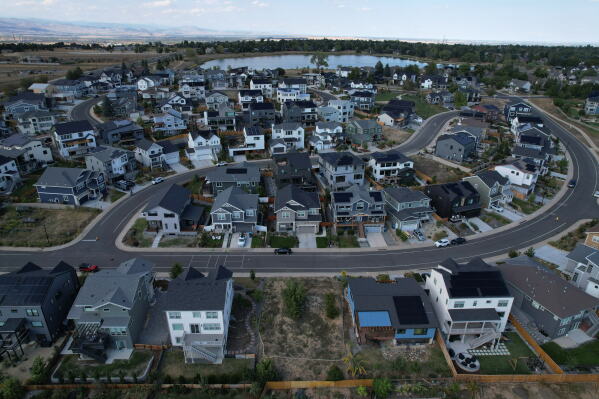
A neighborhood rebuilt after the Marshall Fire is seen from the sky Monday, Sept. 21, 2026, in Louisville, Colo. (AP Photo/Brittany Peterson)
License for this photo
“We lost our homes and they left us to figure out on our own how to make our neighborhoods safe again,” Somauroo said. “At the end of the day, it comes out of our pockets, you know? And I feel like maybe the oil and gas industry should have a role in all of this.”
She lives in Boulder County, one of dozens of jurisdictions in the United States suing oil and gas companies to help them pay for damages caused by climate change-related disasters.

Tawnya Somauroo leans on a ledge in her new fire-resistant home, Monday, Sept. 21, 2026, in Louisville, Colo. (AP Photo/Brittany Peterson)
License for this photo
The case is part of a wave of climate change litigation across the country and around the world, with billions of dollars at stake. On Monday, the first day of the Supreme Court’s new term, the justices will hear the Boulder affair it could decide the fate of others like him.
The city and county of Boulder first sued two oil companies in 2018, years before the fire. They argued that Suncor Energy and ExxonMobil violated state law by misleading the public about their contributions to climate change and sought unspecified damages to help cover the cost of worsening disasters.
Companies say a flood of lawsuits in state courts is not the right solution to the global problem.
“The problem is that climate change is caused by almost everyone on the planet,” said Phil Goldberg, special adviser to the Manufacturers’ Accountability Project, an industry group. “We have to figure out how to solve this problem. We have to solve it in a very meaningful way. This litigation doesn’t do that.”
Tawnya Somauroo holds her child’s belongings that she saved before their house burned down, Monday, Sept. 21, 2026, in Louisville, Colo. (AP Photo/Brittany Peterson)
License for this photo
Businesses benefit from support from the Trump administration. Federal government lawyers say the lawsuits are a backdoor way to regulate heat-trapping greenhouse gas emissions and are an unconstitutional power grab.
“No state can superimpose its own regulatory preferences on others – much less to solve a global problem that exists almost entirely outside its borders and affects the world as a whole,” they wrote.
They say the Clean Air Act allows the federal government, rather than states, to regulate emissions. The Republican administration widely used this power to go back environmental regulations.
Last month, the Environmental Protection Agency ceded some of its climate authority in repeal the rules which limit global warming greenhouse gas emissions from power plants fueled by coal and natural gas. The move could complicate his argument.
Boulder says it doesn’t try to regulate emissions beyond its borders, but only holds companies responsible for local costs.
“The county and city of Boulder are not trying to change what’s happening in Texas or New York, they’re trying to get compensation for things that are currently happening in Colorado,” said Sam Sankar, senior vice president of Earthjustice, which filed an amicus brief in the case.
Climate change was considered a factor in the 2021 Marshall Fire that destroyed Somauroo’s home, after the county’s lawsuit was initially filed. The total damage was estimated at $2 billion. This is the costliest wildfire in Colorado history.

Tawnya Somauroo looks at video she took of her burned home, Monday, Sept. 21, 2026, in Louisville, Colo. (AP Photo/Brittany Peterson)
License for this photo
“Local county municipal governments play a very important role in helping frontline communities adapt to climate change. This case may very well set a precedent,” said Chris Winter, executive director of the Getches-Wilkinson Center, an environmental research group in Colorado.
The case will be brought before a Supreme Court with a conservative majority, where environmental regulations have not always produced good results, including a Decision 2022 which limited the EPA’s authority to regulate carbon dioxide emissions from power plants.
However, only eight of the nine judges will sit. Justice Samuel Alito He recused himself just a week before the rows, after being called to step down because he owned shares in oil companies.
This creates the possibility of a tie vote in this case, although it is unclear how likely that might be. The court is also considering a question that experts say is a potential “way out”: whether judges have jurisdiction to hear the case at this stage.
___
Whitehurst reported from Washington.
Gn headline