November 25, 2026, 9 p.m. ET
A new documentary offers unbridled access to Colin Farrell’s inner world.
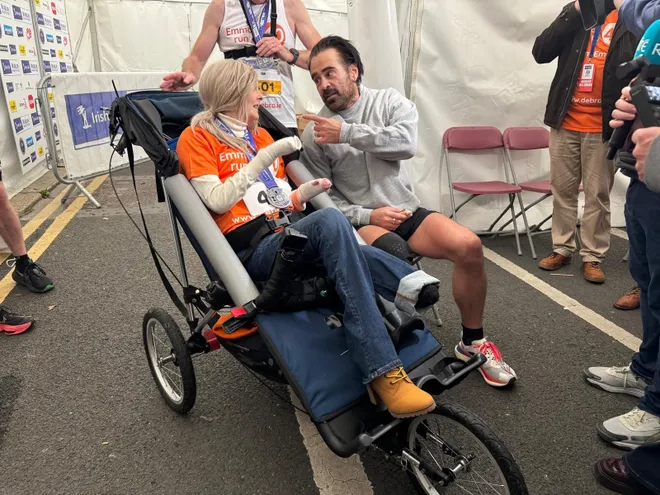
In HBO’s new documentary “The Slightest Touch” (airing Nov. 25 at 9 p.m. ET/PT), the Oscar-nominated actor — best known for his roles in “The Banshees of Inisherin,” “The Lobster” and “The Batman” — teams up with his friend Emma Fogarty as they prepare to compete in the 2024 Dublin Marathon.
Fogarty, who became friends with Farrell at a 2010 charity dinner in Dublin, Ireland, says the marathon was his idea. He made this suggestion in passing, and Fogarty took it up. The feat is particularly daunting for Fogarty because she lives with the genetic disease epidermolysis bullosa, which makes her daily activities incredibly difficult. EB, also known as “butterfly skin,” is a rare condition that causes blistering of the skin, with tasks such as repositioning and dressing causing injury. In the 100-minute documentary directed by Rachel Fleit, Fogarty braves the road race and joins Farrell for the final four kilometers of the marathon, to celebrate his 40th birthday.
While “The Slightest Touch” highlights the couple’s remarkable training journey, it also sheds light on something Farrell’s fans don’t often see: his path to sobriety and his intimate moments of fatherhood.
“Sobriety has brought me extraordinary gifts in my life,” Farrell, 50, told USA TODAY. “My life was very different twenty years ago.”

His early struggles with alcohol abuse are detailed in the documentary. Farrell explains that he started drinking as a teenager and that alcohol brought him “out of his shell.” He also remembers going to a local pub with friends and drinking “four or five pints” on a weekday.
“I would go home and get stuck in a bottle of Jack Daniel’s and smoke a bunch of hash and completely lose my mind. And even then, if I look back, I can say, ‘Was I having fun?’ No, it wasn’t fun,” the “Penguin” star said in the documentary.
But the birth of his eldest son James, 23, changed everything. When he was a baby, James – who Farrell shares with model Kim Bordenave – was diagnosed with Angelman syndrome, caused by a loss of function of the UBE3A gene that occurs during fetal development. According to the Cleveland Clinic, this rare disease causes developmental delays, intellectual disability, movement problems and speech impediments.
When Farrell learned that James would need help with daily tasks, he decided to get sober. In December 2005, Farrell entered a treatment center and was released the following month. By the time James was three, Farrell was out of alcohol.

“I’m grateful to be alive,” Farrell – who also shares son Henry, 17, with actress Alicja Bachleda-Curús – says in the doc.
In the years that followed, Farrell continued to show up for his family. “The Slightest Touch” highlights some of those intimate moments with her sons, from brainstorming dinner dates with Henry to joking around with James on the couch. And in 2024, Farrell launched a foundation to help adults like James with developmental disabilities. (At the time, James was 21, an age at which he would lose access to many support systems available to children with special needs.)
“The sobriety in my life, the clarity and accountability and presence that it has given me means that I can be there as a father, friend, son and brother in a way that I couldn’t before,” Farrell told USA TODAY. “It’s a huge thing.”

The documentary also touches on another private relationship in Farrell’s life: the complicated one with his father, Irish footballer turned restaurateur Eamon Farrell. After completing the marathon with Fogarty in October 2024, Farrell’s father died months later in April 2025 after a long illness. He was 83 years old.
While raising his two boys, Farrell says in the document, he developed compassion for his father, after years of resentment and anger toward him. The actor explains that he grew up as a sensitive child and often sought his father’s approval. He recounts the challenges he faced in their relationship, but also acknowledges that his father grew up in an environment that discouraged emotional vulnerability.
These days, Farrell says he no longer holds grudges and even commemorates his father’s life at the end of the film. “It was selfishly a very nice thing to do,” Farrell told USA TODAY.
Although he poured his heart into the documentary, it took Farrell some time to get used to the cameras in his Los Angeles home, calling the experience “unusual, rare and uncomfortable.” He credits filmmaker Fleit, who also directed the 2021 documentary “Introducing, Selma Blair,” for making the experience bearable.
“My approach is always to create the conditions for that person to be themselves,” Fleit told USA TODAY. “With Colin we sat and talked, and with Emma we did the same.”
And although Farrell felt comfortable with Fleit, he says he has now vowed not to film in his private home again.
“I’ll never do it again,” Farrell admits. “‘I’ll never do it again as long as I live, but I’m glad we did it this time. If there was ever a time it had to happen, it would happen with and for Emma.’
Gn entert