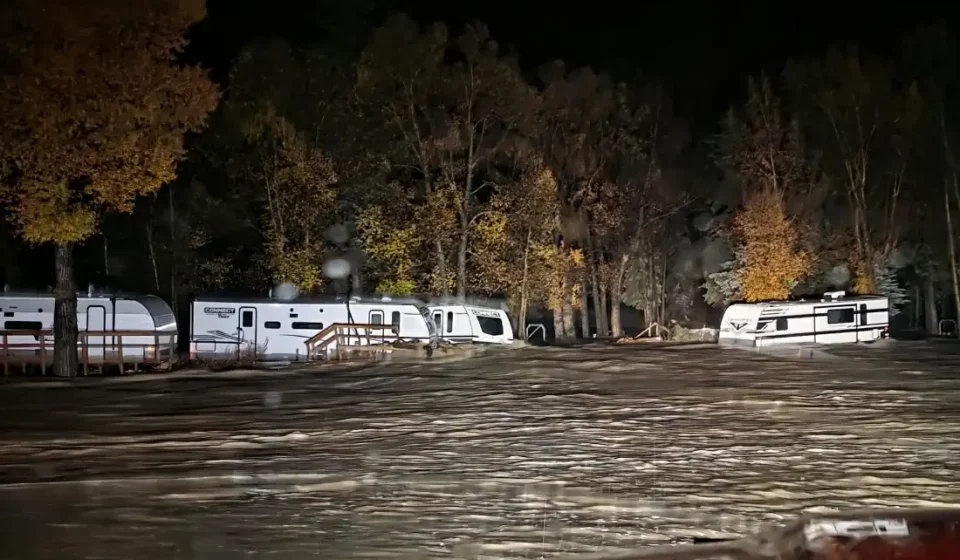

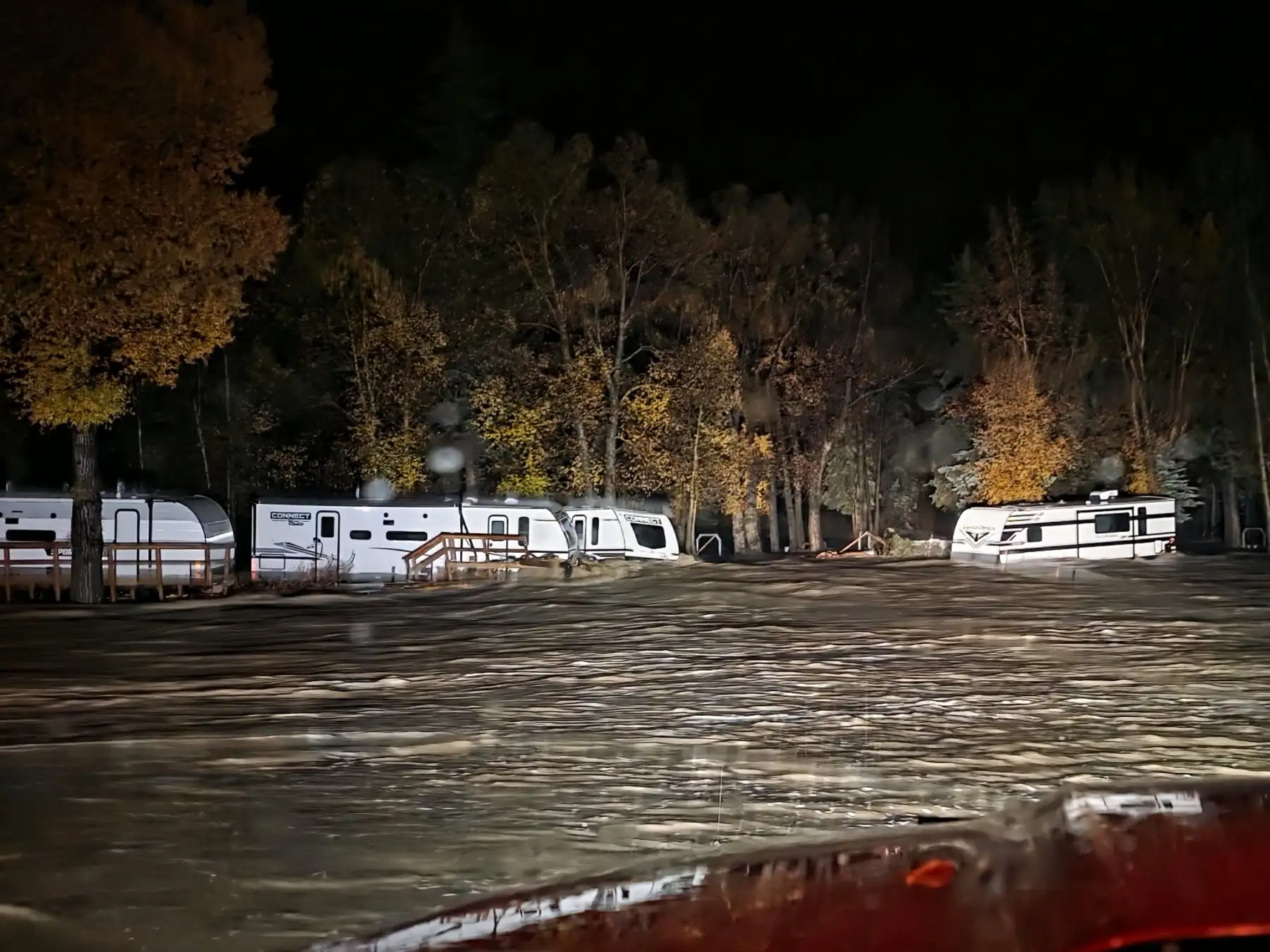
Floodwaters surround trailers at the Fun Valley Family Resort campground and RV part in South Fork, Colorado, early Friday, Oct. 23, 2026.
South Fork/AP Fire Rescue
hide caption
South Fork/AP Fire Rescue
Looking out the window Friday afternoon, Devin Neeley saw light, puffy clouds and blue skies in San Juan County, New Mexico. The county’s public information officer for emergency management called it “surreal.”
Meanwhile, brown rainwater flooded homes in low-lying areas of the county and released sewage into the San Juan River.
“(The sky) really belies the danger coming down the river at historic levels,” Neeley says. “We haven’t seen flooding like this in generations.”
Neeley says emergency workers rescued people from their roofs after floodwaters inundated their homes. The county is under an emergency declaration and residents in hotspot areas were asked to evacuate Thursday afternoon.
“These are communities that have beautiful places to live on the river,” Neeley says. “And unfortunately, that’s a problem today.”
Rare and heavy rains began hitting the Four Corners region – which includes New Mexico, Colorado, Utah and Arizona – on Wednesday.
Since then, severe brown floodwaters have led to road closures, mandatory evacuations and emergency declarations in all four states.
Thick, brown floodwaters
Areas of southern Utah, southwest Colorado, and northern Arizona and New Mexico were inundated with rain, leading to rapidly rising floodwaters Thursday and Friday.
In response to an article on
We are closely monitoring flash flooding from the hurricane. Our thoughts are with the families whose homes and livelihoods have been affected.
Please follow all evacuation orders and local emergency guidelines. We are grateful to the first responders who are working to keep Utahns safe. https://t.co/8hDQ85T0Xz
— Governor Cox (@GovCox) October 22, 2026
The southern Utah city issued an emergency declaration Thursday after flooding damaged more than 100 homes and RVs. People were seen leading horses to safety in ankle-deep water in a video released by the National Weather Service.
In Farmington, New Mexico, at the center of the devastation, Police Chief Steve Hebbe told a news conference Friday that “this is singular and real.”
“So far we haven’t had any deaths, which is very fortunate, but it’s not something to be trifled with,” Hebbe said.
Colorado Governor Jared Polis declared a state of emergency in 11 counties. Polis also authorized the use of members of the National Guard to assist in rescue efforts in southwest Colorado.
The Navajo Nation Police Department, which spans northeastern Arizona, northwest New Mexico and southeastern Utah, said Thursday that authorities had rescued seven families, or 30 people, from their flooded homes. The Hopi Tribe of northeastern Arizona declared a state of emergency Thursday due to heavy rains damaging roads, bridges, homes and other infrastructure.
The Archuleta County Sheriff’s Office in Colorado warned residents to shelter in place Friday morning and by the evening had issued an evacuation warning.
The flooding comes after extreme weather hit the southwest throughout the week. Arizona experienced baseball-sized hail and a possible tornado that injured at least one person Wednesday evening.
Record rainfall
The region’s mountainous terrain is prone to flooding. In August, intense flash floods in the Grand Canyon caused several deaths.
Severe thunderstorm warnings began earlier in the week, said Kris Sanders, a meteorologist with the National Weather Service in Grand Junction, Colorado. The remnants of Hurricane Trudy, which was active October 15-18, in the Pacific Ocean formed into a slow-moving low pressure system that tracked southwest.
Sanders said many of the storms weakened as they moved through the region, but the heavy rains did not. Parts of southwest Colorado and southeast Utah saw between two and four inches, while higher elevation areas, like the San Juan Mountains, saw six inches. This caused flooding of small streams, streams and rivers.
“These precipitation amounts are records in themselves,” says Sanders.
Even though precipitation is rare, he said, these storms typically occur in the area this time of year. An event last year caused major flooding in the same places, “like a carbon copy” of this year, Sanders says.
The threat is not over, he said, and thunderstorm watches are active in many of the same areas through Sunday.
Daniel Swain, a climatologist at the University of California Agriculture and Natural Resources, says severe thunderstorms are fueled by the high amount of moisture in the air. He says the moisture comes from record waters off parts of the West Coast, brought on by a strong El Niño and a pre-existing marine heatwave (which he attributes largely to human-caused climate change).
The flooding is not a surprise, he said, pointing to a prediction he and others made in the spring: If El Niño materializes as predicted, the U.S. Southwest could see extreme rainfall through October.

Now, “that’s exactly what we saw,” he said, “because it’s not even the first event this fall.”
Neeley, public information officer for San Juan County, New Mexico, says his community will be on alert for more damage and safety risks throughout the weekend.
“People care about their lives, their well-being and their property,” says Neeley. “This is going to have a long-term impact on this community,”
Gn usa