NEWYou can now listen to Fox News articles!
A 400-year-old brass lock recovered from a 16th-century shipwreck off the coast of Wales has finally been opened – and researchers didn’t need a key to break it.
The discovery, made as part of a joint effort between Amgueddfa Cymru (Museum of Wales) and Cardiff University, was announced earlier this month.
Museum officials said in a statement that the brass lock had “remained firmly locked” since the ship was destroyed off the coast of Wales in the 16th century.
DIVER DISCOVER HUNDREDS OF ANCIENT RELICS NEAR WRECK EMBEDDED FOR 2,100 YEARS
The Ann Francis was overtaken by a storm on December 28, 1583, while returning from Spain.
It veered off course before wrecking on Margam Beach, near Port Talbot.

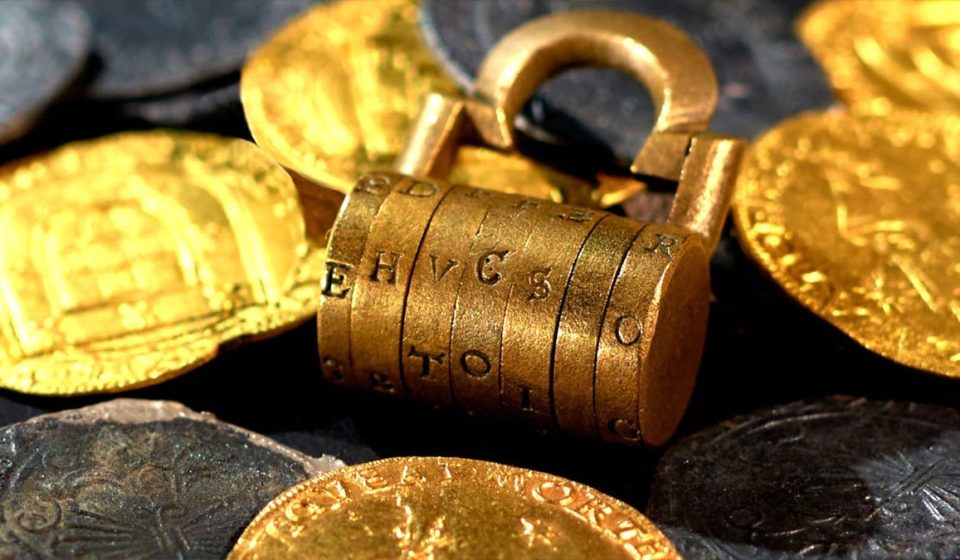
A centuries-old brass padlock from the wreck of the Ann Francis remained sealed for more than 400 years before experts identified its four-letter combination without damaging the artifact. (Amgueddfa Cymru/Museum of Wales)
More than 400 years later, metal detectorist Peter Hughes began unearthing parts of the ship’s treasure on Margam Beach in 1996.
He continued to recover artifacts from the site until 2017, including the brass sluice, after dredging and storms removed layers of sand.
Speaking to officials, Hughes said he was “immediately amazed” when he discovered the lock.
TREASURE HUNTER STRIKES GOLD WITH 1,000-YEAR-OLD DISCOVERY LINKED TO “HAND OF GOD”
“When I moved the dials on the suit, they turned easily after more than 400 years under the sand, and I was left in disbelief,” he said, as reported by Cardiff University.
“I also remember being excited about finding wonderful things (in) the treasure chest that was once locked.”

The Ann Francis was overtaken by a storm on December 28, 1583, while returning from Spain, and veered off course before being shipwreck on Margam Beach, near Port Talbot in Wales. Port Talbot is pictured above. (iStock)
Researchers have revealed the four-letter combination that kept it sealed for more than four centuries: ANCE.
To decipher the code without damaging the artifact, museum experts teamed up with specialists from Cardiff University to examine the lock’s internal mechanism using CT scanning technology.
“Now that we’ve solved it, we wonder if the code meant anything to its owner.”
“SPECTACULAR” WRECK FOUND WITH UNDERWATER CAPSULE OF INTACT CARGO: AMAZING FIND »
David Williams, a research associate at Cardiff University’s School of Engineering, said the micro-CT scanner allowed him to inspect the inside of the lock without damaging it.
“By creating a detailed 3D image of the internal mechanism, I was able to see how the notches lined up with the letters and identify the exact combination,” Williams said, according to Cardiff University.

Found near Spanish silver coins and double coin weights, the 16th-century padlock from the wreck of the Ann Francis is now on display at the National Waterfront Museum in Swansea, Wales. (Amgueddfa Cymru/Museum of Wales)
“We normally use this technology to study bones and other biological structures, so investigating a 400-year-old padlock was certainly a first for us,” he said.
After waiting later that evening for museum officials to test the code, Williams learned it worked.
“Receiving the message that we had succeeded was incredibly satisfying,” he said.
CLICK HERE TO SUBSCRIBE TO OUR LIFESTYLE NEWSLETTER
Alastair Willis, senior curator at Amgueddfa Cymru, said the meaning of the lock code remains unknown.
“Elizabethan combination locks are known in Britain, but this one is in exceptionally good condition and is associated with a dated wreck, making it a unique find and the code a tantalizing mystery to solve,” Willis said, the release notes.
He added: “Of course, now that we’ve solved it, we wonder if the code meant anything to its owner.”
Officials said the lock would have once secured a small safe containing valuables.
CLICK HERE FOR MORE LIFESTYLE NEWS
Because it was found near Spanish silver coins and double coin weights, researchers believe it could have protected those items or a chest containing organic materials that did not survive, such as documents or textiles.
The treasure also included rare gold coins dating from the reign of Ferdinand and Isabella of Spain, as well as a boatswain’s whistle.

Rare gold coins dating from the reign of Ferdinand and Isabella of Spain were also recovered from the Ann Francis hoard. (Amgueddfa Cymru/Museum of Wales)
The combination lock and other items from Ann Francis’ treasure are now on display at the National Waterfront Museum in Swansea.
TEST YOURSELF WITH OUR LATEST LIFESTYLE QUIZ
Recent archaeological and historical discoveries across Wales have attracted similar attention.
Earlier this year, archaeologists revealed new finds from a remote Roman fort in Wales – including 4th-century coins and artefacts – which could link the site to a centuries-old legend about Emperor Magnus Maximus.
CLICK HERE TO DOWNLOAD THE FOX NEWS APP
Last winter, volunteers cleaning a beach in South Wales discovered around 200 mysterious old-fashioned shoes that may have washed ashore during a 19th century shipwreck.
Gn world