
Japanese optical company Nikon said it was “carefully reviewing” information submitted by National University of Singapore optical engineer Ning Xu after commentators accused him of using AI in his winning entry in the 16th annual Small World in Motion competition.
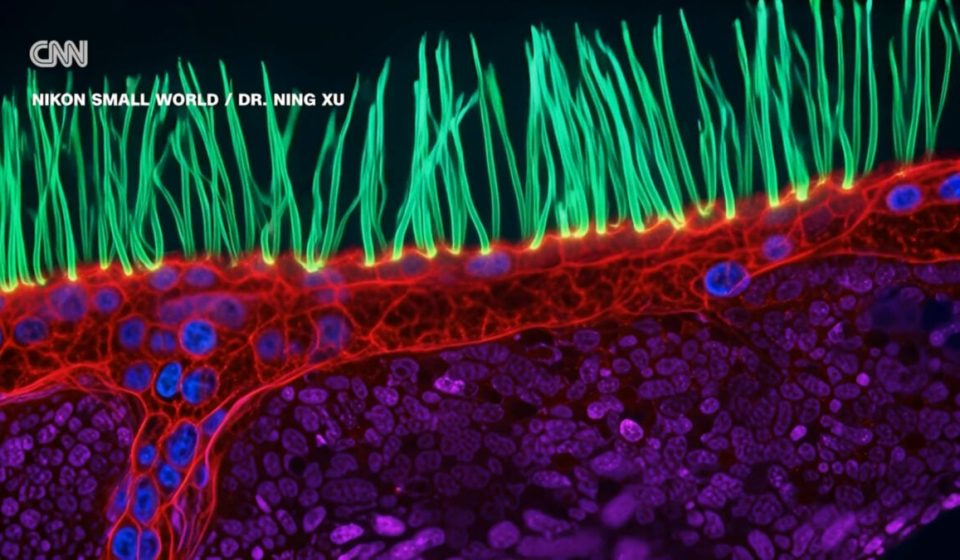
Small World in Motion presents itself as celebrating the beauty of optical microscopy. According to Nature, the video submitted by Xu showed the movement of cilia in lung tissue samples from a child with a chronic condition called primary ciliary dyskinesia. Unidentified red, blue, and purple structures may be seen under the eyelashes.
Nikon Instruments, the division of Nikon that sponsors the competition, announced Xu’s winning entry in mid-September and reposted it on LinkedIn last week. It quickly faced a storm of criticism from users who pointed out significant discrepancies. For example, Edward Phelps, a bioengineering researcher at the University of Florida in Gainesville, posted on LinkedIn: “The purple structures resemble mitochondria, but such a subepithelial structure composed of extracellular mitochondria the same size as cell nuclei does not exist in biology. Phelps added that the blue nodules looked like nuclei but did not act like nuclei, and that he had no idea what the structures depicted in red were.
Another LinkedIn user, Ian Donovan, a doctoral student at UT Southwestern Medical Center, pointed out that the video had a SynthID watermark, according to CNN. These watermarks were developed by Google’s DeepMind research lab and have since been adopted by a large number of AI companies. Most AI detectors that attempt to detect AI by other means perform poorly, and without SynthID or equivalent watermarks, it can be difficult, if not impossible, to determine the provenance of an image with complete certainty.
Fifth-place winner Patrick Hickey told the BBC that microscopists don’t get many opportunities to show their work, which often has “very abstract and artistic qualities.”
A widely cited set of scientific guidelines permits the use of images of stained samples or colorized images, provided that the changes are disclosed and described. This article dates from 2010, before the arrival of generative AI and the pure and simple manufacturing of pixels.
“There are a specific set of rules in the competition, and one of them was very clearly that you couldn’t use generative AI to produce things and the other was obviously that it had to be put under the microscope,” Hickey added.
In updates on LinkedIn last weekend, Nikon said Xu was cooperating.
“Xu respectfully complies and has provided detailed technical documentation describing the microscopy equipment, imaging methods, and processing techniques used to create the source video,” Nikon wrote. He previously updated a blog post about the winning entry to clarify that “an unsupervised neural network method was then used as part of the post-processing and visualization workflow to distinguish and visualize features in the grayscale data, creating a more vivid and visually appealing video.” »
Xu has said this in other LinkedIn posts, Nature noted, and said his team used post-processing on the structures beneath the cilia “without making any anatomical claims about what these rendered features represent.” Xu also said that the original video of the eyelashes and their movement is real and that AI was only used on the “reconstructed grayscale data to distinguish and color structures with similar morphology.”
As of Friday evening, a spokesperson for the contest organizers had no update on the situation for Gizmodo.
Melanie White, a developmental biologist at the University of Queensland in Brisbane, Australia, told Nature that scientific images are data and that scientists “need to be able to be confident that what we’re seeing is based on the underlying measurement.” Former Small World in Motion judge Andrew Moore told the Telegraph that Xu’s entry reminded him of “old photographs restored with AI”.
“The high-resolution colorized photo may be pretty, but if it’s your grandmother who swapped her face, it’s going to be disturbing,” Moore told the newspaper.
Gn tech