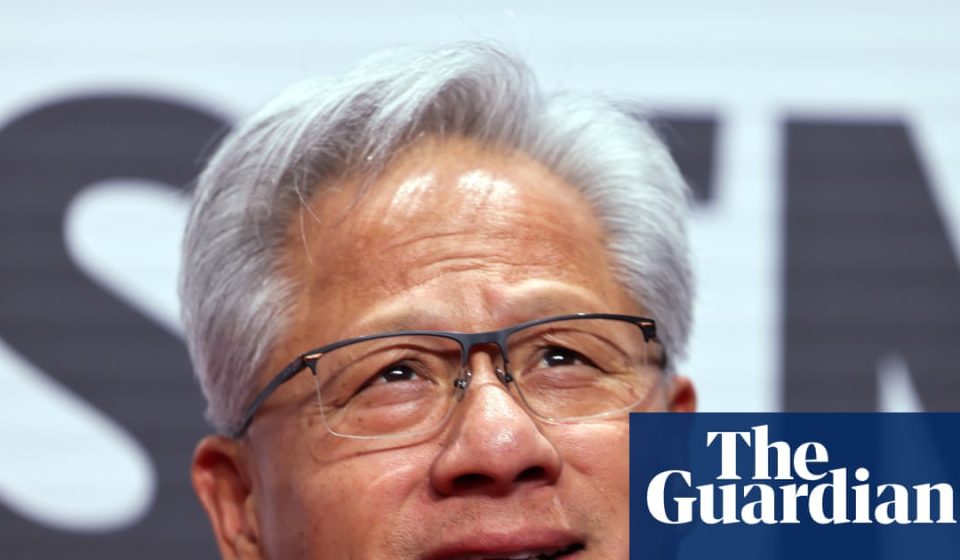
The reinstatement of Jensen Huang as Nvidia’s chief executive is “Proof A” of “the political corruption and rot at the heart of the Trump administration’s technology and AI policy,” Chris Van Hollen, the Maryland Democrat vying to become the next Senate majority leader, told reporters Monday.
Van Hollen said he intends to focus on Huang’s “efforts to increase and accelerate the export of high-end chips to China, how he did that, how he got his results from the administration” when the reinstalled Nvidia CEO appears before the Senate Banking Committee on Dec. 3.
It will be one of several appearances on Capitol Hill next week where skeptical lawmakers from both parties will question Huang about his ties to a woman some in the intelligence community have called a spy for China. Huang will also sit for transcribed interviews with the House Foreign Affairs Committee, as well as the Chinese Communist Party Select Committee and the House Intelligence Committee.
“It’s completely hypocritical of the Trump administration, on the one hand, to say that the reason we need to remove all the curbs on AI development here at home is because China will leapfrog if we don’t,” Van Hollen said. “When in fact it is the Trump administration that is helping China take a leap forward.”
Nvidia’s board reinstated Huang after Donald Trump intervened on the executive’s behalf, assuring the company’s leadership that he did not pose a national security risk despite questions surrounding his relationship with Alice Huang, an unrelated tech executive who has been accused of acting as a Chinese asset and funneling advanced chips to Beijing through her data center company, Megaspeed.
In an interview with CNBC on Monday, the US president defended his involvement in Huang’s reinstatement, arguing that it would be a “greater threat” to Nvidia to lose Huang’s “brain power” in the AI race. Trump also confirmed that he had provided assurances to the board regarding any national security concerns.
“I talked to them, let me put it that way. And I convinced them,” Trump said.
Van Hollen pointed to a series of ties between Huang and Trumpworld as evidence of executive influence over the administration’s advanced chip policy, including Nvidia’s $25 million donation to Trump’s White House ballroom project, his personal holdings of Nvidia stock, Huang’s contribution to Trump’s inauguration fund and his attendance at a $1 million dinner at Mar-a-Lago.
Outrage spread to the Capitol on Monday. Gregory Meeks, a Democratic congressman from New York and ranking member of the Foreign Affairs Committee, called the decision “yet another example” of how “the wealthy and well-connected are held to a different standard.”
John Curtis, a Republican senator from Utah, said Huang was “right to resign” when news of his extramarital affair came to light. “Just 11 days after Nvidia announced his departure, the board brought him back while its own independent investigation was still underway. Last week, the board said it had no plans to reinstate him. I’d like to know what changed,” Curtis said.
For Matt Pearl, director of the Center for Strategic and International Studies (CSIS) specializing in national security, geopolitics and technology, unanswered questions regarding Huang’s conduct remain.
“We have not conducted an investigation,” Pearl said in an interview, noting that such an investigation would normally take “at least a year.”
Nvidia’s board, he argued, instead relied on “representations” from senior U.S. government officials, including Trump himself, and “essentially outsourced the investigation.”
“I suspect we will uncover a lot more information in the coming weeks and months as Congress’ investigation continues, but it appears we have no idea what kind of risks and threats are in this matter,” Pearl said.
This episode, he added, could weaken the way national security concerns are raised and addressed within government.
“It will be difficult for members of the intelligence community to give honest assessments of security risks if it involves high-profile figures like (Huang),” Pearl said.
He added: “It will be difficult for senior officials, like Secretary (Marco) Rubio, to convey them to the president, given that they will potentially be sort of ignored and poorly received. The entire apparatus of the U.S. government in terms of detecting and responding to these types of threats could potentially be put at risk.”
Several Democrats asked for more information about Trump’s pressure campaign to reinstate Huang. Sen. Elizabeth Warren, the top Democrat on the Banking Committee, said the administration “must explain to Congress what ‘input’ was given and by which senior U.S. government officials supported its reinstatement.”
Warren argued that the embattled CEO’s return “only increases the urgency to pass bipartisan export control bills and ensure that Nvidia does not push to overturn this legislation and put our national security at risk.”
Congressman Robert Garcia, the new chairman of the House Oversight Committee, said Trump’s actions needed to be further investigated. “No president who has invested in a private company should be involved in the decisions of his board of directors. Congress must unite in swift bipartisan action and demand immediate answers,” he said.
According to Pearl, who previously served as director of emerging technologies at the National Security Council during Joe Biden’s administration, another national security issue exposed by Huang’s reinstatement is succession planning for senior staff forced to step down.
Reinstating Huang, “almost regardless of what comes out of it,” means “it’s very difficult to act again,” Pearl said.
“It’s hard to fire someone, then hire them shortly after, and then fire them again. At some point you start to look stupid.”
Some Republicans have focused their attention on the White House and Huang in equal measure.
“I warned the administration from the beginning that Communist China was obtaining our most advanced chips through smuggling and remote access,” Sen. Tom Cotton, Republican chairman of the Intelligence Committee, said in a statement. “The controversy with Nvidia and Megaspeed is just the tip of the iceberg, and it’s not resolved because Jensen Huang got his job back. Congress has a lot to investigate, and we will pass chip export control bills with an overwhelming bipartisan majority, including my Chip Security Act, one way or another.”
Van Hollen said Monday that it was a “good sign” that some Republican members of Congress had expressed concern about Huang’s reinstatement.
“Honestly, it’s hard not to,” he said. “But given that in recent years, when Republican senators have stuck their heads in the sand, regardless of what the Trump administration was doing, it seems like a good sign that they recognize this as a threat to our national security.”
“The fact that this individual was able to use the president to get his reinstatement at Nvidia is a problem that I think Republican senators can see as well,” Van Hollen added.
Other Republicans called on Howard Lutnick, the Commerce Secretary, to testify before Congress and respond to allegations that he slowed down an investigation into Megaspeed, the data center company led by Alice Huang that allegedly diverted Nvidia chips to China.
The United States will now add Megaspeed to the trade blacklist after the Commerce Department last week implemented a rule banning remote access to advanced AI chips and servers through data centers in third countries.
“I’m less interested in talking to Mr. Huang. You know he did what he did. I hope he had a good time. It was the most expensive sex since Helen of Troy,” Sen. John Kennedy, a Louisiana Republican who also serves on the Banking Committee, told NBC News on Sunday.
“I’m more interested in talking to Howard Lutnick and Scott Bessent. It appears to me…that the Commerce Department has allowed the Chinese Communist Party to circumvent our export controls on advanced chips,” Kennedy said. “So I want to bring them both before a committee, put them under oath, ask them not to stab each other because I realize they don’t like each other, and let’s answer some tough questions, and if Secretary Lutnick gives our chips, he has to put a stop to it.”
Earlier this month, Bessent said he had been pushing “for months” to sanction Megaspeed, which would prevent the company from buying Nvidia chips. The Treasury secretary appeared to blame Lutnick’s department for the delay.
“The business has the pen and you will have to ask them about their internal processes,” Bessent said in an interview with CNBC.
If elected majority leader in next week’s closed-door Democratic leadership race, Van Hollen said AI policy should be among the new Congress’s top priorities in its first 100 days.
He supports a Senate rules reform proposal that would allow “expedited review” of bipartisan AI legislation coming out of committees, and supports sanctions on tech companies that “develop agents that can endanger the public.”
The Maryland senator also called for the creation of a joint congressional committee to examine “all the different elements of the impact of AI on our society and our world.”
Gn bussni