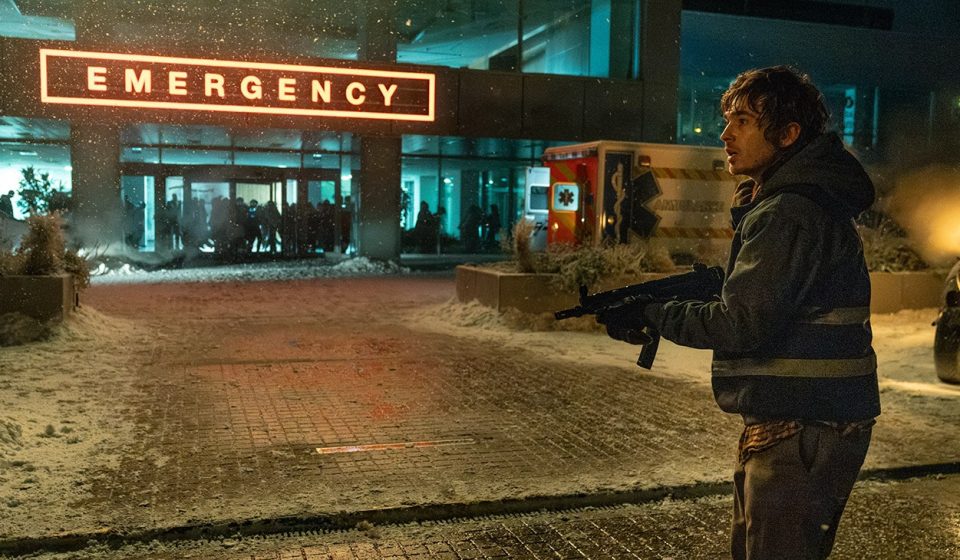
At Zach Cregger resident Evilour plucky protagonist, medical courier Bryan (Austin Abrams), heroically fights his way through hordes of zombies, only to (spoiler alert!) be defeated by the mutant virus within him in the film’s controversial final ending.
As a metaphor for Constantin Film, this might seem a bit ridiculous.
The German production and distribution group, which owns the film rights to resident Evil video game franchise and produced the Cregger reboot with Columbia Pictures, is coming off a triumphant year. But internal problems – particularly the potentially toxic debt levels of its parent company, Highlight Communications – mean its future may ultimately be beyond its control.
resident Evilat least, is a clear victory for Constantin and its CEO, Oliver Berben. The Cregger reboot’s worldwide box office total is $410 million on a reported budget of $75 million, making it the highest-grossing title in a franchise that now has 12 feature films, including four animated films and two Netflix series.
“I discussed this with (Sony Pictures Motion Picture Group CEO) Tom Rothman,” Berben said, “and he pointed out how rare it is to take an intellectual property that has been around for so long – a property that is arguably in declining performance – and reposition it, revitalize it and prepare it for the future. The fact that we were able to turn this intellectual property around is remarkable.”
Berben, who took charge of Constantin two years ago, sees this as proof that his strategy for the German mini-major is working. “Things progressed faster than I expected,” he says. “We were able to get the company back on a growth trajectory faster than expected. »
Berben’s approach at Constantin has been to move the company away from what he calls its previous “high-risk strategy” of investing in “big, very expensive productions” like recent failures. In the Lost Landsa $55 million fantasy film starring Milla Jovovich and Dave Bautista, which grossed a fraction of its budget worldwide, and Moma family fantasy film starring Martin Freeman and Claes Bang that cost more than $35 million and grossed less than $3 million worldwide. “We need to rethink how we finance such large-scale productions in the future,” he says.
Which does not mean that Constantin is lowering the market or limiting its budgetary ambitions.
“This talk about budgets is always somewhat misleading,” Berben says. “It’s rarely just about the budget itself. What’s really at stake is the risk profile of a project, not the budget.”
Instead of relying primarily on in-house productions and assuming most of the risks, Constantin turns to co-productions and projects with a clear, often die-hard fan base. This was the case of resident Evil and Josh Boone’s adaptation of Colleen Hoover Regret youa Constantin co-production with Harbinger Pictures, Frayed Pages Entertainment and Heartbones Entertainment that grossed over $90 million worldwide on an estimated budget of $30 million.
“It’s no longer about focusing on producing a major film every two or three years,” says Berben. “Our goal is to release at least one film, if not more, every year. We have a wide range of filmmakers and at Constantin we have constantly brought in new talent, people who have never worked with us before.”
The biggest uncertainty surrounding Constantin, however, has little to do with his films. It is owned by its parent company.
Since 2009, Constantin has been 100% owned by Highlight, the Swiss media group chaired by Bernhard Burgener. And Highlight is in serious financial difficulty. The group reported an operating loss of CHF 131.8 million ($165 million) in 2025 on revenue of CHF 412.1 million ($503 million) in 2025, and its balance sheet showed negative equity of CHF 3.3 million ($4 million). The damage comes almost entirely from its struggling sports and events division, notably broadcaster Sport1, which accounts for almost all of the group’s operating losses. On the other hand, Constantin’s cinema division remained profitable. Constantin, which now accounts for around three-quarters of Highlight’s turnover, is the group’s most valuable operational asset.
The immediate problem is a bank loan of 74.5 million francs ($93 million) which matures on November 30.
Highlight pledged all of its Constantin shares, listed at approximately 142 million Swiss francs ($177 million) on its books, along with other assets, as security for the loan. If it cannot refinance or repay the debt, banks could assert their claims on those assets, potentially putting Constantin’s ownership at stake. Highlight’s annual report warns of significant uncertainty over the group’s ability to continue as a business.
Burgener said Highlight was reviewing its options and was not ruling out selling Constantin.
At the same time, Constantin took measures that would attract a new investor. At an extraordinary general meeting on August 21, the company authorized its board of directors to issue up to 6.37 million new shares over the next five years, in exchange for cash or assets. This represents a potential one-third stake in Constantin following the issuance of the new shares. If all were entrusted to a single investor, Highlight’s stake would drop from 100 percent to two-thirds. The authorization also allows Constantin to exclude existing shareholders from participation in the new share issue.
No deal with a new investor has been announced and the clearance does not mean a deal is imminent. But it gives Constantine a mechanism to attract new capital and potentially change its ownership structure.
In resident EvilBryan ultimately cannot escape the infection inside him. Constantin could yet avoid a similar fate, but with its parent company facing a November debt deadline, the studio’s future is no longer entirely in its hands.
Gn entert