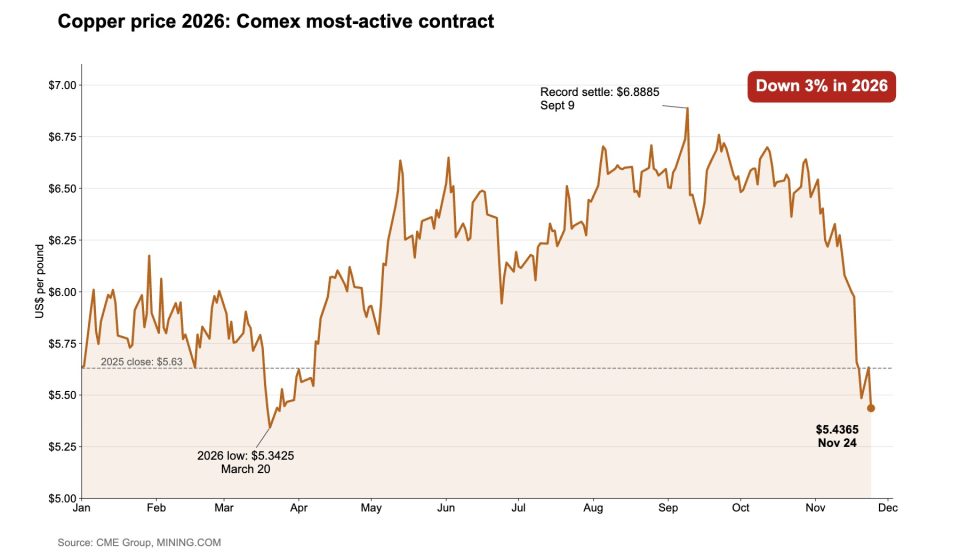
Copper on Tuesday gave up any AI-driven gains on Monday, as investors who dumped the metals during AI’s recent rout showed little appetite to return, and traders continued to shift U.S. stocks toward China.
Comex copper for December delivery fell 3.5% to $5.437 per pound ($11,985 per tonne) in morning trading in New York. A settlement at this level would be the lowest since March 24. The contract settled at $5.634 on Monday, up 2.7% but well below the session high of $5.787 reached after Nvidia reinstated Jensen Huang as chief executive.
Tuesday’s decline leaves copper 21% below its record settlement of $6.889 on September 9, technically a bear market. The metal is now down 3% this year and 16% in November.

Three-month copper on the London Metal Exchange was down 3.5% at $12,054 a tonne in official trading after briefly falling below $12,000, Reuters reports. It jumped 5.3% on Monday.
Investors who sold commodities during the AI rout that followed Huang’s Nov. 12 resignation aren’t rushing.
“These investors are not fully re-engaging in the positions they had before the event, which include exposure to commodities,” Panmure Liberum analyst Tom Price told Reuters. Many have decided that copper is too volatile and are reducing their commodity exposure to focus on AI stocks, he said.
“There are now multiple reasons why the market is selling copper,” Zhou, base metals trader at Hangzhou Chenglian Industrial, told Bloomberg Aces. Beyond the AI narrative, he said, trade flows are starting to reverse as copper leaves the United States, and the factors that supported the metal’s two-year rally are crumbling.
Rate hikes and a strong dollar add to the headwinds. Markets are fully pricing in a quarter-point increase at the Federal Reserve’s December meeting, which would be the second this year, Bloomberg reports, and the dollar index is at its highest level since March 2025, according to BMO Capital Markets.
The physical market remains tight, but financial flows have dominated it, BMO analysts wrote after attending Asia Copper Week in Shanghai last week. Visible foreign exchange stocks only cover about two days of consumption, and Yangshan’s premium for imports into China has risen from less than $100 per ton to about $500 in a month.
Those premiums, along with a narrowing price gap in New York and London, prompted traders to reserve about 30,000 to 100,000 tons of U.S. cathodes for direct shipment to China, BMO said. The metal, held outside exchange warehouses on the U.S. West Coast, takes about two weeks to arrive.
Shipments matter less for tonnage than for what they signal, BMO said: Traders are losing confidence in a tariff decision that would keep U.S. inventories isolated from the rest of the world. Chinese industry players expect President Donald Trump to abandon plans for tariffs on refined copper, while Western players still lean toward imposing tariffs.
BMO expects the sell-off to continue until Washington signals its tariff intentions or prices fall enough to affect supply, potentially in the $10,000 to $11,000 per ton range. Trafigura’s cost curve shows that about 10% of copper produced by solvent extraction and electrowinning is already losing money, to the tune of about $13,000, the bank said. BMO maintains its structurally bullish medium-term view.
Pressed foundries
Discussions about processing fees for 2027, that is, the fees that miners pay to smelters to process concentrates, remain far away. Antofagasta reportedly offered around minus $200 per tonne, while China’s Tongling indicated a price of minus $80 could be acceptable, according to BMO.
This year’s benchmark has been set at zero, already a record low, and BMO estimates that some Chinese smelters are breaking even on a cash basis at around minus $90. A sharply negative 2027 baseline target could accelerate the reduction in production, especially as lower sulfuric acid prices erode by-product revenues.
Mining supply remains limited. Global copper mine production fell 1% year-on-year in September and is down 1% for the first nine months of 2026, the International Copper Study Group said in its latest monthly bulletin. Chile’s output fell 15% and Peru’s 9% during the month, more than offsetting gains in Indonesia, China and the Democratic Republic of Congo. Demand for refined products fell 2% from a year earlier, slightly more than supply, leaving the refined products market in deficit for the month, although it remains in surplus for the year to date.
Miners return their winnings
Copper stocks reversed much of Monday’s rally. Freeport-McMoRan fell 5% at the New York opening, reducing its market value to $68 billion, and Southern Copper lost 4% to $117 billion. Teck Resources fell 4% to $25 billion, while BHP fell 2% to $174 billion and Rio Tinto fell 2% to $125 billion. The five New York-listed heavyweights lost about $15 billion in the first minutes of trading, after adding more than $25 billion on Monday.
In London, Antofagasta fell 7%, Anglo American almost 6% and Glencore 4%, while Poland’s KGHM fell 7%. In Toronto, First Quantum Minerals lost 6%, Lundin Mining and Hudbay Minerals each lost 5% and Ivanhoe Mines lost 4%.

BHP this week announced plans to spend up to $17.4 billion to double copper production in South Australia to around 650,000 tonnes per year by 2040, with a final investment decision expected in the first half of 2027.
First Quantum Minerals and Panama opened formal negotiations on Monday over the Cobre Panama mine, closed since 2023, after the company agreed to the government’s five negotiating conditions, including recognition that Panama owns the mineral resource.
Trader Trafigura has taken full control of the $260 million La Farola copper-gold project in Chile, buying the remaining 50% from owner Minera Altair, as it moves from concentrate trading to mining development. In Santiago, falling prices threaten President José Antonio Kast’s budget plans, with copper accounting for about half of the country’s exports.
(With files from Reuters and Bloomberg)
Gn bussni