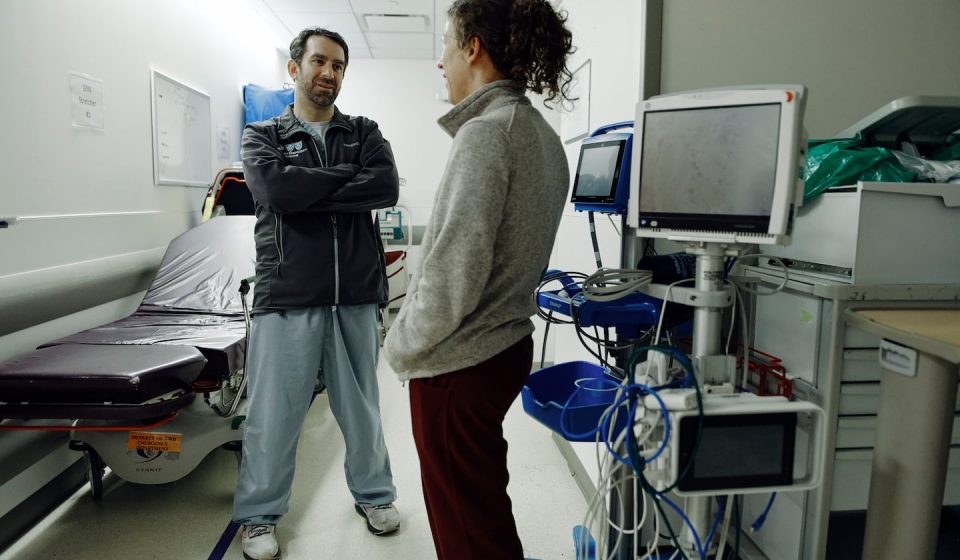

After this lull, COVID levels rise again in Massachusetts, as they do every fall and winter. This is, however, a slight increase and emergency room visits, hospitalizations and deaths remain at record levels. People with COVID also clear infections more quickly, Faust said.
“Honestly, when I see a case of COVID, I’m no more alarmed than when I see a case of the flu,” he said.
Seven years ago, virologists and epidemiologists predicted that as the human immune system grew accustomed to the new virus, COVID would eventually blend into the mix of endemic respiratory illnesses. That time has arrived, many experts say.
It is possible, according to some experts, that serious illnesses and mortality due to COVID will even become less common over time.
While doctors differ on whether COVID is truly no more dangerous than the flu, federal data shows those illnesses now cause comparable numbers of deaths. The Centers for Disease Control and Prevention estimated that the total number of influenza deaths between October 2024 and April 2025, the most recent confirmed data available, was approximately 45,000. COVID deaths were estimated at 34,000 to 53,000 between July 2024 and June 2025.
In other words, COVID should be taken seriously, but it is no longer a particularly unique threat.
“You should be as afraid of this virus as you are of the flu, which is to be afraid,” said Dr. Paul Offit, one of the nation’s leading vaccine experts and director of the Vaccine Education Center at Children’s Hospital of Philadelphia.
Offit has long dismissed the need for healthy adults to get multiple shots if they have received previous shots or have recovered from a bout of COVID. The exceptions, he said, are people vulnerable to serious outcomes from COVID infections: the elderly, pregnant women, people with certain chronic illnesses and immunocompromised people.
The state Department of Public Health still recommends annual vaccination of adults as well as high-risk groups. Booster shots are optional for healthy, previously vaccinated children ages 2 to 18.
COVID normalization is as much a psychological consequence as it is an immunity consequence, and COVID testing is increasingly rare, said Dr. Catherine Brown, state epidemiologist.
Positive COVID tests can help determine the course of treatment, which could be the difference between moderate symptoms and severe illness, experts said. However, for those who are immune, the need for specialized treatments has become less common. Recent studies of older or high-risk patients who had been vaccinated found no evidence that Paxlovid, an antiviral treatment, reduced hospitalizations or deaths. Rates of both were already low, even among vulnerable populations, an April New England Journal of Medicine article noted. This article found evidence that the drug could help patients recover more quickly.
People caring for vulnerable patients or their family members should still get tested and isolate if they are sick, experts said.
Michael Osterholm, founder of the University of Minnesota’s Center for Infectious Disease Research and Policy, is an expert who still tests himself, although he does so more for his own edification than anything else.
“It’s my own curiosity to know what’s going on with the infection,” said Osterholm, an epidemiologist in his 60s. “I do the same thing with the flu.”
None of the experts ruled out the possibility that a new COVID variant could significantly evade existing immune protections and cause another major health emergency. But most national experts believe that such a development is unlikely.
“I can’t imagine another 2020 with this particular virus,” said Jennifer Nuzzo, director of the Pandemic Center at the Brown University School of Public Health. “Personally, I have not seen any evidence that makes me worry that we have a new wild variant that is going to upend society.”
Although opinions vary on the future of COVID, experts are virtually unanimous that another major health threat from a different new virus is almost a certainty.
“I am confident that we are going to see additional new coronaviruses emerge,” Osterholm said.
The reason, according to Offit, the Philadelphia vaccinologist, is humans’ proximity to bats.
Bats are a common reservoir of coronaviruses, which have in some cases mutated to infect humans. COVID-19 is just a condition caused by a type of SARS coronavirus and is not the most virulent. A SARS virus, which spread between 2002 and 2003, killed about 10 percent of those infected. The death rate from MERS, another coronavirus, could reach 37%, according to the World Health Organization.
If any of these diseases adapted to transmit as easily as COVID-19, Osterholm said, the results could be devastating.
One expert, however, said people’s immunity to COVID could provide some protection against other SARS viruses.
“I think that would be enough to avoid a pandemic,” said Dr. Stanley Perlman, a professor of microbiology and immunology at the University of Iowa.
Faust, like others, did not rule out the possibility that COVID could become a serious threat again. This has already surprised him.
He remembers seeing his first three COVID patients more than six years ago and realizing that COVID would cause a massive health emergency. This year, he said, the virus shocked him again.
“It was worse for longer than I thought, but it got better faster than I ever thought it would,” he said.
Jason Laughlin can be contacted at jason.laughlin@globe.com. Follow him @jasmlaughlin.
Gn Health