Curt Cignetti will have no one to blame but himself if Indiana misses the College Football Playoff

Since Curt Cignetti became Indiana’s head coach, the Hoosiers have won 36 of 40 games, made the College Football Playoff twice, won a Big Ten title and hung a national championship banner at Memorial Stadium.
Even today, well past the point where Indiana football’s new reality has become normal, it is a stunning feat with almost no comparison in the history of the sport.
Advertisement
But even the best of the best have a blind spot. With Cignetti, it’s the calendar. It’s still the calendar.
The CFP committee ranked Indiana 14th on Tuesday, putting the Hoosiers in a perilous position heading into the final week of the regular season. While key results across the country will always impact the rankings, and the committee has made surprising last-minute moves before, here’s the tough part for the Hoosiers: The only way to significantly improve their resume is to play in and win the Big Ten championship game, which would automatically put them in the field.
Anything short of that will leave Hoosiers vulnerable. And it’s (mostly) their own fault.
Or, to be more precise, it’s Cignetti’s fault that he refuses to acknowledge that non-conference games are important.
Advertisement
With Cignetti, it’s not that Indiana has trouble finding a top opponent to face them. This is not a financial calculation. It’s a sneering and unserious disregard for any suggestion that Indiana has a responsibility, as a top program, to play non-conference games worth watching.
And now it could really cost him dearly.
“We thought we would just adopt the SEC scheduling philosophy,” Cignetti said at the Big Ten press conference the day before the 2025 season. “Some people don’t like that. I’m more focused on those nine conference games.”
But what if those nine conference games don’t give you enough opportunities for big wins?

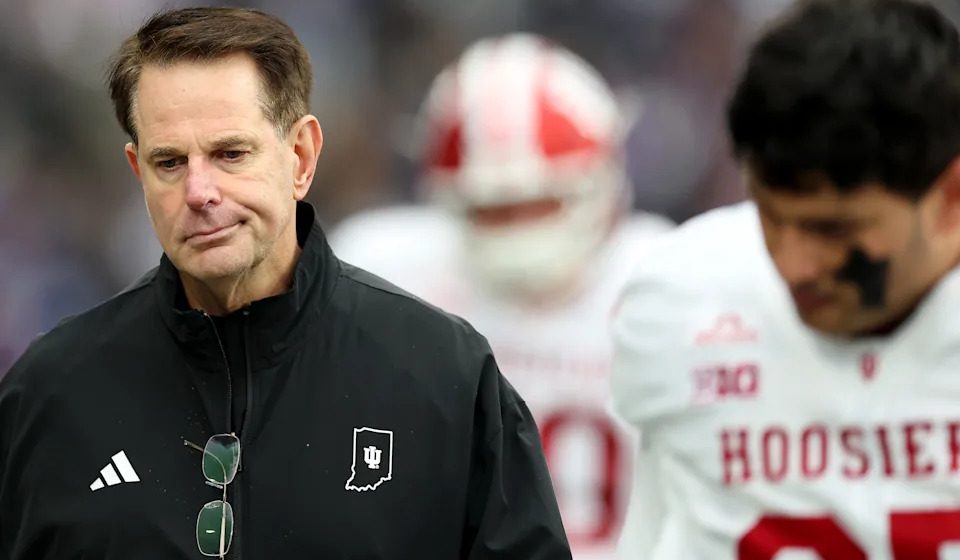
Indiana head coach Curt Cignetti reacts during the Hoosiers’ overtime loss to Washington on Saturday.
(Steph Chambers via Getty Images)
Indiana had, by all accounts, another stellar season at 9-2. The Hoosiers lost at home to Ohio State because receiver Nick Marsh was barely out of bounds when he caught the potential game-winning touchdown, and then again last weekend at Washington because he was 1 of 3 on field goals and lost by three points in overtime. Similarly, Indiana lived on the sidelines all season, winning four games by one score and pulling off a few improbable comebacks. This is probably exactly where it should be.
Advertisement
It’s not Indiana’s fault that the Big Ten had a strange year, but the selection committee can only judge what it sees on tape. Besides a pretty good win against No. 15 Southern Cal, Indiana has nothing else to present to the committee and argue that it has done enough to make the CFP.
Cignetti built a scheduling philosophy around nine Big Ten games, believing the league would give Indiana enough of a chance at notable victories. But when the schedule is filled with the likes of Purdue, Northwestern, Nebraska, this year’s Michigan team and Minnesota, it’s now clear Indiana needed one more shot at a big-time program.
A shot that Cignetti basically deemed unnecessary to get Indiana football over the top.
“I like winning games,” Cignetti told reporters in February 2025. “I think most coaches like it. I mean, we play nine Big Ten Conference games, which is more than most other conferences. So I’m going to play whoever’s on the schedule.”
Advertisement
But Cignetti, of course, has a say in who enters the program. And he’s made it very clear, time and time again, that he’s not interested in anything other than automatic wins.
At the start of his mandate, of course, we can understand this. Indiana football was basically dead, and he’s neither the first nor the last coach to look at a rebuilding situation and decide that scheduling three non-conference wins can get you halfway to bowl eligibility. When you’re just trying to run the program, it’s a smart strategy.
Things changed almost as soon as Cignetti put his first team on the field. Despite accusations of a soft schedule, Indiana made the playoffs in year one and won it all in year two. Once the program was built to this level, Indiana no longer needed to make things as easy as possible. It could even be argued that Cignetti had a responsibility, as the head of a national championship-winning program, to find games that help generate interest in the sport.
Instead, Cignetti leaned even more toward the gentle route — even though his entire personality was built around not being afraid of anyone.
Advertisement
This year, Indiana has scheduled North Texas, Howard and Western Kentucky. Next year’s schedule is even more disgraceful with Jacksonville State, Kennesaw State and Indiana State. In 2028, Miami (Ohio), Austin Peay and Eastern Michigan are in the cards. The next year it was Ball State, Eastern Illinois and Western Kentucky.
For a program of Indiana’s current stature, that’s pathetic.
Even though the Hoosiers will have to give up one of those opponents each year and add a 10th power conference game due to a new Big Ten requirement — it was a key provision in negotiations with the SEC for the 24-team playoff — that won’t do much to help them at the moment.
Indiana always should have been better than this, and no one should feel sorry for Cignetti if it costs the Hoosiers a bid this year.
Advertisement
Planning is always a delicate subject because it is true that the best strategy is only clear in retrospect. Last season, Texas lamented playing Ohio State because it assumed any win replacing that loss would have gotten it into the CFP. But this year, Texas’ victory over Ohio State gave the Longhorns plenty of margin for error and they are ranked No. 3 despite two losses.
Part of the idea behind expanding the playoffs is that it would motivate schools to take more scheduling risks. So far, it hasn’t really worked, although no one has gone to the extreme like Indiana. Hopefully one of the consequences of the 24-team playoffs will be a reversal of this trend since three or even four losing teams are likely to be in the field each year.
College football must adapt to a new reality that every game has to count and you can’t ignore non-conference play. Over a 12-match season, this represents 25% of matches! When so much money is on the line for players and fans, you shouldn’t be able to just write off much of the season as glorified scrimmages.
Advertisement
Indiana did this voluntarily and deliberately because it believes it will benefit the program in the long run and will not cost Hoosiers any credibility with the committee. But for it to work, you have to crush it in conference, which Indiana has done the last two years. This season, not so much.
Indiana can make this a moot point by winning the Big Ten, but with six teams still alive for the championship game, it will need some help this weekend. Of all the tiebreaker scenarios, Indiana’s most likely and easiest path is to beat Purdue, but also requires Iowa to beat Nebraska, Minnesota to win at Wisconsin, Oregon to beat Washington, and Southern Cal to win at UCLA (there are several other paths, but the point is that the Hoosiers need a specific sequence of results).
If that doesn’t come to fruition, Indiana will be 10-2 going into Selection Day with a ranked win (and USC might not even be ranked if the Trojans lose to UCLA). The committee sent a clear message Tuesday that this may not be enough.
And if Indiana’s 10-2 mark is left aside, the criticism should be aimed not at the committee but at Cignetti, who has relied on the strength of the Big Ten to bail out his embarrassingly weak scheduling philosophy. If that strategy falls apart this year, he will have no one to blame but himself.
Gn sports