Customs duties. In the absence of an agreement, Canada suffers new American taxes and promises a response


In the absence of a last minute agreement, the new 50% customs duties wanted by Donald Trump against a certain number of Canadian products came into force this Saturday. The two countries have blamed each other for this failure, which has raised fears of a commercial escalation.
“Despite an American offer allowing Canada to benefit from better treatment than any exporter on our market, new demands and setbacks on other commitments by Canada have upset the fragile balance obtained in recent days,” regretted the White House Trade Representative (USTR), Jamieson Greer. According to him, the American government has notably proposed lowering sectoral customs duties affecting steel and aluminum, the automobile sector and even construction lumber, in exchange for concessions from Canada, which have not been detailed.
Canadian response “to the nearest dollar”
Canadian Prime Minister Mark Carney, for his part, denounced the conditions imposed by Washington which “were unfair, uneconomic and called into question the reliability of any agreement”. “Canada will apply equivalent customs duties, to the nearest dollar, to protect our workers and businesses,” he said in a statement.
The new punitive American surcharges in force since 12:01 a.m. apply to a total of $20 billion in Canadian imports, including cement and hockey sticks. This represents about 5.5% of Canadian exports to the United States, according to some estimates.
The two countries have been negotiating a trade agreement for weeks and Canadian Trade Minister Dominic LeBlanc spent the week in Washington to try to resolve this crisis. In vain. The new surcharges, announced in July, were initially due to come into force on Wednesday but Donald Trump granted a three-day delay, given the progress of the discussions.
“America has changed”
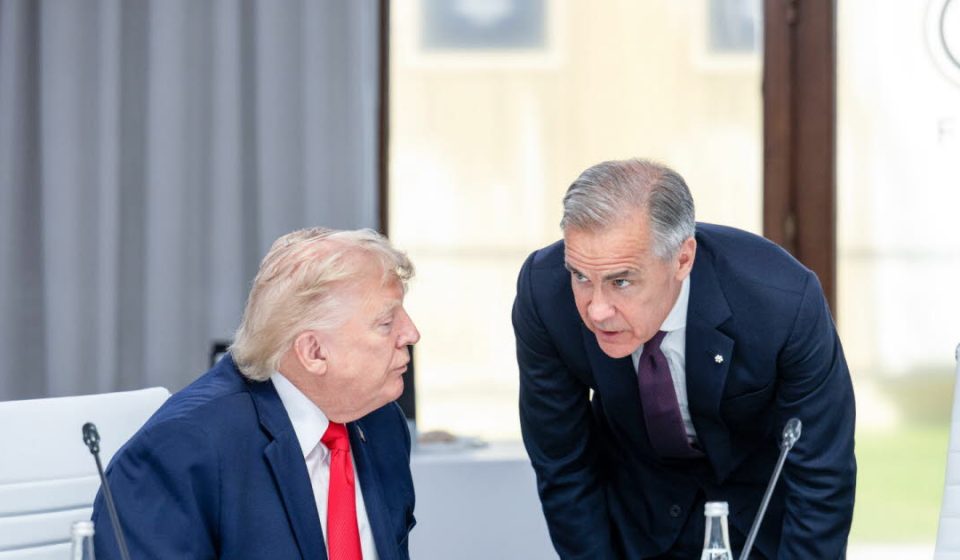
The American president displayed his optimism on Friday, highlighting his “good relationship” with Mark Carney.
The latter did not hide his bitterness Friday evening: “We have become aware (of the fact) that America has changed and that we will not return to our old relationship.” Very economically dependent on the United States, Canada found itself on the front line in the trade war launched by Donald Trump, who has repeatedly said he wants to make it the “51e State » American.
Since coming to power in March 2025, Mark Carney has been trying to reduce his country’s dependence on its big neighbor by seeking new trade partners in Asia or Europe. The United States is, by far, Canada’s largest trading partner, with Canadian exports to this country currently representing around 70% of the total.
Boycott
If the majority of Canadian products are exempt from American customs duties thanks to the free trade agreement with the United States and Mexico (CUSMA), the surcharges imposed by Donald Trump since last year have had a strong impact on certain strategic sectors such as aluminum, steel or the automobile industry, closely linked to the American market. And this new series opens a new breach by affecting in particular products which are normally protected by the free trade agreement. However, the sticking points no longer seemed very numerous, a few hours before the gong.
The Canadian government had even sent signs of goodwill, notably asking provincial authorities to put an end to the boycott of American wines and spirits, a central demand from Washington which also demands more favorable conditions for its dairy producers on the Canadian market. But the leaders of the provinces, who hold the monopoly on the sale of alcohol on their territory and are the only ones competent in the matter, are far from all convinced. Beyond the negotiations which failed on Friday, the two countries are supposed to agree on the future of CUSMA which Washington refused to sustainably renew last month.