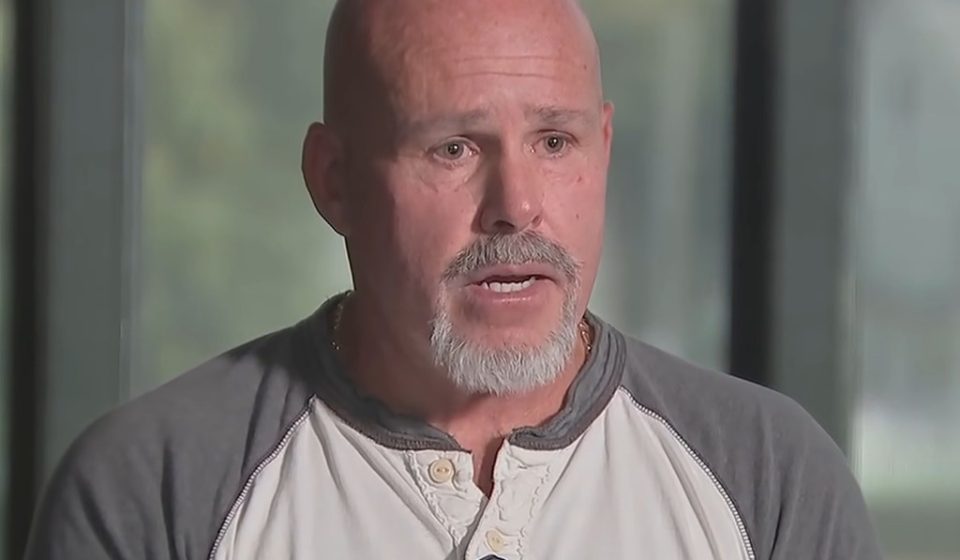

Edward Gillen, 59, woke up one morning in May last year and noticed a spot in his eye.
The Massachusetts father of four and beloved softball coach was set to retire. Meanwhile, his eyesight was getting worse day by day. He desperately tried to quickly determine the cause, but his vision loss deteriorated even faster.
“It was Memorial Day weekend and by June 1, I was blind,” Gillen told the US Sun. After undergoing MRIs, CT scans and an examination by a neuro-ophthalmologist, he got an answer.
Doctors told him his vision loss was non-arteritic anterior ischemic optic neuropathy (NAION), related to the Ozempic he had been taking for about a year to treat his diabetes.

“You don’t accept it. You don’t believe it. You just wonder, ‘What’s going on?'” Gillen said. He’s trying to relearn every aspect of daily life as a blind person. “Cooking, preparing food, eating food, trying to sit at the table. You can’t go out.”
Today, it joins more than 200 other lawsuits against the makers of GLP-1, alleging that the drug caused NAION, sudden and irreversible vision loss.
“I knew there were certain (side effects). Because you hear it in commercials, you hear an announcer, your doctor tells you,” Gillen told Boston 25 News. “But not that. Not that.”
Does GLP-1 cause NAION?
Like Gillen, people with NAION typically notice that they lose vision when they wake up. It is painless and sudden, and most often affects only one eye.
Experts liken this condition to a “stroke” in which blood flow to the optic nerve is blocked, starving and killing the nerve fibers. It is still a rare disease that scientists do not fully understand.
This type of nerve damage is usually irreversible. There is no treatment available.
We are only just learning more about the potential link between GLP-1 and this disease. A 2024 study found that taking semaglutide, sold under the names Ozempic, Wegovy, and Rybelsus, was associated with an increased risk of NAION. A July study confirmed this association, although the authors stressed that the risk was low.

In May, the North American Society of Neuro-Ophthalmology and the American Academy of Ophthalmology concluded that “the overall magnitude of risk for NAION remains low.”
“Although many report a possible small increase in the risk of NAION in patients taking GLP-1 PRs such as semaglutide, some studies report no correlation,” they wrote.
Part of the difficulty in determining whether GLP-1 is to blame is that people who take these medications are often at much higher risk for NAION before taking the drug. Risk factors for NAION include diabetes, obesity, hypertension, high cholesterol, heart disease, and sleep apnea.
Hundreds of plaintiffs file suit for vision loss
There are more than 200 lawsuits alleging that GLP-1 drugs caused NAION currently pending in federal court. The plaintiffs are suing Novo Nordisk, which makes Ozempic, Wegovy, Rybelsus and Saxenda; and Eli Lilly, who directs Trulicity, Mounjaro and Zepbound.
The plaintiffs say the manufacturers should have been aware of the risk and failed to warn them enough, and that the drugs are dangerous.
“Novo believes the personal injury lawsuits filed in the United States are without merit and we are defending them in court,” Liz Skrbkova, head of U.S. media and stakeholder relations at Novo, said in a statement to the US Sun.
She added that patient safety is a “top priority” for the company and that semaglutide, the drug Gillen took, has a “well-established safety profile,” supported by “robust clinical development programs, with post-marketing exposure of more than 58 million patient years across oral and injectable formulations in obesity and type 2 diabetes.”
Meanwhile, Gillen’s community is raising money for the Coach BlindEd Foundation, which aims to “support people who are blind or partially sighted, raise awareness of vision loss, and help fund crucial research.”
Gn Health