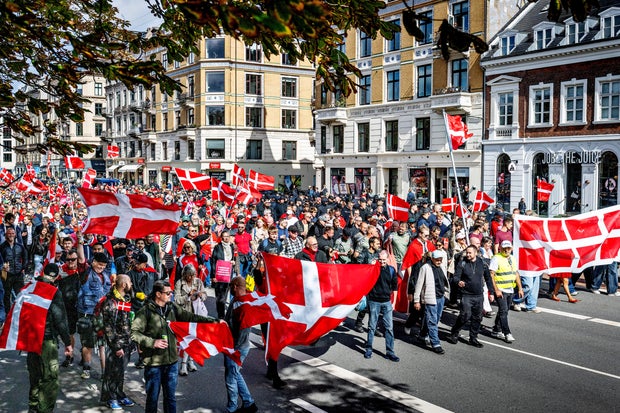
Denmark’s Supreme Court on Monday upheld a controversial law aimed at eliminating ethnic enclaves in public housing, or “ghettos”, as the government calls them, by giving authorities the ability to limit the number of “non-Western” immigrants and their descendants who can live in a particular housing estate.
The court ruled that the 2022 eviction of residents of Nøjsomhed-Sydvej, a housing estate in the town of Helsingør, north of Copenhagen, did not constitute ethnic discrimination.
The Danish law introduced in 2018 constitutes one of Europe’s most aggressive attempts to force immigrant communities to assimilate and avoid the evolution of “parallel societies” in the country. The plan has drawn both international condemnation and admiration from politicians in other countries who seek to emulate the Danish approach to immigration and integration.
Under the legislation, residential areas with at least 1,000 residents, where more than 50% of residents are immigrants or descendants of immigrants from “non-Western” countries, and who meet certain socioeconomic criteria related to employment rates, income levels, education levels and crime, may be subject to redevelopment requirements.
Housing estates designated as “transformation zones” must reduce the proportion of public family housing to no more than 40% by 2030. This may involve demolishing buildings, selling properties to private owners or converting them to other forms of housing, leading to the eviction and relocation of some residents.
By law, non-Western countries include all countries outside the European Union, Andorra, Iceland, Liechtenstein, Monaco, Norway, San Marino, Switzerland, United Kingdom, Vatican State, United States, Canada, Australia and New Zealand. The classification is based on a person’s country of origin rather than their citizenship, meaning that even Danish citizens born and raised in Denmark can be classified as non-Western if both of their parents immigrated from non-Western countries.
The seven families evicted from Nøjsomhed-Sydvej argued in their case that the distinction between Western and non-Western origins was in fact an indicator of ethnicity and therefore amounted to illegal discrimination based on race. The Supreme Court concluded that the distinction was based on nationality and country of birth rather than ethnicity, noting, however, that both categories encompassed a wide range of ethnic groups and that people of the same ethnic origin could fall into either category.
The court’s decision follows a ruling last December by the European Union’s highest court, which found that Danish law could discriminate on the basis of ethnic origin, but the EU court left it to Danish courts to make the final decision.
Anders Svendsen, legal director of the Danish national tenants’ organization LLO, told CBS News that the organization did not expect the Supreme Court to rule the way it did.
“We were slightly surprised, given what the European Court proposed last December,” he said.
The organization estimates that several thousand homes have already been demolished under the legislation.
“A lot of people are still very worried, because they don’t know if they will be next,” Svendsen said. “This regulation has been quite unpopular among public sector tenants, but it has been very popular with the population as a whole.”
The LLO said it recognized the government’s desire to promote social cohesion, but questioned whether demolishing houses and reducing the availability of affordable housing was a proportionate response.
“We disagree because he sees public housing as a problem to be solved and less public housing is seen as the cure,” Svendsen told CBS News.
Joachim B. Olsen, a former Danish lawmaker and now opinion editor of the Danish newspaper BT, was not surprised by Monday’s decision.
“The legislation is carefully reviewed by the Ministry of Justice to ensure it complies with Denmark’s constitution and international obligations before being presented to Parliament,” he told CBS News.
Olsen rejected the suggestion that the distinction between Western and non-Western origin was an indicator of race, arguing that it was based on cultural background.
“It is important to understand that the provisions of the ‘Ghetto Law’ apply to everyone living in the area designated as a ‘ghetto’, regardless of their ethnicity or citizenship,” he said.
Olsen argued that this policy had been largely successful. According to Danish government figures, the number of neighborhoods officially classified as ghettos fell from 29 in 2018 to five in 2025.
“Incomes in these areas have increased. Employment is increasing. So is the level of education,” he said. “Overall, I would say the positives outnumber the negatives.”
Denmark’s influence on European immigration policy
Denmark has become a model for some other European governments as they seek ways to tighten immigration restrictions and address public concerns about the integration of immigrant communities.
While demands for stricter immigration policies in many European countries have been mainly driven by right-wing populist parties, Denmark’s restrictive approach has been championed by its center-left Social Democratic party, led by Prime Minister Mette Frederiksen.
Nils Meilvang/Ritzau Scanpix/AFP via Getty Images 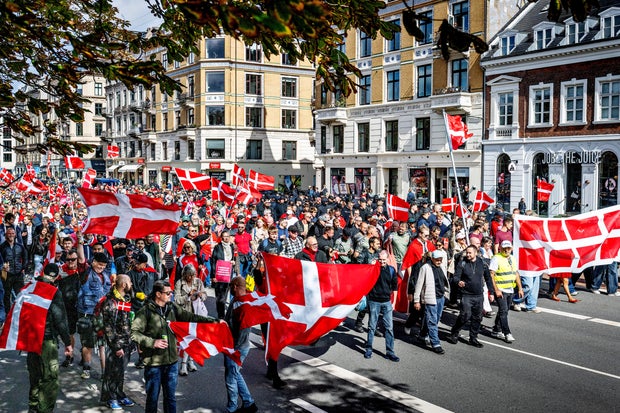
Frederiksen has openly expressed his desire to preserve Danish culture and his opposition to a concept of multiculturalism in which all cultures enjoy equal status in the country.
“We are a Danish company and we are an ethnically Danish indigenous tribe,” Frederiksen said last week on BT newspaper’s podcast, Borgerlig Tabloid. “Of course it changes when new people come here. But it is also necessary that in the future Denmark still has a strong majority culture.”
The British government cited Denmark’s policy earlier this year as it changed its own rules regarding people granted asylum in the UK.
Home Secretary Shabana Mahmood, who announced a new policy in March under which those granted asylum will benefit from this status subject to regular review, said the “reset of UK asylum provision” had been “inspired by Denmark’s success”.
Denmark was also at the forefront of efforts establish “return hubs” – deportation centers outside Europe.
Last week, Denmark joined Germany, Austria, Greece and the Netherlands in announcing its intention to establish a “return hub” in Rwanda for migrants who have exhausted legal channels to stay in Europe, but who cannot be returned to their country of origin.
Gn world