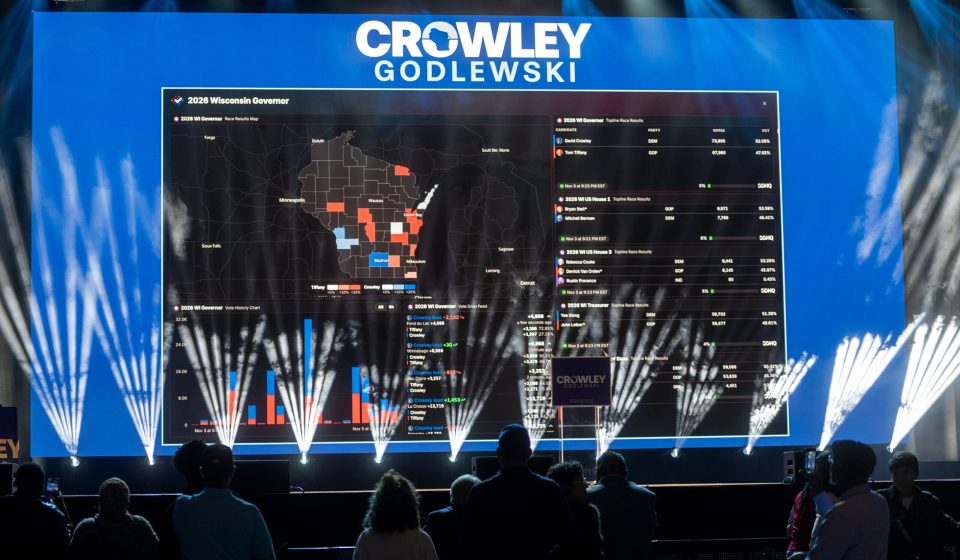

Democrat David Crowley will be Wisconsin’s next governor, making history as the first black person to hold the office.
Crowley, who is Milwaukee County’s executive, defeated Republican U.S. Rep. Tom Tiffany, R-Minocqua. Tiffany conceded in a speech at 9:45 p.m. The Associated Press had not yet called the race.
Understanding Wisconsin, Together.
WPR’s “Wisconsin Today” newsletter helps you stay connected to the state you love without feeling overwhelmed. No paywall. No agenda. No company filter.
All results are unofficial until certified by election officials in the coming weeks.
Crowley’s victory seemed impossible this summer, when he briefly withdrew from the gubernatorial race, only to return.
His journey to office represents an extraordinary rise after a difficult childhood in one of Milwaukee’s most troubled neighborhoods. As a candidate, he often cited his parents’ struggles with drug addiction and a childhood marked by multiple expulsions to motivate his political work.
He began his career working on former U.S. Senator Russ Feingold’s re-election campaign in 2010, and worked as a member of county and state government before being elected to the State Assembly in 2016.
In 2020, he became Milwaukee County’s youngest and first Black executive. While in office, he returned to school and became the first person in his family to earn a college degree.

But his bid for governor failed to gain momentum this year, and he left the race in early July. Ten days later, after Lt. Gov. Sara Rodriguez ended her campaign, he returned, this time with the support of incumbent Gov. Tony Evers. It was a clear effort by mainstream Democrats to offer an alternative to Madison Rep. Francesca Hong, the democratic socialist who had run at the front of the pack for months.
Crowley’s victory over Hong, by less than a percentage point, was a shock in the middle of the night. He became a proven candidate, someone who many Democratic voters believed would have a better chance of winning the November general election.
Wisconsin Democrats had high hopes heading into this election cycle, expecting that Trump’s low approval ratings, growing frustration over high prices and a war with Iran would result in a midterm “blue wave.”
But a decisive Crowley victory was not a certainty. A September poll showed his race with Tiffany tightening, as Republicans bombarded Crowley with negative ads and Tiffany distanced herself from Trump, who had supported him.
Tiffany’s campaign focused on Crowley’s record in Wisconsin’s most populous and diverse county, with messages about Milwaukee’s crime and tax rates. Its ads warned that a Crowley victory would export Milwaukee’s urban challenges across the state. And one of Crowley’s major victories as county executive — a deal with legislative Republicans that allowed the city and county of Milwaukee to raise sales taxes to raise revenue — provided easy attack ground at a time when voters were expressing deep concerns about high costs.
Crowley and his supporters responded by linking Tiffany to Trump at every turn, and Crowley repeatedly hammered home Tiffany’s connection to the president during the pair’s only debate. While Tiffany’s ads presented him as a candidate in his own right, his conservative voting record went back years, both in state and federal government.

Tiffany’s defeat ended the northern Wisconsin congressman’s winning streak dating back to his election to the state Assembly 16 years ago. It was his first time running statewide.
Secretary of State Sarah Godlewski, Crowley’s running mate, was also elected Wisconsin lieutenant governor on Tuesday. Both will take office in January.

Editor’s note: This story will be updated.
Wisconsin Public Radio, © Copyright 2026, University of Wisconsin System Board of Regents and Wisconsin Educational Communications Board.
Gn headline