
Although it is the Treasury Department’s responsibility to finance the interest on the $40 trillion U.S. national debt, it was members of both parties in Congress who increased Uncle Sam’s borrowing.
As Democrats picked up a wave of seats in the midterm elections, everyone from Wall Street analysts to the CEOs of America’s biggest companies are wondering what more divided government will mean.
Budget watchdogs do the same, and the Committee for a Responsible Federal Budget (CRFB) has costed Democrats’ plan for their first 100 days.
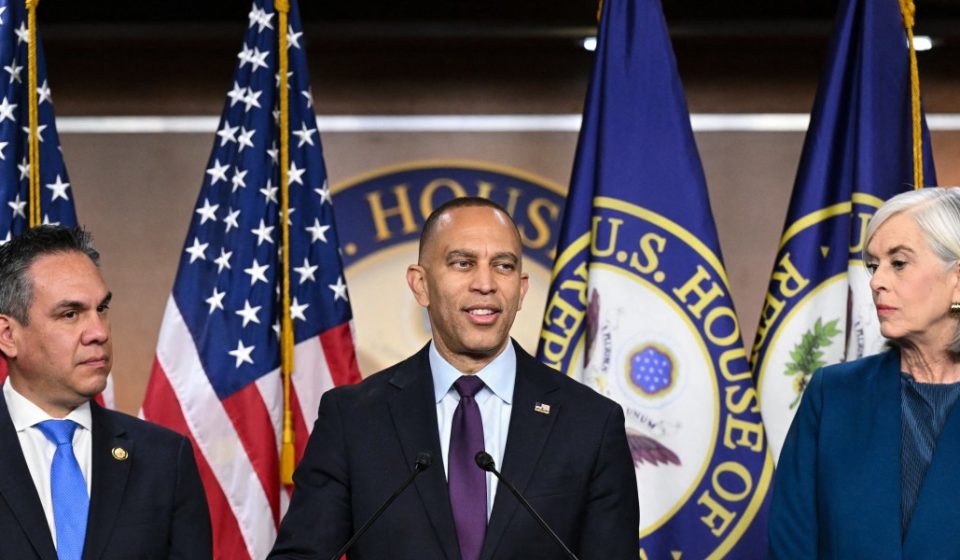
Democrats will enter the 120th Congress with slim majorities in both chambers, and they have made clear what they want to accomplish in their first three months with more power. Hakeem Jeffries, the Democratic nominee for Speaker of the House of Representatives, wrote in November that the first 100-day package includes “reversing Medicaid cuts, restoring SNAP funding, expanding the Affordable Care Act tax credits, eradicating Trump’s tariffs, and stopping the irresponsible war of choice in Iran.”
Some factors have obvious budgetary implications: Deescalating the war in the Middle East would save money, while ending Trump’s tariffs would eliminate a revenue stream that generated $287 billion in tariffs, taxes and fees in 2025 according to the Richmond Fed, a 192% increase from the previous year.
The CRFB estimates that in total, the “First 100 Days” policies would cost $4.1 trillion through 2037. Without offsets (spending reductions or revenue increases used to balance the new policies), $4.9 trillion would be added to the debt burden over the next decade, including interest costs.
But the factor that really interests analysts – and budget hawks – is the US debt-to-GDP ratio. This describes a country’s level of borrowing in relation to its economic growth, and therefore its capacity to service this borrowing. Right now, it stands at about 121 percent, according to the Federal Reserve Bank of St. Louis.
Economists suggest that if this balance were to tip further, U.S. lenders could then start charging higher premiums to compensate for the risk associated with borrowing, thereby triggering a bond crisis.
House Democrats’ policies would increase the debt-to-GDP ratio to 135% by 2037 without compensation, compared to 125% of GDP based on an adjusted CBO baseline, the CRFB added.
The budget watchdog is offering alternatives for how the revenue needed to offset those proposals could be generated, although the reforms are unlikely to be popular with voters.
“Repealing the One Big Beautiful Bill Act (OBBBA) tax cuts for high earners would generate about $2 trillion in savings, enough to offset a program cut in half,” the budget watchdog wrote.
“Repealing all of OBBBA’s tax cuts and spending increases, including tax cuts for low-income and middle-class people, would generate about $7 trillion. This would be enough to fund the first 100 days’ program 1.7 times.”
Prize distribution
The budget committee broke down each aspect of the proposals by line.
Starting with policies that could save money, CRFB pointed the finger at Iran. He noted that while ending the conflict would not immediately reduce deficits, it would likely avoid increased military and defense spending. Continuing the war in Iran, the committee wrote, would cost about $30 billion a year and could be avoided.
As for political costs for 2027-2037, removing Trump’s tariffs leaves the largest budget hole. That’s $1.8 trillion in total, from the repeal of Section 301 tariffs (costing $955 billion alone) and Section 232 tariffs ($780 billion) to the repeal of Section 338 tariffs on certain Canadian goods ($35 billion).
Reversing OBBBA’s health care provisions would cost $1.6 trillion by 2037, the committee adds, including $600 billion to roll back the provider tax and state-mandated payment limits, as well as $485 billion to eliminate Medicaid work requirements. Rolling back SNAP provisions would cost $250 billion over the next 10 years.
Raising the deficit would also mean higher interest payments on the debt, CRFB added, amounting to some $840 billion over the next 10 years.
Gn usa