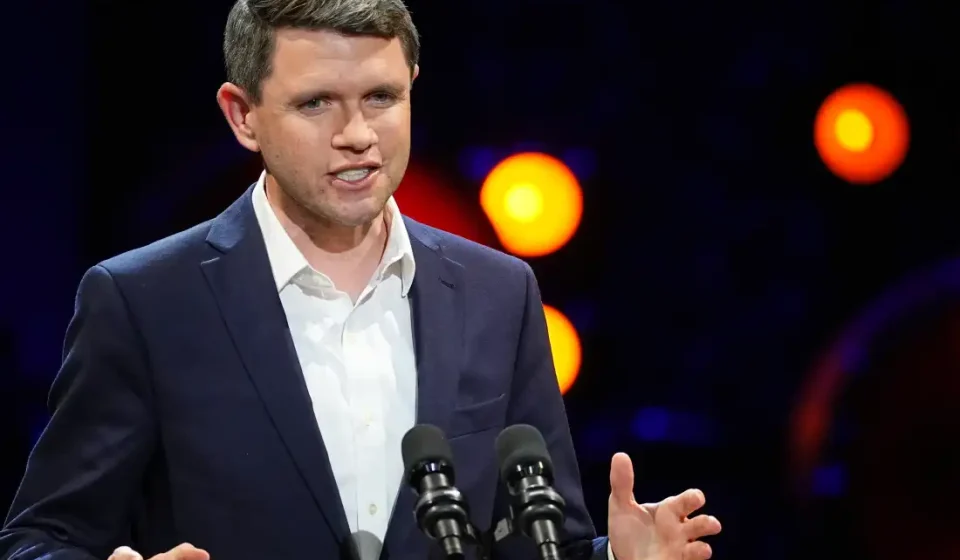

Texas Senator-elect James Talarico speaks at the Mission Ballroom during the What’s Next political convention in Denver, November 12, 2026.
David Zalubowski/AP
hide caption
David Zalubowski/AP
DENVER — Democrats headed to Denver for a two-day conference that was half victory party, half sober look at the road ahead to meet the expectations of the voters who elected them.
The “What’s Next” conference, organized by the group Majority Democrats, was planned well before Democrats exceeded expectations with their best electoral performance since Watergate. It brought together rising stars — like new Gov. Rob Sand in Iowa and Sen.-elect James Talarico in Texas — as well as strategists, organizers, state and federal lawmakers and potential presidential candidates.
Held in a concert hall, with colorful artwork depicting party heavyweights dotting the room, Democrats attended sessions such as “What Voters Want” and “What Needs to Change.” The overwhelming emphasis of speakers was that Democrats must regain trust.

A compilation of posters exhibited at the What’s Next conference in Denver on November 12, 2026.
hide caption
“We’ve won elections in places where we haven’t won in a long time, even places where we’ve never won. And the message shouldn’t be that (voters) fully embrace the Democratic Party,” Colorado Rep. Jason Crow said in an interview.
“It took us decades to dig ourselves into a hole and push people away from us, and it’s going to take more than one cycle for us to gain that trust,” said Crow, who is one of the party’s organizing co-chairs.

Participants applaud during the What’s Next summit. After the midterm elections, prominent Democrats and political figures gathered for the event to evaluate the election results and discuss party strategy.
Mark Makela/Getty Images/Getty Images North America
hide caption
Mark Makela/Getty Images/Getty Images North America
A party on probation
Anderson Clayton, chairman of the North Carolina Democratic Party, criticized the party for not investing more in the South and in black voters.
“When we say that black voters are the base of our party, then I ask why don’t we invest in a region of the country that on Tuesday night just proved everyone wrong about what was possible,” Clayton said to much applause. “Rural America deserves the Democratic Party’s investment and we must run to the communities our party has fled.”
Former Transportation Secretary Pete Buttigieg said Democrats shouldn’t rest on their laurels.
“I think we’re politically traumatized enough from the last few cycles that we won’t learn bad lessons from all of this,” Buttigieg said. “Because here’s the thing: It remains to be seen whether what we’ve just experienced is yet another swing from one side to the other and back again, or whether it’s the beginning of a tectonic shift changing American politics.”
He said Democrats can learn from the current White House on two fronts, by having: “a bias for action and a willingness to get things done up front and at the same time a willingness to plan for the long term,” adding that Democrats should come out of the gate strong, with a quick round of bills aimed at lowering the cost of living.
The presumptive next House Speaker, Hakeem Jeffries, told the audience he intends to do just that, with a strong agenda that includes reversing Medicaid cuts, banning congressional stock trading and mid-decade redistricting, establishing a statutory right to abortion and overturning the Supreme Court decision. Citizens united decision that removed limits on political spending by corporations and unions.
The conference itself was peppered with potential presidential candidates, including Buttigieg, New Jersey Sen. Cory Booker, Pennsylvania Gov. Josh Shapiro, Arizona Sen. Ruben Gallego and California Rep. Ro Khanna, one of the few progressive speakers.
No one has announced a formal candidacy, but many have offered insight into their theory about the case.
“I think it’s important that whoever we hire to be the chief executive of this country knows how to lead something, knows how to get things done, knows how to not only have a vision but how to achieve it,” Shapiro told reporters.
Someone who was previously plotting a possible White House run — Maryland Sen. Chris Van Hollen — told reporters he is no longer considering it because he is instead seeking the top leadership position in the Senate.

Sen. Elissa Slotkin, D-Mich., speaks at the What’s Next Summit Nov. 13 in Denver.
Mark Makela/Getty Images/Getty Images North America
hide caption
Mark Makela/Getty Images/Getty Images North America
Should Democrats work with Trump?
Throughout the conference, Democrats debated whether and how to work with the Trump administration to bring meaningful change to voters.
“If putting Trump’s name on it and putting it in gold letters would get it passed, hell yeah, I would,” Michigan Sen. Elissa Slotkin said.
Talarico agrees.
“The American people cannot wait two years for change, so we must work with President Trump,” Talarico said. “We should make the last two years of his presidency the most productive of any American presidency.”
But New Jersey Gov. Mikie Sherrill added a note of caution, describing the president as a bad faith actor.
“The art of making a deal with Trump is that he finds out what you want, exploits what you know what about you, and keeps taking, taking, taking, and never delivering,” Sherrill said. “My advice to Senator Talarico is that if Trump wants to work with us, we will set the agenda and he can sign it.”
Gn headline