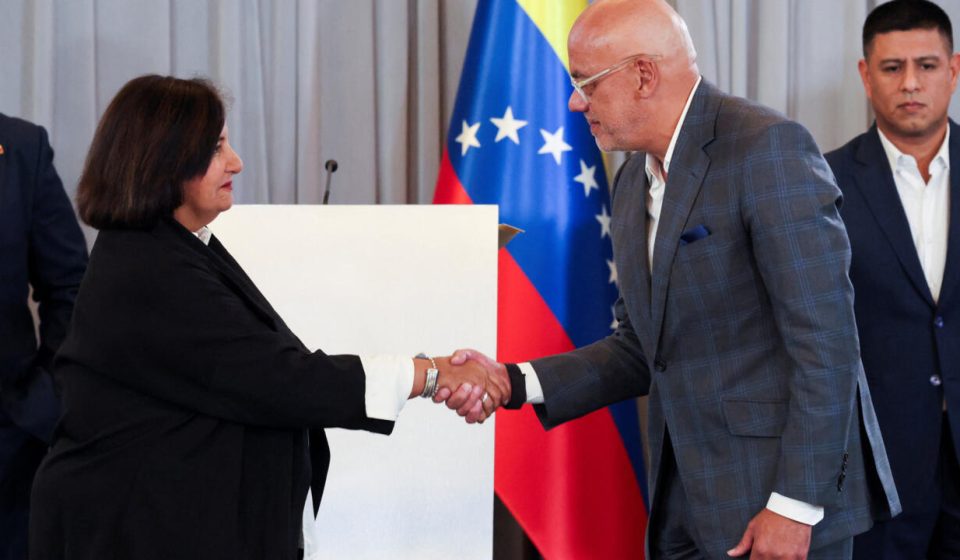

The Venezuelan government and opposition closed their first cycle of dialogue on Wednesday August 12 with a view to a possible political transition, announcing points of agreement on the start of judicial reform and the recovery of funds frozen in the United Kingdom due to sanctions against the country under the presidency of Nicolas Maduro.
This dialogue, wanted by Washington, comes seven months after the capture of Maduro by the American army after more than a quarter of a century of Chavista power, the socialist-inspired doctrine of the late President Hugo Chavez (1999-2013). Another round of talks will take place on a date to be determined.
Dozens of opposition supporters gathered in front of the Caracas hotel where the last day of the dialogue cycle which began on August 6 took place. Some complained about the hermetic nature of the discussions taking place behind closed doors without the leader of the opposition and Nobel Peace Prize winner Maria Corina Machado, exiled in Panama. She was not invited but assured that she would not hinder the process. The separation of powers and justice reform is one of the priorities for “redemocratizing” the country, many observers believe.
The Supreme Court in the sights of the opposition
The government and the opposition said they “agreed” on Wednesday in a joint statement to “initiate a process that contributes to the transformation of the justice system, focused on reforms of the organic law of the Supreme Court and other laws of the justice system”, announced the President of the National Assembly Jorge Rodriguez, brother of interim President Delcy Rodriguez, and Dinorah Figuera, head of the opposition delegation. The opposition insists on a reform of the judicial system, and of the Supreme Court which notably validated the contested re-election of Maduro, tainted by fraud according to the opposition.
Also readIn Venezuela, the historic amnesty law for political detainees approved in the Assembly
We must “eliminate the structural conditions which make repression possible”, said a source close to the opposition, also stressing the desire to repeal the laws punishing incitement to hatred and terrorism which served as the basis for the detention of numerous political prisoners.
Nearly two months after the June 24 earthquake which left more than 6,300 dead and thousands missing, the two parties “will join efforts to promote the recovery of assets” of Venezuela held at the Bank of England, “by establishing transparency mechanisms for efficient use of these resources”, according to the press release.
Delcy Rodriguez announced at the beginning of August that she had written to King Charles III to recover some 30 tons of gold and use them to rebuild the country after the earthquake which caused at least 6.7 billion dollars in damage according to the UN, nearly 20 billion according to the World Bank. Venezuela, under the presidency of Maduro, has repeatedly requested this gold from London in vain.
Washington had gripped Venezuela in a heavy vise of economic sanctions with the aim of making the situation untenable for Maduro.
The United States is involved in the discussions
A source close to the opposition points out that even if the United States is not at the negotiating table, it is very present in the discussions and has been called upon several times as “mediator” during sticking points. This source specifies that American pressure ensures that power can move forward unlike other vain negotiations in recent years.
“There is no naivety. We know that those we have in front of us are not democratic reformers comparable to Adolfo Suárez (who managed the Spanish transition), to Gorbachev (transition from the Soviet Union). Delcy Rodriguez and her government have changed their attitude, but not their preferences. She looks more like (Daniel) Ortega (president who reigns as absolute master in Nicaragua) than a reformer,” assures this source.
While some opponents believe that Dinorah Figuera, a former deputy living in exile for years, is not legitimate, this source emphasizes that the opposition delegation recognizes Maria Corina Machado as “leader of the Venezuelan opposition, the voice that Venezuelans identify as their own voice.”
On Wednesday, demonstrators demanded more transparency on the negotiations: “In other countries, when we discuss the problems of 35 million inhabitants (high estimate of the country’s population), the meetings are public and people can debate. Here no!”, said Carlos Salazar, a 54-year-old trade unionist. “What happens in the dark and in the silence smells bad,” he adds.
With AFP