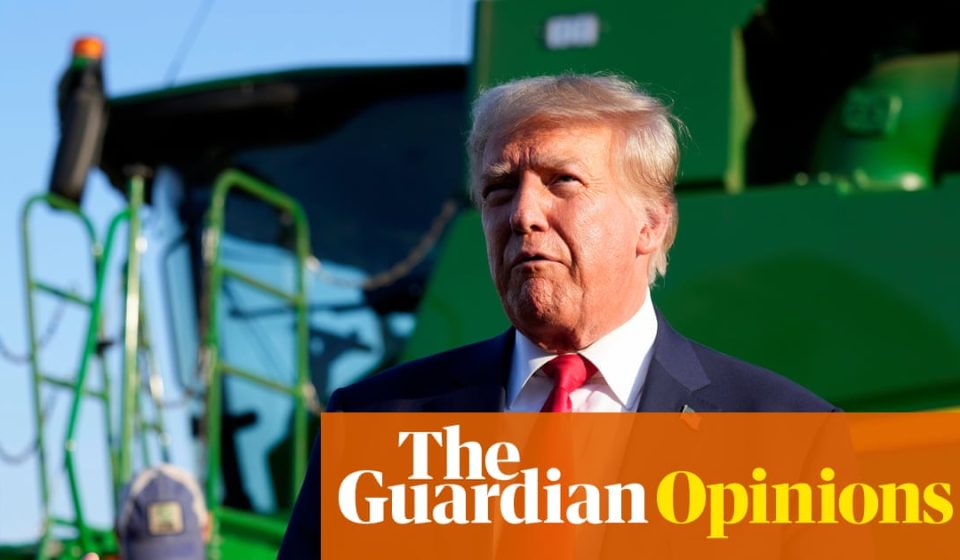

DDonald Trump’s policies have been a disaster for the nation’s farmers, so much so that a near electoral miracle may soon occur: Kansas, one of the reddest and most rural states, could elect its first Democratic senator in nearly a century.
After Trump won farm country handily in 2024, many rural voters in Kansas, Iowa and elsewhere turned bitter against him because the price of diesel fuel, a key input for agriculture, soared nearly 70 percent, farm bankruptcies increased and because Trump’s trade wars dramatically reduced agricultural exports.
Rural voters are so angry with Trump that polls show Republican Senate candidates have a good chance of losing in Kansas, Iowa, Nebraska and Texas, even though Trump won those rural states by 13 percentage points or more in 2024. It’s no wonder Trump is hopscotching in Kansas, Iowa and other states in the final weeks of the midterm campaign.
No one is saying Trump deliberately hurt farmers, but when he plunged the United States into war with Iran and its numerous trade wars, he showed little concern about the possible consequences of those decisions for rural America. It was almost inevitable that Trump’s measures would hit farmers — driving down exports of soybeans and other agricultural products and driving up the price of fuel, fertilizer and farm equipment. What’s more, Trump’s proudest legislative achievement, his “big, beautiful bill,” hit farm country even harder with its deep cuts to food aid and billion-dollar cuts to Medicaid, which will cause an estimated 1.8 million rural Americans to lose their health insurance.
“He sold rural America with his policies,” said Jon Tester, a third-generation Montana farmer and former U.S. senator.
Even the Cato Institute, a conservative, Republican-friendly think tank, criticized Trump for what he did to farmers. A comment from Cato said that while Trump calls this a “golden age” for farmers, the fact is that “Trump’s tariffs are inflicting serious damage” on farmers, raising the price of their inputs and causing their exports to decline by billions of dollars.
This partly explains why farm bankruptcies jumped 85% compared to two years ago.
It’s no wonder that a recent KFF/AP poll found that about six in 10 rural voters disapprove of how Trump is handling the economy, while about half think the economy is in worse shape than when Trump returned to office.
Indeed, many rural voters have turned against Trump — while nearly two-thirds supported him in 2024, now less than half, or 49 percent, of rural voters say they support Republican candidates this fall, according to a Fox News poll.
At a recent news conference in Washington, John Hansen, president of the Nebraska Farmers Union, sought to express the pain and anger felt by many farmers. “Due to the overuse of tariffs, record agricultural input costs, soaring fertilizer costs” and “high interest rates,” Hansen said, farmers “are facing the worst economic and financial crisis since the agricultural crisis of the 1980s,” when many farms went bankrupt due to extremely high interest rates.
In a direct slap at Trump, Hansen added: “Just when farmers need to expand markets for their products, the president appears to be at war with our country’s three largest trading partners: Mexico, Canada and China. When trade wars break out, farmers’ noses always bleed first, and worse and longer.”
Many rural voters supported Trump in 2024 because he promised to cut prices, including energy prices, and not plunge the United States into unnecessary and costly foreign wars. But today, many feel betrayed because Trump launched an unnecessary and costly war against Iran, which sent diesel fuel – which farmers depend on for their tractors and combines – soaring to a record high of $6.52 a gallon in late September, before falling somewhat (to $6.32). This price spike – diesel averaged $3.75 a gallon before the war – cost most farmers thousands of extra dollars while many were barely breaking even.
“Compared to last year, our fuel bill is $50,000 more,” Vance Ehmke, a Kansas farmer, told the Hastings (Nebraska) Tribune, while “fertilizer, it’s going to be at least $20,000 or $40,000 more. This is all because of Trump and his war in Iran. We’re beyond mad about it.”
“I want to tell you that I’m a Republican and I’m pissed.”
Last month, the American Farm Bureau Federation published a poor article claiming that the “record high input cost environment”—that is, high diesel and fertilizer prices—means that “no major row crop,” like soybeans or corn, “is expected to break even” this year.
In Texas, Kansas, Nebraska and other agricultural states, ranchers are furious that Trump announced plans to import about 660 million pounds of beef duty-free in an effort to reduce beef prices by 25% — one of the many ways Trump’s tariffs have angered consumers has been by driving up beef prices. The National Cattlemen’s Beef Association expressed dismay over Trump’s beef imports, saying the move would harm the stability of the struggling industry.
North Carolina farmer Matt Bell issued a warning to Republicans. Bell, who voted for Trump in 2024, told CBS News: “Everything we touch has gone up. We’re in a position now where we’re angry and ready to be heard.”
As rural America suffers deeply, Bell and many other farmers who traditionally support Republicans want to send a message to the party that controls the White House, Senate and House. Many are upset that Republican lawmakers have failed to seek to protect farmers by fighting Trump’s tariffs and war with Iran.
“We need to have other voices heard to push back on this stuff a little bit,” Nancy Danner, a soybean and corn farmer in Iowa, told the Wall Street Journal. “We need as many changes as possible.” Danner said she plans to vote only for Democrats in November.
A Wall Street Journal headline announced grim news for the Republican Party: “Republicans face worst political environment in farm country in decades.” »
All this disarray could go a long way toward electing Democratic Senate candidates in rural states: Josh Turek in Iowa, Adam Hamilton in Kansas, Roy Cooper in North Carolina and James Talarico in Texas, not to mention progressive independent Dan Osborn in Nebraska.
John Tsitrian, a South Dakota business executive who writes about rural America, minced no words about who was to blame.
“Farmers are suffering because of Trump’s apocalyptic mistakes,” he wrote. Perhaps the biggest problem, Tsitrian said, has been the loss of global markets caused by Trump’s relentless trade wars, which he says have caused long-lasting “structural damage” to American farmers.
Before Trump’s first term, the United States and Brazil each supplied about 40% of China’s soybean imports. But due to Trump’s repeated trade wars with China and China’s search for more reliable and less antagonistic trading partners, the United States now supplies only 23% of China’s soybeans, with Brazil supplying more than 60% and Argentina 10%. While China imports about $60 billion worth of soybeans each year, that means a painful loss of $10 billion a year in U.S. soybean exports.
Trump has long been known to seek to give money, often a lot of money, to people who are angry with him. Just look at his brazen plan to hand out $5,000 to every American adult.
Seeing how upset farmers are about sky-high diesel prices, Trump announced new aid Monday at a rally in Kansas: He promised $8 billion in emergency aid to U.S. farmers through what he called the Harvest Fuel Relief Program. It looked like a desperate, last-ditch effort to save incumbent Kansas Republican Sen. Roger Marshall. This came after Trump announced a $12 billion bailout for farmers last December.
While acknowledging that farmers need emergency help, South Dakota’s Tsitrian wrote: “Today’s difficult agricultural economy, which regularly needs federal cash infusions, is the result of a disaster with a specific name: Donald Trump. Unlike most disasters, this one was entirely predictable.”
Across rural America, there is growing frustration, dismay and anger over economic conditions, Trump’s policies and Republican lawmakers that farmers have long supported.
“This Republican-led Congress has not done its job,” said Hansen, the Farm Union president. “They have failed to help our nation’s farmers during these difficult times, and it’s time for change.” »
Steven Greenhouse is a journalist and author, focusing on work and the workplace, as well as economic and legal issues.
Gn usa