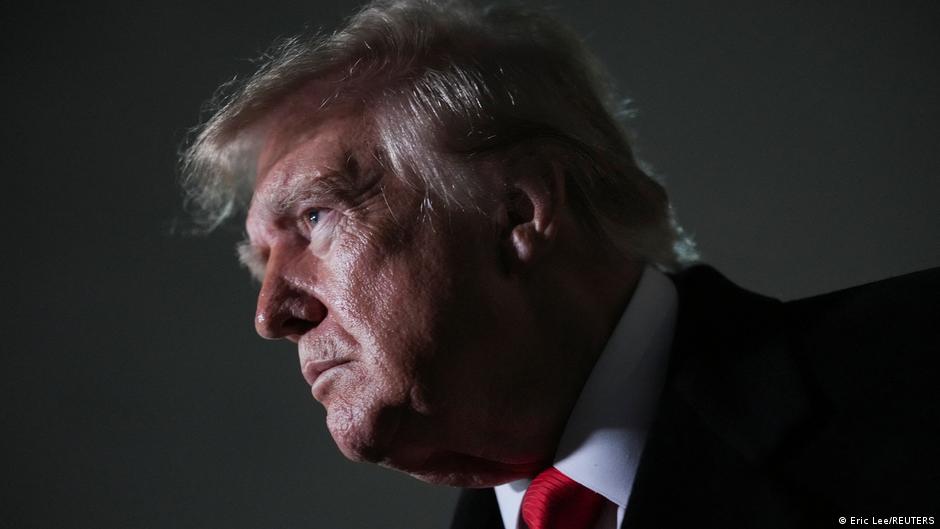

Many Ukrainians and Europeans viewed the news from Washington last weekend as a slap in the back of their American ally. First, President Donald Trump announced a deal to buy Russian diesel, which involves a temporary easing of U.S. sanctions against Moscow.
And later, Trump announced a supposedly agreed-upon “energy ceasefire” between Ukraine and Russia. kyiv said the idea had not been discussed with Ukraine, but was ready to stop attacks on Russian energy infrastructure if Moscow did the same.
“Trump is not interested in supporting Ukraine”
Security expert Carlo Masala, of the Bundeswehr University in Munich, said the events showed that “Trump is not at all interested in supporting Ukraine, but that US domestic politics and relations with Russia are much more important to him than supporting Ukraine.”
He added that the president wanted to influence the outcome of the November 3 US midterm elections through a deal with Russia.
All seats in the House of Representatives and a regular portion of the Senate will be contested in the midterm elections. Polls suggest that Trump’s Republican Party could lose its majority in the House. A loss of the Republican majority in the Senate is also possible. Polls indicate that American voters are unhappy with high fuel prices, and the US president apparently hopes to influence prices through diesel shipments from Russia.
Observers, however, consider Trump’s hopes that Russian diesel shipments could affect prices in the United States illusory.
“The volume is so small that it will have absolutely no effect on prices,” Thomas Jäger of the University of Cologne told the German public broadcaster. ARD.
The political scientist added that deliveries planned before the midterm elections would not even cover U.S. diesel demand for a single day.
“The same goes for shipments that may arrive subsequently, if they materialize they will also have no effect on prices,” he said.
Trump’s goal, Jäger said, is simply “the story”: showing voters he is trying to solve an issue they care about.
“No concrete military advantage for Russia”
The main criticism from kyiv and EU countries is that Russia will use revenue from diesel sales to finance its war against Ukraine.
Carlo Masala, however, does not foresee that the agreement with the United States will have “concrete positive military effects” for Russia.
He points out that Washington had already temporarily suspended sanctions on Russian oil exports in March this year, shortly after the launch of American and Israeli attacks against Iran.
“Despite the money that Russia has and has received, it does not have a military strategy to advance further in Donbass. The question is more about the political impact and symbolism of separate agreements between the Americans and Russians at the expense of Ukraine,” the expert said.
Another source of concern in kyiv could be US threats to suspend intelligence sharing with Ukraine and block the Prioritized Ukraine Requirements List (PURL) program unless Ukraine stops its attacks on Russian oil refineries. Under the PURL program, European countries purchase American weapons from Ukraine.
European alternatives to American intelligence
A possible US decision to stop sharing intelligence with Ukraine regarding strikes on Russian territory would have “dramatic” consequences for kyiv, Masala said, but European intelligence, particularly French, could help mitigate that impact.
If French intelligence is “not as complete as American intelligence”, the Ukrainian army already uses it to carry out strikes in Russia with French weapons systems.
As for the weapons that European countries are purchasing from the United States for Ukraine under the PURL program, Masala noted that the most important element of the program – interceptor missiles for air defense – has barely been available to Ukraine since the start of the war with Iran.
Support for Ukraine by both American parties
On the eve of the US midterm elections, experts point out that Ukraine enjoys broad support not only among Democrats but also Republicans. One example is the bipartisan passage this summer of legislation to strengthen U.S. sanctions against Russia, known as the “Lindsey Graham Act,” named after its Republican sponsor in Congress, who has since died.
Signed by Trump in September, the law gives the president a wide range of tools. It can impose sanctions on Russian officials, oligarchs, financial institutions and Russia’s shadow fleet, used to circumvent restrictions on oil exports. It can also impose punitive tariffs on buyers of Russian energy products.
“Trump can resist, but political forces, especially after the US midterm elections, could push the administration to try to end the war using available tools,” former US diplomat Daniel Fried told DW.
He added that the “Lindsey Graham Act” and the 2022 law banning U.S. imports of Russian oil are “not absolute barriers, but strong barriers against stupid ideas like a unilateral, no-compromise diesel deal with Russia.”
Several Democratic and Republican senators cited the legislation in a joint statement in which they called the diesel deal with Russia illegal, calling on the U.S. government to “immediately rectify” its decision.
This article was originally published in Ukrainian
Gn usa