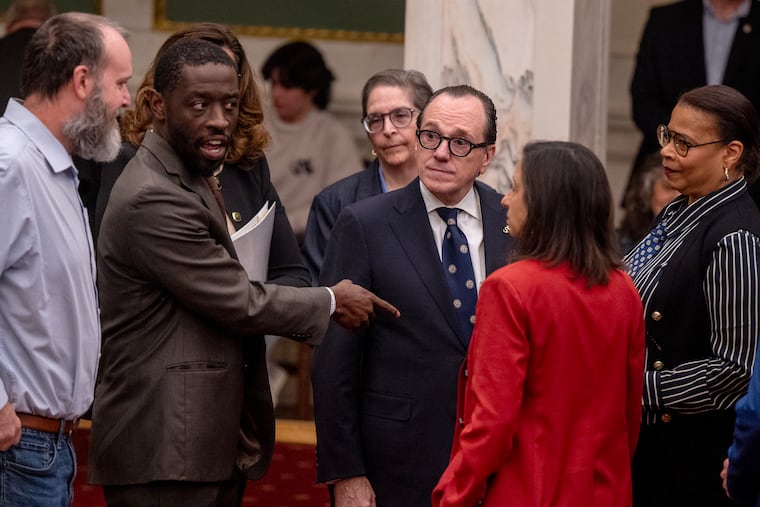
Drexel and Academy of Natural Sciences trade blame as Philadelphia council pushes to reopen museum

The president of Drexel University sought Monday to defend the school’s handling of the closure of the Academy of Natural Sciences museum under intense questioning from City Council members during an hours-long hearing.
In their first public, no-gloves exchange, Drexel President Antonio Merlo and Academy Board Chairwoman Suzanne Biemiller shared their different versions of what brought the institutions to the brink of divorce after 15 years of affiliation.
Much of the hearing focused on steps needed to reopen the nearly 200-year-old museum, which closed in late September.
But even there, Academy leaders and Drexel could not agree on who had the authority to do this.
“Any decision regarding reopening,” Biemiller told the Board, “is up to Drexel.”
Earlier in the hearing, Merlo, expressing frustration with the university’s inability to control the Academy’s deficits, said, “The public museum was never ours to run, keep it open or close.” »
The city council, for its part, said it wants to commit taxpayer dollars by the end of this year to help reopen the museum. Council member Isaiah Thomas, chair of the committee, said he has spoken to eight lawmakers — almost a majority of the body’s 17 members — who want to “put money on the table” by the end of this year to provide recurring revenue to the Academy over a “three to five year period.”
“It’s important that we find a solution as quickly as possible,” Thomas said.
It’s unclear whether Mayor Cherelle L. Parker, who could sign or veto any funding legislation, would support removing money from city coffers to support the Academy. A city hall spokesperson did not immediately respond to a request for comment.
In his testimony, Merlo told the Board that more than a year ago, the Academy presented Drexel with a plan it was considering in development to permanently close its Philadelphia museum and move the entire collection to Cleveland or Abu Dhabi.
And it was Drexel that opposed that plan, Merlo said during the second part of a hearing called by the Board to investigate the closure.
“The Academy Board of Trustees and executive leadership presented the closure of the public museum as inevitable and unavoidable” at an Academy Board retreat in September 2025, Merlo testified. “In response, I made it clear that this was unacceptable and that Drexel did not want to participate in any plan to remove the Academy’s treasures from the City of Philadelphia. I told them that they would have to disaffiliate from Drexel to move forward with this.”
» LEARN MORE: Amid ‘divorce’ talks and ‘witch hunt’ allegations, Drexel-Academy of Natural Sciences talks have stalled
Merlo did not testify at the first hearing in late October, but instead sent one of his administrators. The Council then, in a rare move, issued a subpoena to force Merlo to testify, along with Deputy Mayor Patricia Wellenbach.
Biemiller, who was in the audience during Merlo’s testimony, shook his head in response.
She later told the Council that it was Merlo at the September meeting who said he wanted the Academy to leave the building.
“He basically said, ‘Look, you all need to move your collections and sell the building within two years,'” Biemiller said.
It was information that visibly upset administrators, she said.
Biemiller has served as Chairman of the Academy Board of Trustees since March 2025, replacing David Griffith, who is now a Board Member Emeritus.
The conflicting statements concerned the council.
“Obviously there is a difference of opinion on how we got to this point and who is to blame,” Thomas said.
As part of its testimony, Drexel submitted Academy board meeting minutes marked confidential as well as planning and financial documents, revealing the Academy’s behind-the-scenes steps in ultimately closing the Academy building and sending its valuable collection of 19 million items to other museums as they continued to face deficits.
Ultimately, plans to move the collection to Cleveland or Abu Dhabi did not materialize, and the Academy and Drexel found themselves at an impasse over the future of the Academy and their affiliation. Drexel said it could no longer afford to fund the Academy’s deficits as it faced financial pressures to close its own budget deficit, and gave the Academy the choice of merging completely with Drexel or disaffiliating.
The Academy, for its part, opposed Drexel’s maneuvers to gain total control over collections and operations and its reluctance to continue funding its needs. The Academy chose to disaffiliate, but the two parties differed on terms regarding financial support from Drexel in the years immediately following the disaffiliation. This led to an impasse and no negotiations have taken place since early October.
» LEARN MORE: City Council questions Drexel officials over Academy of Natural Sciences museum closure
Merlo Monday presented a timeline of his relationship with the Academy from the time he became Drexel president in July 2025. He told the board it was clear to him from the beginning that the affiliation “was no longer tenable.”
Since its affiliation, Drexel has provided nearly $95 million in funding, services and in-kind contributions to the Academy, he said. The school also provided a year-by-year breakdown of support to the board in a submitted document.
In response to the Academy’s desire to close the museum, he recommended that Drexel provide a new home for the collections “while more closely integrating the Academy’s educational and research mission with that of the University.”
In documents submitted by Drexel, the value of the Academy building on Benjamin Franklin Parkway and its air rights was estimated at $30 million.
“Under my proposal, Drexel would preserve the Academy’s identity and heritage as a public institution through public programming and the staging of public exhibitions either on campus or with a partner museum,” Merlo said. “Under our proposal, Drexel would assume the assets and liabilities of the Academy, and the Academy Board of Trustees would become advisory. If the Parkway building were sold, its profits would be devoted entirely to the care and preservation of the collections.”
» LEARN MORE: Drexel agrees to conduct study funded by William Penn and other foundations to assess the future of the Academy of Natural Sciences
In March 2026, Gov. Shapiro asked former Comcast executive and U.S. Ambassador to Canada David L. Cohen to try to broker a deal between the Academy and Drexel, Merlo said.
“The Governor’s primary goal for the outcome of these negotiations is that the Academy and its vast resources do not leave the Commonwealth of Pennsylvania,” Cohen wrote at the time, according to Merlo.
» LEARN MORE: Academy of Natural Sciences and Drexel University reach tentative terms on Academy’s future
Cohen’s involvement came about six months after the Academy’s board meeting at which plans to move the collections to Abu Dhabi or Cleveland were discussed. It was not immediately clear what had happened in the meantime or why the plan to move the collections had not moved forward.
In early September, the two sides agreed to a set of terms that “looked a lot like our proposal” and included closing the museum, Merlo said. The deal “would have ensured a financially viable future” for the Philadelphia Academy, he said.
“Drexel was all in on the deal,” Merlo said. “The mayor too. The governor too… But the Academy administrators backed out of this agreement.”
Biemiller, chairman of the Academy’s board of trustees, told The Inquirer last week that the board concluded the deal was not in the Academy’s best interest.
“We said the term sheet did not work economically and therefore the Academy trustees would not approve it,” she said. She added that Drexel’s initial rejection of an offer from the William Penn Foundation to fund the Academy’s operating expenses to keep the museum open “signaled to Academy trustees that Drexel was not working in the best interests of the Academy.”
The Academy, Cohen said last week, decided instead to pursue disaffiliation.
The governor and mayor did not respond to requests for comment on the matter.
Merlo said it would take “tens of millions… to create a sustainable operating model (for the Academy), including undertaking major repairs, providing reliable operational support, and supporting a museum program that gives people a reason to visit and return.”
He said Drexel would continue to honor the terms of the 2011 affiliation agreement that united the two institutions and pursue options to keep the Academy in Philadelphia, but on “a secure and sustainable financial footing.” The university also agreed to a study funded by the William Penn Foundation and other philanthropies that would result in a wide-ranging study of the Academy’s physical and financial conditions and a sustainable model for its future. The foundation plan was announced Friday.
“Drexel is ready to do its part,” Merlo said.
During his testimony, Merlo also explained his absence from the last city council hearing — he was supposed to be on campus for a meeting with the school’s accreditor — and said he meant no disrespect to the council. He also said he regretted the way the museum’s closure was announced.
“It is now clear,” Merlo testified, “that this process would have benefited from including City Council members, foundations and other civic leaders much earlier in the conversation about our efforts to address the Academy’s dire financial situation.”
This is a developing story and will be updated.
Gn usa