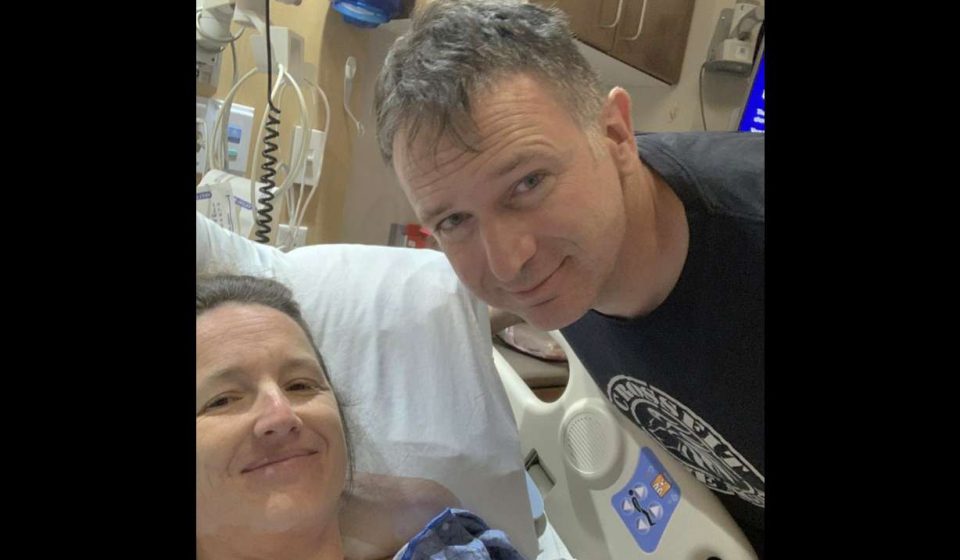

PLEASANT GROVE — When Laura Baxter entered her 40s, she knew she had to get a mammogram.
“I’m a big fan of preventative medicine and it just so happened to be time for my first mammogram earlier this year.”
Baxter, 41, also has a history of breast cancer in her family and has seen her grandmothers endure the disease.
“I’ve seen family members go through this and it can be really, really hard,” she said. “I saw my grandmother and my great-grandmother go through this at the same time. They were both going through it, and they had their own mastectomies and their own treatment.”
So, last March, Baxter had her very first mammogram and doctors discovered that she had ductal carcinoma in situ, which is a non-invasive, stage 0 breast cancer.

“I was like, ‘Oh my God! I can’t believe we got stage 0 cancer,'” she said. “This is unheard of. I didn’t even know it was a thing. But with this imagery, we captured him when he was precocious and small.”
However, due to her family history, Baxter wasn’t taking any chances and therefore decided to have a double mastectomy.
“I’ve been married for 21 years and I always joked with my husband that when it hit me, I was just going to cut them off and not worry,” she said.
It was after her surgery to remove her breasts that doctors discovered more.
“In surgery, an additional tumor was discovered, which was a second type of breast cancer called invasive lobular carcinoma,” she said. “This one is actually harder to detect because the way it grows and the way it forms in your body, it’s very difficult for people to see it on scans.”
This second diagnosis moved Baxter to stage 1 cancer, but thanks to early detection, the cancer was ruled out.
“There’s so much more dignity involved and choice for the patient and I think there’s a deeper understanding of women’s health, which I really appreciate,” she said. “And I wish my grandmother had that experience. I’m grateful I did and I hope it gets better for my daughter as she gets older, too.”
In addition to her family history of breast cancer and her own diagnosis, Baxter opted for more genetic testing so that her two children would have this information as they grew up. What she discovered was that she carries two cancer-causing genes.
“I found that I now had to be very aware of pancreatic cancer and ovarian cancer, and that the men in my family had to be careful about prostate cancer,” she said. “I now have the information I need to do something, take care of it, and pay attention to it sooner.”
Baxter said she realizes her situation is the “best case scenario,” while urging others to also take preventative measures.
“One thing I didn’t realize until going through this process is that if you have a family history of breast cancer, you should have a mammogram 10 years before the younger person is diagnosed,” she said. “So. Because I was diagnosed when I was 41, my family, my sisters and my daughter should start getting scans at 31 to catch things earlier.
“It’s not just ‘Wait until you’re 40,'” she added. “You need to have a little more context and be aware of what’s good for you. … “Know your body and you need to advocate for yourself when you see changes.”
The key takeaways from this article were generated with the help of large language models and reviewed by our editorial team. The article itself is solely written by humans.
Gn Health