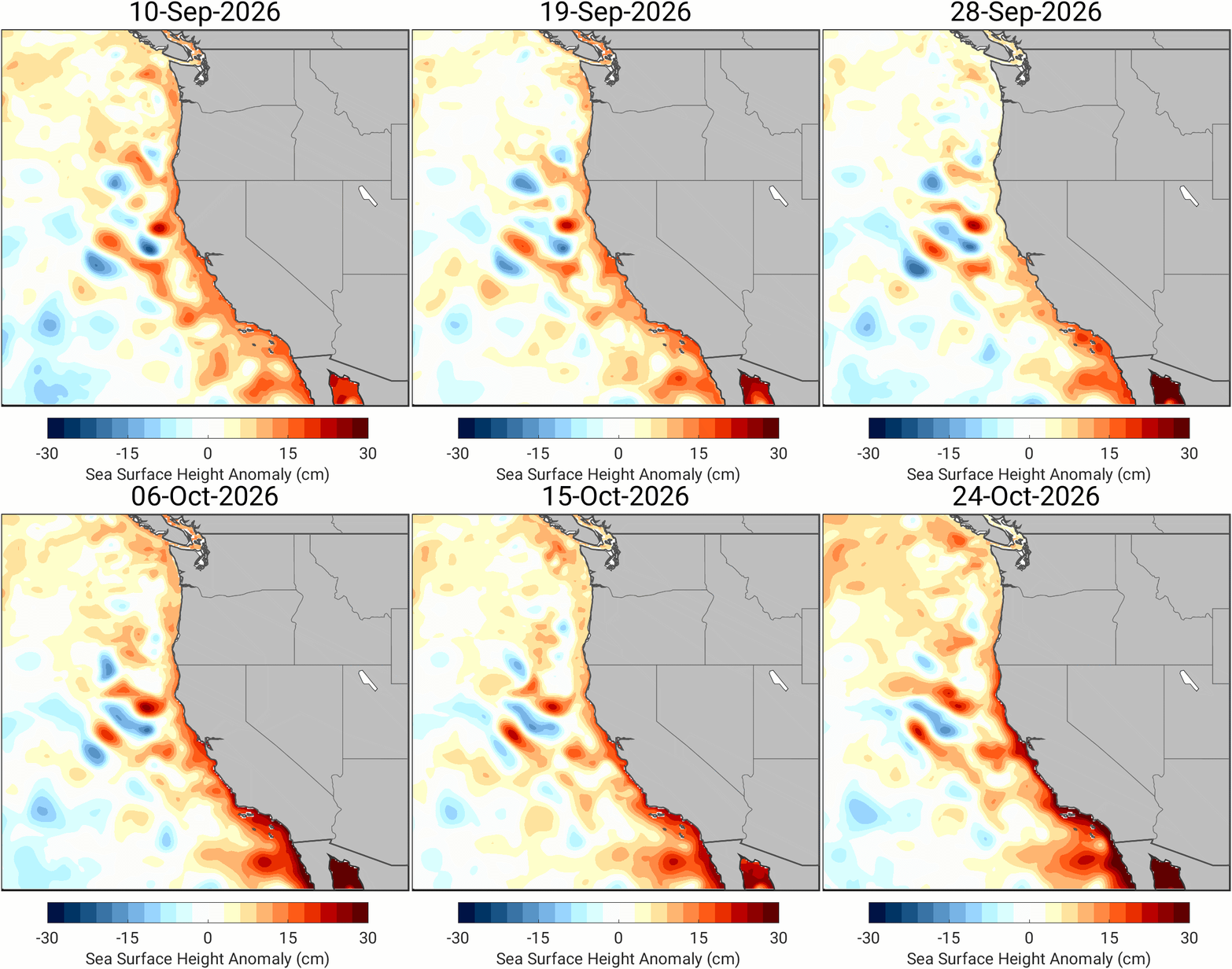


Kelvin waves trapped on the coast move along the west coast. Dark red represents higher than normal sea levels.
Dillon J. Amaya/North Carolina State University
hide caption
Dillon J. Amaya/North Carolina State University
One of the first major signs of this year “Super El Niño” reached the United States. It’s called a Kelvin wave – a deep ocean wave that is currently causing sea levels to rise along the west coast.
Scientists have known about Kelvin waves for a long time, but this year the phenomenon attracted public attention with video explanations that have been viewed thousands of times around the world. TikTok And X.
“It surprises me – I mean, here it’s been around all this time,” says Mark Cane, who created one of the first models to forecast and predict El Niño. “I’m sure Lord Kelvin is happy in his grave.”
(Lord Kelvin, the British physicist who also developed the Kelvin temperature scale, first described the wave in the late 1800s.)

Kelvin waves can develop along the equator during El Niño years, when a large region of Pacific Ocean water becomes much warmer than usual.
Some of this warm water, in the form of a Kelvin wave that extends thousands of kilometers, slowly moves eastward beneath the ocean surface until it reaches South America. Then it splits, traveling north along the west coast and south to Chile.
“It’s like a huge sloshing bathtub,” says Cane, professor emeritus of earth and climate sciences at Columbia University. “But the slosh is very special, because it only goes west to east along the equator in a Kelvin wave.”
It’s not about the massive, highly visible waves that crash onto shores during major storms and hurricanes.
“It’s not a wall of water, it’s not a tsunami, it’s not a wave you can surf on,” says Dillon Amaya, assistant professor of atmospheric sciences at North Carolina State University. “It’s a wave on a planetary scale.”
The impact of a Kelvin wave is gradual, raising sea levels as it moves up the coast and leading to a high risk of flooding and warmer water temperatures.
What is the impact?
Kelvin waves can increase the risk of flooding and coastal erosion.
Kelvin waves alone don’t cause flooding, Amaya says. Instead, they roll the dice, making flooding more likely by raising sea levels.
“It makes the background conditions more favorable for coastal flooding, but what you need are triggering factors,” Amaya said, like a major storm or very high tides.
Josh Willis, a climate scientist at NASA’s Jet Propulsion Laboratory, says Kelvin waves increase the risk of a “triple whammy” along the California coast: “El Niño, high tide and storm surge arrive at the same time.” »
This is exactly what some Southern California communities experienced in early October. Sea levels were already higher than normal because of the Kelvin wave – about six to eight inches, Amaya said. Then, when Tropical Storm Rachel hit, a storm surge flooded neighborhoods and left the seaside partially submerged houses.
“This storm surge was definitely made even more devastating because of the Kelvin wave,” says Amaya.
Warmer water temperatures

Kelvin waves travel slowly eastward beneath the ocean surface until they reach South America. Then they split up, traveling north along the west coast and south to Chile. Dark red represents higher than normal sea levels.
Dillon J. Amaya/North Carolina State University
hide caption
Dillon J. Amaya/North Carolina State University
Kelvin waves also bring warmer waters to the coast, which can be disruptive and stressful to marine life.
“We saw tropical fish in places where we don’t usually see them,” says Amaya. “As if a whale shark had been spotted off the coast of San Diego.”
The Kelvin wave can bring down cold, nutrient-rich waters that support productive marine ecosystems. Amaya says researchers have already seen evidence of seabirds die in response to warmer water temperatures along the coast.
When is the next Kelvin wave?
There are typically five to six Kelvin waves during a strong El Niño year, says Amaya.
Amaya predicts the next Kelvin wave will reach San Diego in late October or early November. Several more waves are expected during the fall and early winter, he said. Kelvin waves generally weaken before the peak of El Niño.
The El Niño phenomenon generally peaks at the end of the year or the beginning of January. This year, NOAA researchers predict that El Niño stay strong until early 2027.
Gn headline