Elon Musk has permission to launch 1 million satellites. Astronomer explains what impact it would have on the sky

This week, on the eve of the Thanksgiving holiday, the US Federal Communications Commission approved SpaceX’s plan to launch one million “Starmind” artificial intelligence (AI) data center satellites. The move reflects the convergence of a satellite boom, an AI bubble and the Trump administration’s disregard for environmental regulations.
If Starmind fully unfolds, the number of operational satellites will increase 50-fold. Space and our night skies will become much busier places.
SpaceX’s goal is to shift the impact of data centers away from Earth, using a million solar-powered satellites to analyze AI data in space and transmit the results back to Earth.
But what is the impact of a million satellites, both in space and on Earth? Why did the Federal Communications Commission make this decision? And will a million satellites actually end up in orbit?
Ups and downs
We are currently experiencing a satellite boom, and constellations of hundreds or thousands of satellites are a key part of this.
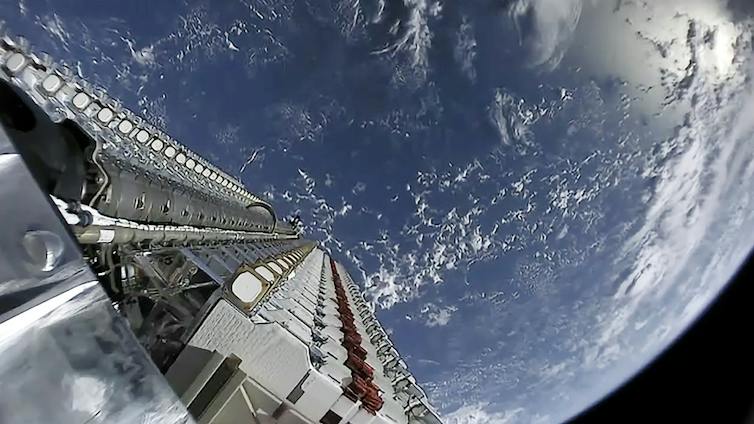
The Starlink internet satellites (another SpaceX project) are the best-known example of such a constellation. Orbital rocket launches have increased to nearly one per day, while the number of operational satellites approaches 20,000.
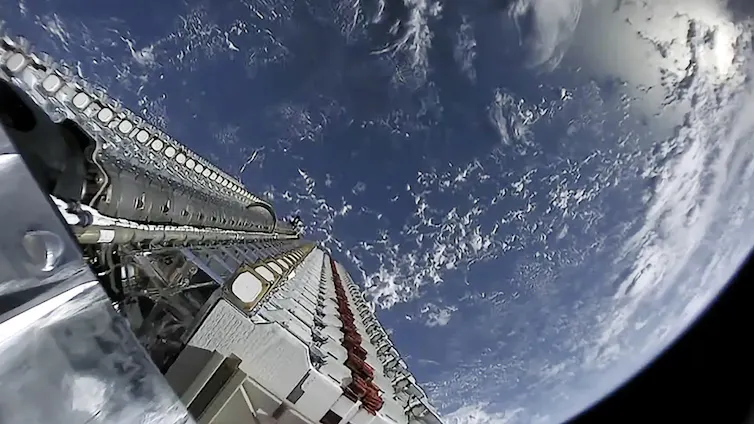
EspaceX
But Starmind represents something else. A million satellites.
Putting that many satellites into orbit would be a massive undertaking. If the satellites have a lifespan of five years (like the Starlink satellites), then around 500 satellites would need to be launched each day.
This also implies that eventually around 500 satellites would have to be destroyed every day. For satellites less than 2,000 kilometers above Earth, their removal usually means re-entry and burning up in the atmosphere. And that has consequences.
When satellites burn up in the atmosphere, their materials react with and are deposited in the upper atmosphere. We now have satellites that deposit far more aluminum, titanium, copper and lead into the atmosphere than the natural amounts coming from meteors.
Aluminum is of particular concern, because alumina can lead to the destruction of ozone in the upper atmosphere. This could increase ultraviolet light on Earth and the risk of skin cancers.
It’s starting to get busy
Multiplying the number of satellites by 50 will change our vision of the sky.
If you look up in the early evening, you will see the stars that your ancestors saw. But in a minute or two you will see a satellite. A point of light moving silently from one horizon to the other.
Our view of the night sky could fundamentally change.
Each satellite would be 75 meters wide and, in the early evening, would be brighter than any star. And with a million satellites in orbit, there will be hundreds of Starmind satellites above the horizon, wherever you are.
Orbital clutter carries real risks.
Satellites move at speeds of about seven kilometers per second, and collisions produce clouds of debris that can cause further collisions. A nightmare scenario is Kessler syndrome – an uncontrollable cascade of collision-producing debris that renders low Earth orbit unusable.
Of course, SpaceX is aware of the risks of orbital collisions, and is already mitigating this risk with Starlink by moving satellites away from potential collisions. However, such maneuvers require operational satellites and it is inevitable that some satellites will fail.
These uncontrolled satellites will constitute a real danger.
Regulator or promoter?
The Federal Communications Commission is a key regulator for U.S. satellites. This includes the regulation of radio frequencies used by satellites for communications to and from Earth, the disposal of satellites at the end of their useful life, and environmental impacts.
However, under the Trump administration, the commission is taking a more lenient approach to satellite regulation. This does not include any consideration of environmental impacts, which is reflected in the commission’s decision on Starmind. It states that the commission “will not require further environmental review under the National Environmental Policy Act (…) for SpaceX’s Starmind system.”
There are also some statements from the commission about Starmind that are, frankly, bizarre. For example, he claims that Starmind “promises to bring the human race closer to a Kardashev II civilization – a civilization capable of harnessing the full power of the sun.”
This is science fiction nonsense. A Kardashev II civilization would need several billion square kilometers of technology orbiting the Sun. Starmind is not a stepping stone to a vast “Dyson Sphere” – a hypothetical megastructure that would surround the Sun and capture its energy.
But can it work?
One reason data centers are so unpopular on Earth is their use of valuable resources, including water to cool hot computer processors. But cooling in space is even more difficult. When you’re stuck in a vacuum, you can only radiate heat. And if you’re familiar with vacuum bottles, you’ll know that it can be a slow process.
Of course, it is possible to regulate heat in space, and satellites do this all the time. But they generally don’t give off heat like data centers do.
Google recently launched an AI demonstrator satellite into orbit and tasked it with performing AI calculations. But there had to be some downtime between calculations to remove excess heat.
And besides physics, there is finance.
We are currently experiencing an AI boom, with investment flows far exceeding revenues. And the cost of deploying AI in orbit will be much higher than that of equivalent AI on Earth.
If the AI boom is a bubble, then the burst may bring Starmind back to Earth.
Gn bussni