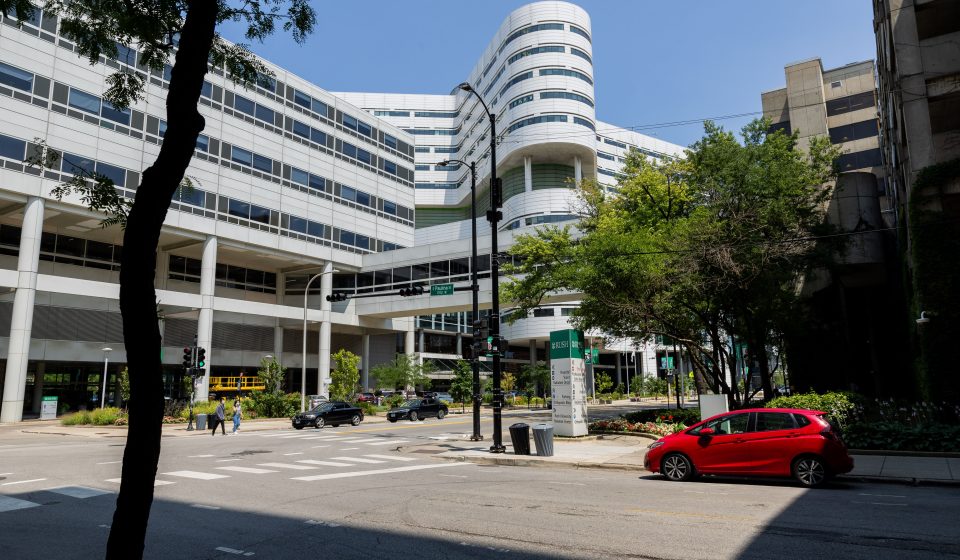

Two major Chicago-area hospital systems — Endeavor Health and Rush University System for Health — announced plans Wednesday to merge, a union that would create one of the largest health systems in Illinois.
If the merger goes through, all hospitals in the system will include “Rush” in their name, and the name “Endeavour” will eventually disappear.
Endeavor and Rush hope to close the deal in early 2027, pending regulatory approval. The combined system would include 12 hospitals, more than 46,000 employees and more than 400 care sites.
The merger would allow Rush — which has three hospitals in Chicago, Aurora and Oak Park — to reach more patients in additional geographies, said Rush Chairman and CEO Dr. Omar Lateef. He said he expects the merger will “dramatically improve care across the state of Illinois.”
It would also allow the nine-hospital Endeavor system to benefit from Rush University Medical Center’s strong reputation as a premier academic medical institution. Rush University Medical Center tied with Northwestern Memorial Hospital for the state’s best hospital this year in U.S. News & World Report’s annual rankings.
System leaders said they expect patients to have more access to care closer to home and clinical trials. The merged system would also likely open more outpatient care sites, said JP Gallagher, Endeavor’s president and CEO.
Endeavor now has hospitals in Evanston, Glenview, Highland Park, Skokie, Arlington Heights, Elmhurst, Naperville and Chicago.
When asked if the merger would result in job losses or layoffs, Lateef said, “We’re doing this to grow and we want to increase our footprint. We want to grow in the state of Illinois. We expect an increase in jobs.”
Under the deal, Endeavor would dedicate $1 billion of its endowment to the new system’s efforts, including $300 million to reduce health care disparities in its communities; $500 million for Rush University to expand its programs, research and clinical trials; and $200 million to improve quality and care.
Once the merger is completed, Gallagher would be named president and CEO of the system. Lateef, along with Rush, previously announced plans to retire from his leadership role in 2027. Lateef would remain in his current role until the deal closes, then serve as CEO emeritus and strategic advisor to the CEO.
The deal still needs approval from state and federal regulators, who could review it to determine whether it would reduce competition and raise prices.
Some researchers have found that hospital consolidation leads to higher prices for insurance companies, and those costs can be passed on to consumers through higher premiums and other payments. Hospitals have long disagreed with this notion, saying consolidations can lead to cost savings and better quality of care.
Endeavor has been thwarted by federal regulators in the past. The Federal Trade Commission challenged a previous deal that would have merged NorthShore University HealthSystem, as Endeavor was once called, and Advocate Health Care. The two systems backed out of the planned merger in 2017 after a federal judge ruled in favor of the FTC.
Gallagher said, however, that Rush and Endeavor had already begun discussions with regulators and expected “the process to go smoothly.” He said he was optimistic the deal would close in early 2027 as planned.
He also said that expanding the system to increase leverage with insurers is not a driver of the merger, noting that many of the systems’ patients are on Medicare and Medicaid, which are government-funded health insurance programs.
“We believe that to be able to achieve this at scale, we need to be able to deliver care efficiently and in a way that is accessible and affordable,” Gallagher said.
He said one of the goals of the merger was to create a stable and strong system for the long term.
News of the merger follows the closures of West Suburban Medical Center in Oak Park and Weiss Memorial Hospital in Uptown. It also comes as a number of hospitals have eliminated their labor and delivery units, and others are on the verge of closing.
“When I think about some of the headlines we see regarding health care in Chicago, they are sobering: Hospitals closing, service lines limited,” Gallagher said. “We are moving in the opposite direction. »
Both Endeavor and Rush are in “a healthy situation today,” he said. Both organizations have reported positive operating margins so far this year, according to financial statements.
Endeavor’s positive numbers, however, follow the challenges.
Endeavor reported operating losses of $494 million in 2024 and $33.9 million in 2025, according to financial statements. Much of the 2024 operating loss was attributable to $453 million in expenses to settle patient claims alleging that one of Endeavor’s former doctors sexually abused them, Endeavor said in a late 2024 financial filing.
Gallagher said those prior losses were not motivation for the merger, and that some of those losses were expected as Endeavor worked to integrate additional hospitals into its system.
Endeavor has seen rapid growth in recent years – and if the merger is successful, it won’t be the first time it has had to redo its entire signage.
Since 2020, when it was still called NorthShore, the system acquired Swedish Hospital in Chicago, Northwest Community Healthcare in Arlington Heights and merged with the system that was under Edward Hospital in Naperville, Elmhurst Hospital and Linden Oaks Behavioral Health.
After all this growth, NorthShore changed its name to Endeavor in late 2023.
For this new proposed merger, systems executives agreed that Rush would be the best name for the hospitals going forward. Hospitals will keep their locations in their name.
“It’s been around for 150 years,” Gallagher said of Rush, “and as we thought about creating a unique organization, we thought it was important to make sure that identity was consistent as well.”
Endeavor first contacted Rush in March about a possible merger, Gallagher said.
The merger would place the new system among the largest in the state. Northwestern Medicine has 11 hospitals, Prime Healthcare has nine hospitals in Illinois, and Advocate Health Care has 11 hospitals, including its children’s hospital on two campuses.
Gn bussni