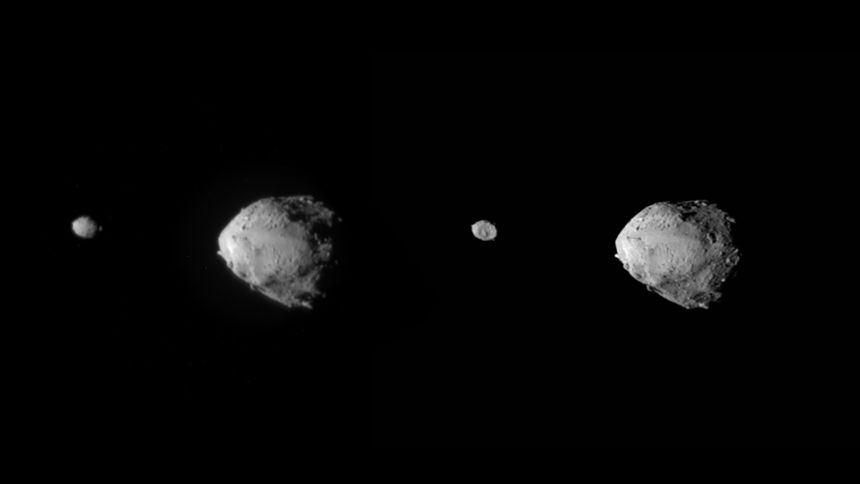
NASA’s DART spacecraft moved an asteroid called Dimorphos four years ago in humanity’s first test of planetary defense — a movie-worthy mission to explore whether it’s possible to stop an asteroid from hitting Earth. Today, scientists are taking a closer look.
The European Space Agency’s Hera spacecraft arrived at the asteroid to assess the damage and investigate what exactly happened when DART, or Dual Asteroid Redirection Test, slammed into the space rock at 14,000 mph.
The ESA released the first images from the mission on Wednesday and shared some intriguing early observations, including a stadium-sized crater that flattened one of the asteroid’s previously rounded faces and the surprise discovery of rocks encircling the asteroid.
“It’s a big crater almost as big as the body itself, which is really spectacular,” Sabina Raducan, a planetary scientist at the International Institute of Space Sciences in Bern, Switzerland, and the Free University of Brussels in Belgium, said at a news conference in Berlin. She is part of the Hera mission team.
Hera, which launched in October 2024, arrived at Dimorphos three weeks ago and is currently about 30 kilometers (19 miles) from the space rock, which orbits a larger asteroid named Didymos in what is called a binary asteroid system. Neither Dimorphos nor Didymos pose a danger to Earth, but Dimorphos’ size is considered comparable to asteroids that could threaten our planet, making it an ideal testing ground.
The impact of the DART 2022 mission also sent Dimorphos, which is 151 meters (495 feet) wide, into a chaotic fall, according to initial observations.
“Before the DART impact, Dimorphos was more like our own moon: it always showed the same face,” Raducan explained, adding that Dimorphos now moves like a “barrel that you throw down the stairs.”
The rest of Dimorphos shows no signs of major changes: the rock fields covering its other regions look exactly like those in the 2022 DART images, the ESA noted.
Astronomers used telescopes on Earth to assess the impact and consequences of NASA’s DART mission, finding that the time it took for Dimorphos to orbit Didymos was shortened by 33 minutes, much more than expected.

While it was clear that the DART impact moved a large amount of rock and dust, Hera’s arrival is the first opportunity for scientists to understand the consequences of the DART mission in detail and refine technology and strategies that could one day divert asteroids on their impact path. Earth.
The press conference took place in the Dinosaur Hall of the Natural History Museum in Berlin, which the ESA said was a fitting reminder of the importance of the mission. Most dinosaurs became extinct after a city-sized space rock hit the planet 66 million years ago, leaving an indelible mark on Earth’s history.
The biggest surprise of Hera’s initial observations is that hundreds of previously unknown rocks surround the pair of asteroids, including more than 100 that are between the size of a soccer ball and a washing machine, said Naomi Murdoch, a planetary scientist at the University of Toulouse who is part of the mission team.
“As we approached Didymos and Dimorphos, we quickly realized that the asteroids were not alone,” Murdoch said during the briefing. “They actually had a lot of company.”

The origin of the rocks is unclear. “We can’t say today, with the information we have, whether it was debris from the DART impact or whether there is another origin, for example, from the primary asteroid,” Murdoch said, adding that scientists need more time to determine where the rocks came from and why.
Asked if DART would have observed the rocks in 2022 if they were already there, Raducan said the mission may be moving too fast to make such an observation.
Margherita Cardi, a space engineer and executive at Tyvak International who oversees Milani, one of two CubeSats aboard the car-sized Hera spacecraft, said the discovery of the rocks three weeks ago was a “nightmare” challenge for her team.
The two satellites, equipped with scientific instruments, are expected to be released in January and are expected to venture close to Dimorphos and then land there. However, the rocks pose a collision risk, Cardi said.
“We can address these challenges and understand what technical approach we can describe and create to survive,” she said. “So there’s a mixture of excitement and panic.”
In December, the spacecraft is expected to approach the asteroid at a distance of about 13 kilometers (8 miles) to take higher-resolution images and make critical observations that will allow scientists to calculate Dimorphos’ mass.
“With the Hera measurements of mass, we will then be able to see exactly how effective and efficient the impact of DART has been,” Murdoch said.
This information, the ESA added, will help improve models used to predict how other asteroids might respond to deflection attempts. The mission is also the first to investigate and explore a binary asteroid, which is currently 193.5 million kilometers (120.3 million miles) from Earth.
“Sixty-six million years ago, an asteroid impact changed the course of life on Earth,” Hera mission manager Ian Carnelli said in a statement. “Today, for the first time in history, humanity is validating how to prevent such an event from happening again. »
Gn headline