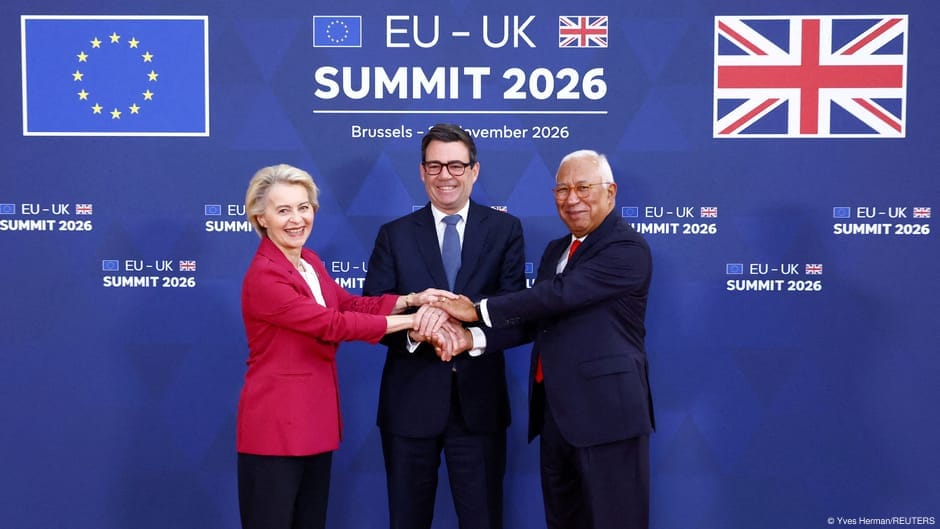
Senior European Union officials and British Prime Minister Andy Burnham announced deals on trade and youth mobility at the Brussels summit on Friday.
It could be the first step towards rebuilding ties, a decade after Britain voted to leave the EU.
At the meeting of delegations, Burnham said the agreement was a “historic agreement”, while European Commission President Ursula von der Leyen called it a “turning point” in relations.
“A Good Day for Britain” and “A Good Day for Europe”
“It’s a good day for Britain. It’s a good day for Europe,” Burnham said.
Speaking at the joint news conference, European Council President Antonio Costa said the bloc respected Britain’s decision to leave the EU and would respect its choice to strengthen ties in the post-Brexit era.
He joked that the EU and UK “may be driving on opposite sides of the road, but what matters is that they are heading in the same direction.”
Burnham said the deals had been made with young people in mind, adding: “This deal is for you. This deal is really about increasing your life chances.”
“Brexit has taken away opportunities for young people”
He went further and said that “Brexit has taken away opportunities from young people” and they need to “open up new opportunities” for young people.
Von der Leyen said the youth experience project would “open horizons and create friendships that will last a lifetime.”
She said the trade deal was a “two-way street” and meant “more choice for customers”.
Von der Leyen also spoke about the carbon market deal, saying it would reduce emissions and generate investment in cleaner industries.
She also said Britain would rejoin the Erasmus+ programme, adding: “We miss them so much.”
Burnham said the deals reached on Friday, however, represented all the UK could achieve at present. “What we are announcing today is probably the limit of what we can achieve in this Parliament, given what needs to be done to implement it.”
In September, Burnham said he would seek political consensus on the country’s future relationship with the EU, even suggesting he could campaign to bring Britain back into the EU at the next election.
“Britain and Europe share values, interests and a global neighborhood. In a more dangerous world, we are stronger together. A closer partnership with Europe is good for workers, good for Britain and good for Europe,” Burnham said on his arrival in Brussels.
What are transactions?
The three key agreements establish ways to:
- Simplify food exports by reducing red tape
- Linking the UK and EU emissions trading systems
- Set up a youth experience system
The “youth experience program” would allow 100,000 people under the age of 30 from each side to reside for up to three years in the other’s territory to work, study or travel without being subject to existing visa requirements.
No deal was reached on tuition fees for EU students studying in Britain, ending the deal for the bloc. The EU has been pushing for the UK to reduce university tuition fees for EU students to the same level as those paid by UK students.
“Further discussions will arise from this on issues such as tuition,” Burnham said.
Von der Leyen said she was confident negotiators would reach a solution on tuition fees, “We will work on this next month and as we are used to finding solutions.”
On the food deal, the EU and UK agreed to remove certificates and border controls on food and animal products to facilitate post-Brexit trade. In return, Britain will align more closely with EU rules on food safety and animal health.
They also agreed to link their emissions trading systems, allowing them to recognize each other’s carbon quotas and exempt traded goods from carbon taxes at borders.
According to the AFP news agency, London estimates the deal could boost the British economy by 3.8 billion pounds a year and save 6.5 billion pounds of exports of steel, aluminum and other industrial products from additional taxation.
The leaders said they would establish a “structured dialogue on migration”. Their joint statement at the summit said this would include, among other issues, “engagement with third countries” and “returns to third countries”.
The two sides agreed to launch formal negotiations on economic security and strengthen cooperation on export controls and supply chains, among other areas.
What do the British think about Brexit today?
On Monday, Burnham said it was a “self-evident truth” that “Britain had lost more than it had gained from Brexit”.
Polling company YouGov regularly tracks whether the UK was right or wrong to vote to withdraw.
Since mid-2022, a majority of those surveyed believe that Britain was wrong to leave. In September, the “Bregret” camp rose to 60%, the highest level ever reached.
Gn world