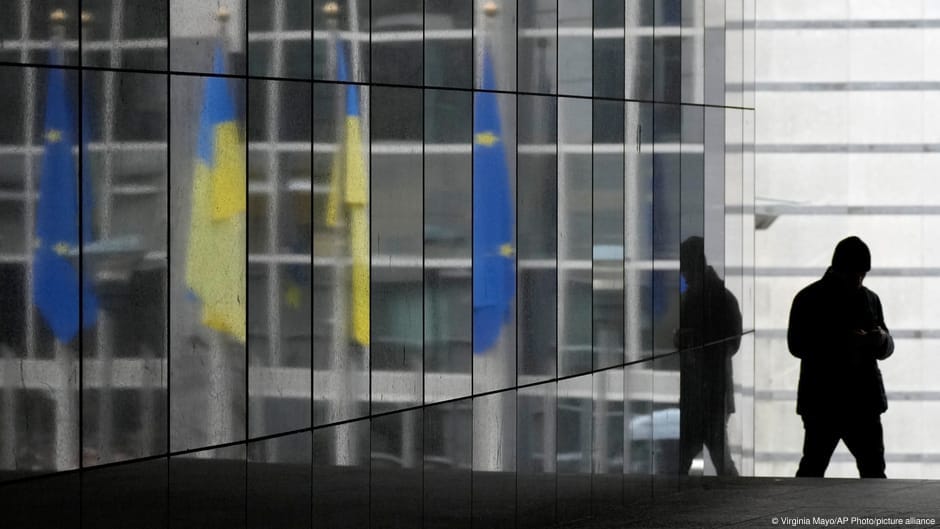
EU leaders arrived in Brussels bracing for a tough showdown over the bloc’s multibillion-euro seven-year budget. But few expected the summit to move so quickly, with negotiations breaking down Thursday evening.
Quarrels and thinly veiled public barbs meant they left without an agreement and did not even attempt to resume talks on the second scheduled day.
He imposed a deadline to find an agreement before the end of 2026 on the budget which covers the period 2028-2034. But experts say there is no reason for alarm yet.
“Every time there are long-term European budget negotiations, there are breakdowns, chaos, recriminations and a lot of political theater and drama,” said Jacob Funk Kirkegaard, a European economist and expert at the Bruegel think tank in Brussels.
This time, the center of this political theater was the prime ministers of Denmark, Sweden, Belgium and Austria – countries seeking a reduced budget – who staged a walkout at smaller group meetings, saying the atmosphere had not been constructive for reaching an agreement.
Hungarian Prime Minister Peter Magyar called the entire summit “completely useless”, pointing the blame at the feet of the man who decided to organize it and whose role it is to mediate the negotiations, European Council President Antonio Costa.
Costa was diplomatic in defending his decision to bring the leaders together in Brussels, telling the press: “For me it was very useful to determine the parameters of a possible landing zone in December.”
Germany demands more in terms of competitiveness, security and defense
Well before the summit began, Germany had issued an ultimatum: Berlin would only approve the budget if all other EU countries gave the green light to an additional support loan of 45 billion euros ($49 billion) to Ukraine to finance the country’s war efforts until 2027.
Hungary, Czechia, Bulgaria and Slovakia opposed the proposal, insisting that giving Ukraine money to buy weapons would prolong the war. Slovak Prime Minister Robert Fico even accused Germany of “blackmail”.
As Europe’s largest economy, Germany’s contribution amounts to around 25% of the total budget.
At a press conference after the summit, German Chancellor Friedrich Merz said “hundreds of billions” still needed to be cut. The European Commission’s initial proposal of around €1.786 billion had already been reduced by €204 billion (down 10.2%).
“Europe must show a sense of proportion,” Merz said. “The budget cannot grow indefinitely and the burden of financing it must be distributed equitably.”
Merz also sent a comment to Costa, who updated the details of the draft budget at each stage.
“The proposals that have been on the table so far do not constitute a basis for an agreement,” Merz said.
Costa told leaders on Thursday he planned to cut between 220 billion and 230 billion euros from the next proposal.
Berlin’s budget-cutting efforts are supported by six other countries that together call themselves the “Sensitive Seven.” Everyone contributes more to the EU’s collective financial pot than they receive.
They are opposed by 17 EU member states who insist the total budget should increase, led by France and Italy. These countries call themselves “Friends of Cohesion” – a nod to the EU’s cohesion funds which are used to share the wealth of the EU’s richest regions and nations with its poorest.
In the current proposal, spending on agriculture, fisheries and cohesion decreases from 59.1% to 42.4%, while funds for economic competitiveness, security and defense increase from 17.7% to 27.7%. This rebalancing is a key German demand.
EU looks elsewhere to raise funds
The EU is also looking for a way to add money to the budget that does not come from national contributions. The current proposal includes a controversial EU-wide digital tax, which could pave the way for a major battle with the United States.
The idea, initially put forward by French President Emmanuel Macron, involves a 3% tax on revenue from online advertising, online marketplaces and the monetization of user data. This money, which will be paid directly to the EU budget, is expected to bring in 5 billion euros per year.
But the proposal is raising alarms in Ireland, where US tech giants like Google, Meta, Apple, Microsoft and LinkedIn have their European headquarters.
“A digital tax sends the wrong messages,” said Irish Prime Minister Michael Martin, who could still veto the proposal.
Protecting the EU’s top triple A rating
Some European capitals fear that, without being able to generate their own funds, future EU loans could damage the European Commission’s impeccable position in international markets.
The EU has around 860 billion euros in debt taken on to finance the recovery from the pandemic and to support Ukraine. Its triple-A credit rating could be downgraded if Marine Le Pen, the far-right candidate in the French presidential election, wins in the spring and keeps her promise to reduce French contributions to the EU budget.
EU member states that favor a financing model through national contributions rather than tax revenues “understand very well what will happen if the EU loses its triple A,” said Kirkegaard de Bruegel. “The costs of interest rates will increase further. Who should pay for this? The net contributor countries, like Germany, the Nordic countries, the Netherlands, that’s why they are much more open to this than in the past.”
Other European tax experts say past examples of these digital taxes show that the costs outweigh the benefits.
“We analyzed states that have a digital services tax (DST) and found that the economic cost exceeds the revenue generated,” said Cristina Enache, an economist at Tax Foundation Europe, a Brussels-based nonprofit. “Spain has a DST and the expected revenues were two or three times what they actually receive.”
Enache called the tax proposal “politically impossible.”
EU leaders know the clock is ticking on their end-2026 deadline and they will return to the same conference rooms at the end of December in the hope of a more conducive atmosphere for striking a deal.
Gn world