EU drops sponsorship of disinformation conference at request of Trump officials | Trump administration

The Trump administration pressured several countries to withdraw their sponsorship of a high-profile European conference on disinformation, with Canada, Lithuania and the EU diplomatic service subsequently agreeing to do so, according to reports from the Guardian.
The #Disinfo2026 conference, which takes place Wednesday and Thursday, is the annual meeting of the European community fighting disinformation and has attracted hundreds of researchers, journalists, technologists and policy makers to a hotel in Vilnius, Lithuania. It is managed by an independent Brussels non-profit organization, EU Disinfo Lab.
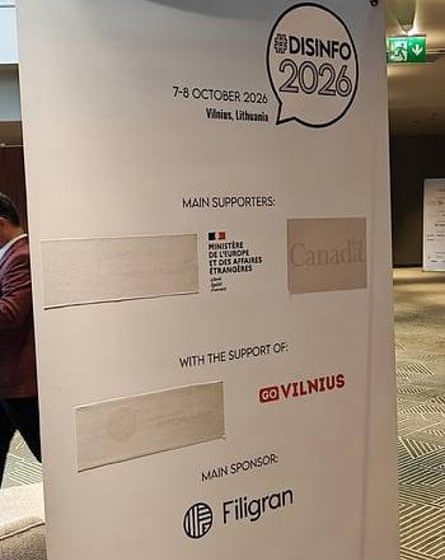
Days before the conference, the logos of its main supporters – the Lithuanian Ministry of Foreign Affairs, the European External Action Service (EEAS) and Global Affairs Canada, the country’s foreign ministry – were scrubbed from its website.
Photos from the event shared with the Guardian also show white stickers affixed to the logos of these organizations printed on official conference materials, appearing to indicate that they were hastily excluded from the program.

Three people familiar with the matter, including European officials, confirmed that the US State Department had been in contact with several governments about their support for the conference.
Internal State Department documents seen by the Guardian also show US officials thanking Lithuania for “taking US concerns seriously”. The document said Washington was “grateful” that Lithuania supposedly found “objectionable and surprising” a panel describing the United States as a foreign information threat and welcomed its decision to limit its participation in the conference.
That panel — titled “The United States as a FIMI Threat: Adapt, Recognize, Repend,” with the acronym FIMI referring to “foreign information manipulation and interference” — took place on Wednesday. It explored how the European disinformation community could rebuild its resilience without Washington, and is the first time the conference appears to have considered the idea that the United States could be a disinformation actor in Europe. Sources and the internal document indicate that the State Department explicitly focused on this panel, which included three American speakers, including a former CIA officer.
Other communications appeared to come from the office of Sarah B Rogers, the US undersecretary of state for public diplomacy, according to a person familiar with the deliberations.
Nina Jankowicz, a former U.S. official and disinformation expert who briefly in 2022 led the Biden administration’s Disinformation Governance Council, which Republicans attacked as a way to control Americans’ speech, said she understood that Washington had pressured Lithuania and Canada to withdraw from the conference. The Guardian has learned from French authorities that France had also been contacted.
“This amounts to a supposed free speech advocate at the State Department using the enormous power of the U.S. government to try to pressure Americans not to criticize their government,” Jankowicz said.
In statements, Lithuania, Canada and the EU said the conference agenda did not match their official views on the U.S. role in disinformation — even though that agenda had been in place for months before they withdrew support, starting in June.
“Lithuania has canceled its participation in ‘Disinfo 2026’ because several parts of the conference program differ from the government’s official position,” the Lithuanian Foreign Ministry wrote in a statement.
Global Affairs Canada “carefully evaluates participation and sponsorship of external events on a case-by-case basis,” said GAC spokesperson Samantha Lafleur. “Following changes in the framing of several roundtables, GAC has decided to review its participation in these sessions during the EU DisinfoLab 2026 conference.”
Canadian officials are still participating in the conference, Lafleur added.
An EU spokesperson confirmed that the European External Action Service had decided to withdraw its support for the conference because “organizers chose to frame certain discussions in a way that does not correspond to official positions defended by the EU.”
EU officials, according to the Guardian, disagreed with the characterization of the United States as a disinformation actor.
Despite withdrawing its image of official support, the EU continues to fund the conference.
In its latest report on threats of foreign information manipulation and interference, published in March, the EU diplomatic service called Russia and China “threat actors,” with no negative reference to the United States.
A diplomatic source at the French Foreign Ministry said “there is absolutely no reason for us to change our commitments” in supporting the conference.
“We stick to the support of civil society. It’s not just a matter of principle, it’s operational,” she said, adding that the conference was a “laboratory” that helped Europe develop key policy on disinformation.
The US State Department has adopted an increasingly interventionist posture towards free expression and civil society in Europe over the past year. The Guardian revealed that the State Department was awarding millions of dollars in non-competitive grants to mainland organizations that support Trump’s agenda.
Lithuania’s withdrawal comes just after Prime Minister Mindaugas Sinkevicius said Lithuania would pay for a permanent U.S. military base if the United States agreed, a day after Trump said he would consider the request. Sinkevicius called an enduring U.S. presence a key guarantee of deterrence against Russia.
“They are great people, so we will certainly think about it,” the US president said on Monday.
Sinkevicius said he first proposed the idea in a meeting with Trump envoy John Coale and called it a “critically important deterrence and security safeguard.” Lithuania, a member of the EU and NATO, borders Russia and its close ally Belarus.
The United States has maintained a rotating armored battalion of nearly 1,000 troops in the country since 2019, the U.S. Army noted.
Gn world