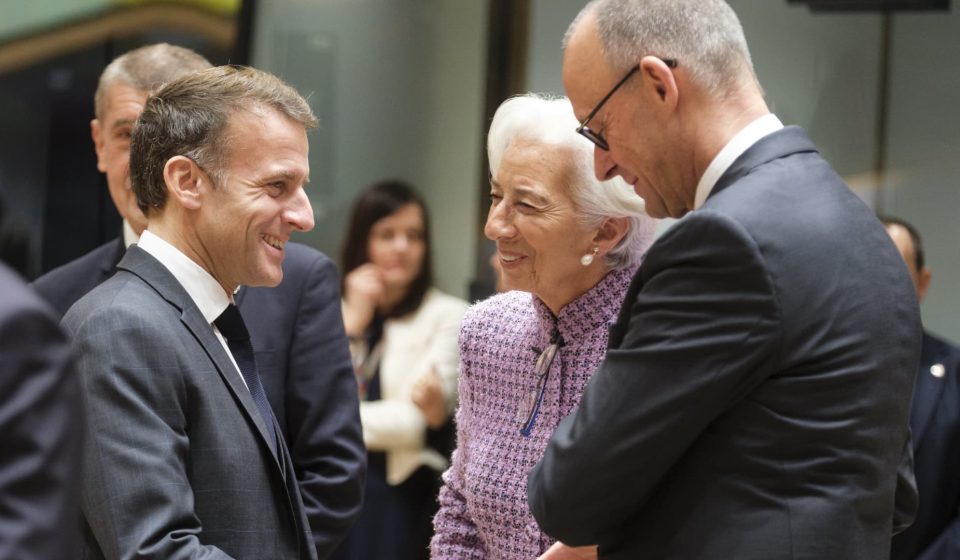
Czech Prime Minister Andrej Babis speaks with French President Emmanuel Macron, European Central Bank (ECB) President Christine Lagarde and German Chancellor Friedrich Merz before an EU summit at the EU Council headquarters on November 26, 2026 in Brussels, Belgium.
Thierry Monasse | Getty Images
European leaders failed to break the deadlock over the EU’s next long-term budget on Thursday, leaving negotiators under pressure to meet their year-end target before the busy 2027 election cycle adds new complications.
National leaders are divided over the European Union’s next long-term budget, which sets spending priorities and limits from 2028 to 2034. Its adoption requires unanimous approval of all 27 member states, as well as a majority vote in favor of members of the European Parliament.
Representatives of EU member states met on Wednesday and Thursday to discuss European Council President António Costa’s latest budget proposal, which represents a spending plan worth 1.58 trillion euros ($1.73 trillion). This is a downward revision of around 10% from initial proposals for the bloc’s long-term budget, known as the multiannual financial framework, or MFF.
The EU budget negotiations come against a backdrop of rising public borrowing costs, soaring inflation and sluggish growth across much of the continent, as well as concerns about rising budget deficits in various EU countries.
Missing the year-end deadline for budget approval risks deepening the political impasse at the center of the ongoing negotiations.
Budget negotiations at risk of withdrawal
At a summit in Brussels on Thursday, budget negotiations lasted 12 hours, according to a BBC report – with some participants reportedly leaving the meeting as conflicts emerged over spending priorities and aid to Ukraine.
A spokesperson for the European Commission was not available to comment on Thursday’s discussions.
German Chancellor Friedrich Merz told reporters Thursday evening that the negotiations had resulted in “new movement” toward reducing the overall budget amount, adding that leaders would meet again in mid-December to resume negotiations.
But he also said: “The European Union has 27 member states, not 23 or 24.”
Merz, alongside the leaders of Denmark, the Netherlands, Austria, Finland and Sweden, said in September that the initial 2 trillion euro proposal should be reduced by “several hundred billion euros.”
“We must make choices,” they said in a letter to Costa and Irish Taoiseach Micheál Martin, pointing out that their six countries fund almost 40% of all contributions to the budget.
They called for funding to be focused on defense spending, competitiveness and innovation as well as “the fight against irregular migration”.
Costa described the revised budget plans as “realistic” when he presented them last week, pointing out that despite cutting spending by 10.2%, the proposals still represented a 120% increase in competitiveness funding and a 232% increase for defense compared to the current budget.
“We have not reached an agreement,” he said in a statement after Thursday’s meeting. “As for the overall volume of the budget, some member states requested further cuts, most opposed them. And some even proposed reversing some cuts.”
Some European parliamentarians also do not seem convinced by the new proposals.
“Parliament is coherent and proposes more investments, (the) Council is incoherent and proposes cuts,” Romanian MEP Siegfried Mureşan said on Wednesday.
“When the Council finally reaches a position, that is when the negotiations will begin, not when they end. Just as prime ministers cannot dictate to national parliaments, neither can prime ministers dictate to the European Parliament to adopt a budget that is too small and does not prepare Europe for the future.”
National elections pose risks for the EU
Elections are expected to take place in major EU economies, including Spain, Poland and Italy, over the next 12 months, while the French presidential election this spring is at the forefront of regional leaders’ minds.
France’s current presidential candidate, far-right candidate Marine Le Pen, has already called on the country to leave the EU and reduce its contributions to the bloc’s budget.
Outgoing French President Emmanuel Macron stressed on Thursday that he had little time left to comment on EU spending.
“After December 31, I will no longer be able, politically or democratically, to reopen discussions on the budget and bring them to a conclusion, because we will enter a period far too close to the presidential election in France,” he told journalists after the negotiations, according to France 24.
France, the EU’s second-largest economy after Germany, is tasked with slashing spending to bring its 5.1% national deficit closer to the EU guideline of 3%, while reeling from months of mass protests, riots and strikes over education funding and a cost-of-living crisis.
Gn headline