
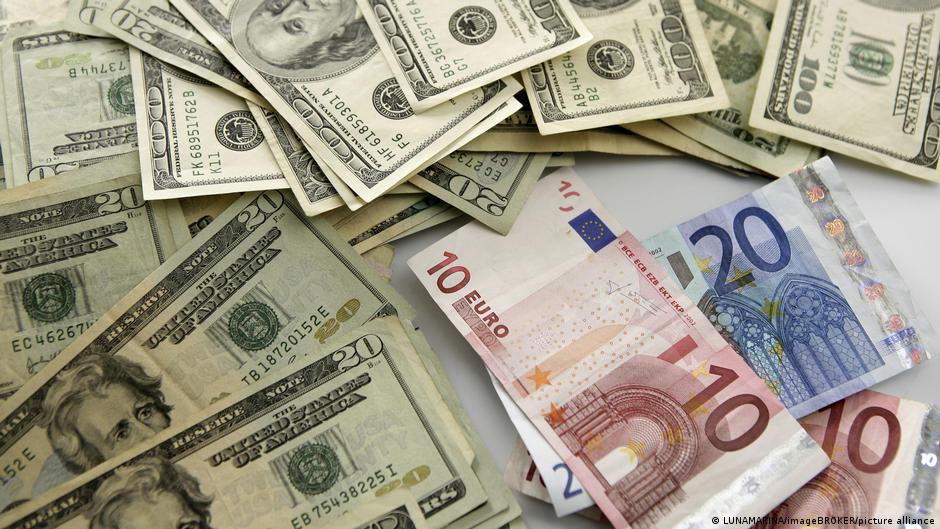

The euro hit a 17-month low against the dollar in early trading on Monday, as concerns over eurozone debt, particularly in France, compounded investors’ worries about global government bond yields and rising oil prices.
The euro has slipped against the dollar for much of 2026, down about 5% since the start of the year. It reached $1.12 (€0.99) on Monday, its lowest level since the start of 2025.
Ricardo Amaro, chief euro zone economist at Oxford Economics, told DW that the general decline can be attributed to a reassessment of investors’ expectations for the US Federal Reserve’s policy in terms of rising interest rates in the face of rising global bond yields.
He added, however, that the latest selloffs were driven in particular by concerns about France, where “investors are positioned to face higher fiscal risk.”
The French problem
The sale of French debt accelerated last week as doubts grew over its long-term viability. French 10-year government bonds – the cost France must pay to borrow money within 10 years of issuing the debt – reached a yield of 5% before easing slightly.
France has long had underlying budgetary problems. Since President Emmanuel Macron came to power in May 2017, public spending has increased while he implemented deep tax cuts. As a result, the country’s national debt increased by more than 1 trillion euros ($1.12 trillion).
France’s debt/GDP ratio now stands at almost 118%. It systematically displays unbalanced budgets. Its annual budget deficit is now regularly above 5%, above the rate of 3.4% when Macron came to power.
For many investors, broader concerns about weak euro zone growth levels and soaring energy prices have contributed to a renewed interest in France, with many turning to options perceived as safer, such as German government debt.
The difference between yields on 10-year French and German government bonds last week rose to its highest level since the euro zone debt crisis, a closely watched measure of the EU’s financial stability.
What can the ECB do?
The resulting pressure on the euro and other government bond markets, including Italy’s, is prompting the European Central Bank (ECB) to take steps to prevent worries about France from turning into panic.
Deutsche Bank’s Jim Reid said in a note Monday that at one point last week the spread between German and French bonds had become so wide that a “mini-panic” was imminent.
“The big question is whether this is the start of a new sovereign crisis in the eurozone or whether the markets have already exceeded the limits,” he said.
Ricardo Amaro said the situation poses a challenge for the ECB because it must act without making the situation worse. “An overly hawkish attitude would also add pressure on French bond yields, which have become a significant factor in the euro’s weakness,” he added.
He expects policymakers to continue to monitor developments in US dollar-euro exchange rates, but without attempting to influence the market for now.
What is at stake?
Uncertainty reigns due to political and economic pressures. France has been plagued by political crises in recent years, where the adoption of annual budgets has become a major test for government stability.
Even though the 2027 budget has been approved, with reforms aimed at reducing the deficit, the right-wing National Rally remains well placed ahead of the 2027 presidential election, in which Marine Le Pen is expected to be at the head of the list.
Concerns about French economic policy if Le Pen wins the presidency are spooking investors, in the same way that the rise of the far-right AfD in Germany has raised questions about the future direction of the bloc’s key economy.
Much of the political instability is due to voter anger over the high cost of living. In Spain, Prime Minister Pedro Sánchez has just called early elections after measures intended to tackle the country’s housing crisis were rejected by Parliament.
Amaro believes that a weakening of the euro could worsen the underlying problem of inflation.
“Further euro weakness would reinforce the inflationary shock at a time when inflation is already expected to remain high until 2027,” he said.
A weaker euro would increase the cost of imported goods, especially those priced in U.S. dollars. Global commodities such as oil and gas are valued in dollars, meaning surging energy prices could rise further, as could U.S. imports.
The next financial crisis?
With memories of the sovereign debt crisis that hit the EU in the early 2010s still fresh, many observers are beginning to wonder whether developments regarding French debt could be a sign of a new crisis in the eurozone.
Some, like Geoffrey Yu, senior strategist at BNY, say such concerns are misplaced. “Comparisons with 2012 are far from accurate,” he said.
However, Amaro believes that the fact that further interest rate hikes are expected from the ECB this year, combined with the deterioration of the inflation outlook, means that this situation must be managed and monitored very carefully.
“The weakness of the euro should not be interpreted as an isolated development,” he said. “If it were triggered by growing concerns about France’s fiscal outlook, then the ECB would certainly want to take into account the risks for the eurozone.”
Edited by: Kristie Pladson
Gn bussni