At the airport in freezing Moscow, billionaire real estate developer and one of President Donald Trump’s top envoys, Steve Witkoff, answered a brief question from a CNN crew that had been ushered onto the tarmac.
Yes, there was “progress” in negotiations that day with Russian President Vladimir Putin, Witkoff responded.
“That’s what President Trump wants to see,” he added, referring to the US leader’s desire for a diplomatic victory in the brutal five-year conflict that he once boasted would end in a day.
This progress is European involvement.
For almost two years, Europe has been effectively kept out of negotiations with Russia aimed at establishing peace in Ukraine. But now, after Witkoff and Trump’s son-in-law Jared Kushner met with President Putin in Moscow on Thursday, the Russians appear to have agreed to give Europe a seat at the negotiating table, something Moscow had previously opposed.
The move was welcomed by Ukrainian President Volodymyr Zelensky, who is increasingly dependent on European military, diplomatic and financial support to keep his country afloat and Russian forces at bay.
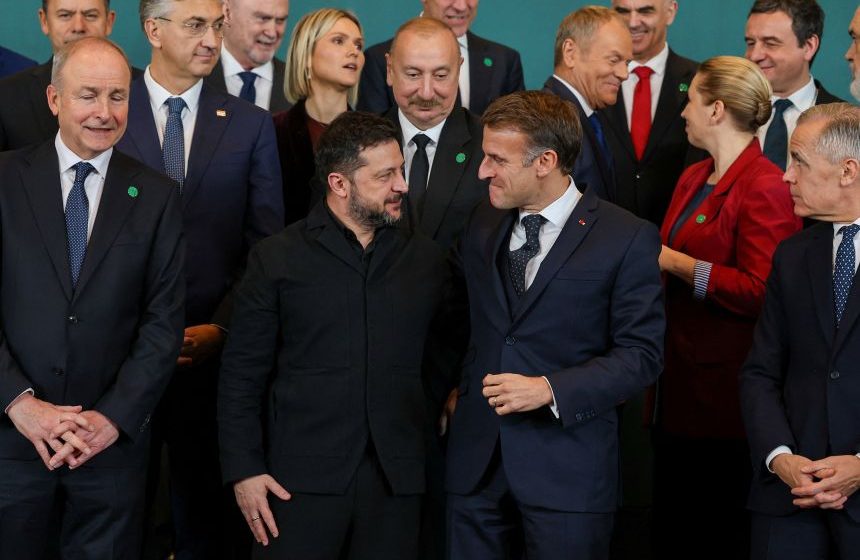
“It is important that the Europeans, next time, at the next meeting, that Europe is part of the negotiating team, not somewhere, not separately. They will have a voice,” Zelensky told reporters in Ireland, after being briefed by Kushner and Witkoff at a meeting of European leaders.
“It is important for us because the war is in Europe. We will be members of the EU in the future and that is why it is very important. For prosperity and for security guarantees it is very important to have Europe,” Zelensky added.

Europeans, while deeply skeptical of Russia’s commitment to finding a diplomatic solution to end the war in Ukraine, view the inclusion of a European element in future peace talks as a positive step, as well as a long-overdue recognition that Washington cannot achieve it alone.
“I think after almost two years of negotiations between the United States and Russia, they have now understood that Europe is an important player here,” commented Kaja Kallas, the EU’s top diplomat, in Dublin.
“We are the ones who supported Ukraine, we are the ones who put sanctions in place and we have the (Russian) assets frozen. So, clearly, without us, any agreement in place cannot be implemented,” she added.
The composition of the European delegation was the subject of heated internal debates. On Friday, European Council President António Costa said the European team would be represented by EU institutions and E5 countries including France, Germany, Italy, Poland and the United Kingdom.
Earlier, Kushner highlighted potential difficulties with Europe’s ability to “identify a person to speak on its behalf,” saying that doing so “would be a greater achievement than getting the Russians to include them in the negotiations.”
The formal involvement of European negotiators may be welcomed in kyiv and Brussels, but it will not necessarily hasten the end of a conflict that has so far killed hundreds of thousands of people on both sides.

In subsequent remarks, Russia avoided admitting that it had fully accepted a European presence at the table. At his regular press briefing on Friday, Kremlin spokesman Dmitry Peskov said Europe must show its “willingness to contribute to the peace process” before a decision can be made on joining future negotiations.
European leaders regularly take a tough, moral line toward Moscow, often calling for Russia to be defeated and punished for launching its full-scale invasion of Ukraine, and for the Kremlin to withdraw its troops from all Ukrainian territory.
If these mantras are simply repeated at the negotiating table and Europe does not offer more practical compromises, a breakthrough with the Kremlin will become even less likely, as Moscow has indicated.
“They (Europeans) must decide whether they want peace or a continuation of the war. So far, all their practical actions are precisely in this direction,” Yuri Ushakov told a briefing to journalists after the meetings in Moscow.
And there are signs that Moscow, after agreeing to admit European negotiators, is already doubling down on its maximalist demands to end the war, reviving its call for NATO withdrawal from Eastern Europe and sticking to the issue of potentially deploying peacekeepers to monitor any ceasefire along the front lines.


“The solution that the US administration and President Trump must come up with is to agree on potential arrangements for pan-European security. And what are we hearing from the Europeans? They said no. Only after the Ukraine peace deal is concluded,” President Putin told Witkoff and Kushner in a televised snapshot of the talks.
“But once this peace agreement is concluded in Ukraine, they… they will deploy their troops, which would mean the continuation of the war. So it’s a vicious circle,” Putin continued.
This is a sign that the Kremlin, even if it does not appreciate European involvement in the negotiations, will find a way to use this new reality to try to achieve its objectives in Ukraine, notably by prolonging the negotiations while shelling Ukrainian cities.
A new winter of bitter conflict, a last effort, is probably what the Kremlin really wants.
Gn headline