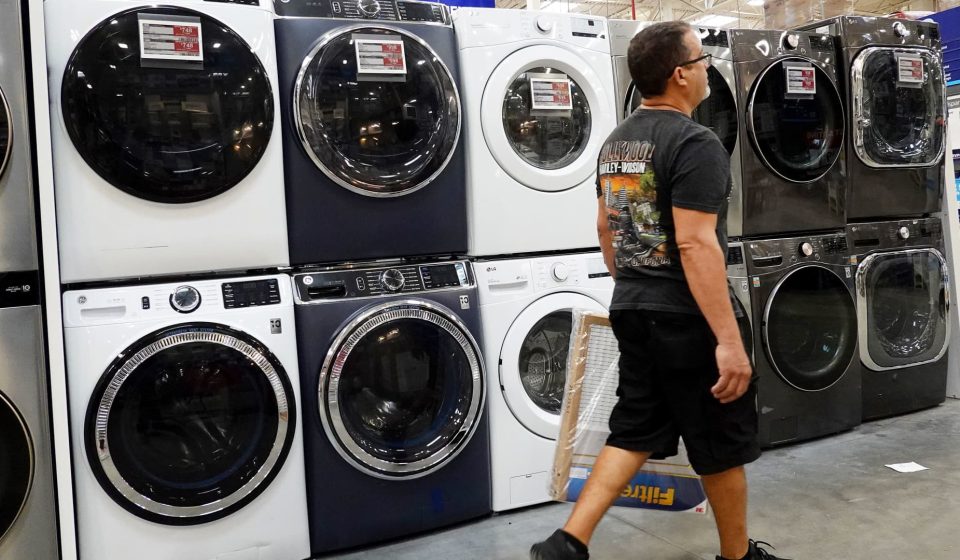
A customer walks past washers and dryers on display at a Lowe’s Home Improvement store in Miami, Florida.
Joe Raedle | Getty Images
This holiday season, big-ticket items are expected to be in short supply, with diesel prices near record highs, trucking rates near a post-pandemic level and transportation costs reaching multi-decade highs. All of this is forcing many retailers to rethink their holiday inventory strategy.
“We’re going to have some of the lowest inventory levels we’ve seen in history for some of these big-ticket items,” said Deborah Weinswig, CEO of retail analytics firm Coresight Research.
Weinswig said the retailers she works with are holding less inventory of big-screen TVs, grills, large appliances like washers and dryers, and other items that take up a lot of space or cost a lot to keep.
“It’s getting the freight from there to here, the freight charges, and then trucking it to get it to the stores,” Weinswig said. “We’re talking about three different things here and each one is up significantly year over year.”
Rising prices for supply chain services are caused by domestic and international politics.
According to Evercore ISI, general trucking rates increased more than 47% year over year during the week of November 2.
Industry experts say the federal government’s crackdown on non-citizen truck drivers and non-U.S.-based truck drivers operating in the United States has been a significant factor. This has created a capacity shortage that has led to increased rates and is expected to continue to create upward pressure.
At the same time, fuel surcharges are increasing.
Most transport providers charge their customers an additional fuel surcharge to compensate for variations in the cost of diesel fuel. That surcharge rose 64% year over year, according to Evercore ISI data, as diesel prices hit new records in part because of the U.S.-Israel war over Iran.
And inventory holding costs — or the total expenses of storing unsold goods, which could include capital costs, servicing, storage and other risk factors — are closely tied to the yield on the 10-year Treasury note, which topped 5% in October and remains at multi-year highs in November.
Collectively, the higher costs could mean deeper discounts for shoppers willing to wait, according to Bill Catania, CEO of logistics technology company OneRail, which provides same-day delivery for companies such as FedEx And Lowes.
“You’re going to see more discounts and price promotions as we get closer to the holidays to clear inventory, so they don’t have to transfer it, get rid of it or position it in some other way,” Catania said.
Peak planning
Trucks drive on Doremus Avenue on September 17, 2026, in Newark, New Jersey.
Michael M. Santiago | Getty Images
Retailers also face a dilemma in their holiday inventory strategy when it comes to shipping costs versus opportunity costs. In other words, is it worth stocking up now, or waiting in hopes that shipping rates will drop a bit, but risk not having the right mix of products?
That’s leading to a wait-and-see approach to restocking shelves after the first holiday sales in October, executives said.
UPS CEO Carol Tomé said during the company’s Oct. 27 earnings conference call that she is “just starting to receive peak season forecasts from our customers.”
Likewise, Derek Leathers, CEO of Werner Enterprises, a trucker for big box and large retailers, said retailers are being cautious.
“When rates are higher and the cost of capital is higher, you’re going to focus much more intensely on not having excess inventory,” Leathers said.
Still, 2026 holiday sales are expected to exceed $1 trillion as inflation drives growth and customer spending is expected to remain healthy, according to Bain & Company’s annual forecast. Leathers said that even with trucking and shipping rates rising, he sees that retailers are willing to pay for supplies.
“The biggest concern right now is making sure their capacity is locked in. There’s a lot more dialogue around making sure you have a truck or any other mode that needs to be secure,” Leathers said. “I’m not saying they’re insensitive to price, because they’re certainly still concerned about price. But you can’t sell it if it’s not on the shelf.”
Last minute and last mile
ShipMatrix, a data analytics company for the logistics industry, predicts that 2.4 billion packages will be delivered during the peak holiday season of 2026, a 4% year-over-year increase.
This is an increase that will likely lead retailers to increasingly rely on on-demand delivery, especially later in the holiday season. Gig workers allow retailers and delivery companies to adapt to changes in order flow and accommodate last-minute purchasing surges without spending time and money on onboarding new team members.
“Delivery at scale is great. You know, it happens quickly, but there are better unit economics,” Catania said.
Industry experts said they also expect to see more retailers using drones for last-mile delivery of smaller items.
A 2024 PwC study predicted that the cost of drone delivery would “decrease by more than 70% over the next 10 years, not only matching traditional last-mile delivery costs, but surpassing them and creating an inflection point for the industry.”
Amit Regev, CEO of drone company Flytrex, said the company is in active talks with retailers about using drones for holiday deliveries.
“Expectations are now becoming much more instantaneous,” Regev said.
Retailers are using drones more and more. Lowe’s announced in September the launch of a drone delivery service in partnership with DoorDash and Alphabet’s Wing. Amazon earlier this year, it aimed to offer drone deliveries to nearly 500 U.S. cities and towns by the end of the year.
Flytrex currently delivers for Walmart and a number of restaurants, including Little Caesars and Papa John’s.
“Customers are looking for that instant gratification,” Regev said. “So if it takes too long, they might not want to order from you. And from what we’re seeing, that gives them more incentive to try testing or deploying deliveries using drones.”
Gn bussni