
At a rally for Republican Senate candidate Ken Paxton in Texas, President Donald Trump was interrupted more than a dozen times by protesters whom he then cursed from the stage.
“This guy needs to lose a lot of weight,” Trump said as a protester was being removed.
“He’s going home to mom now…but what he doesn’t know is that his mom voted for Trump,” he said of another.
The president also made the unproven claim that protesters were paid to heckle him. “These are paid protesters. They are paid by the enemies of our nation,” Trump said without any evidence.
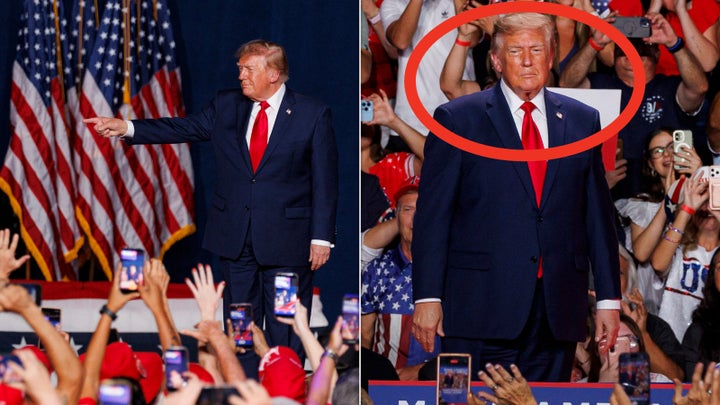
As he said these words and watched protesters move through the audience, he demonstrated revealing body language and facial expressions.
“One thing we want to remember in this scene is that he is in his element,” said Denise Dudley, a clinical psychologist and behavioral expert. “It’s not a bipartisan thing…he’s with his people. And so what he’s doing, instead of just getting (protesters) out of there, is he’s using it,” Dudley said.
He uses what’s called “audience-led reframing,” Dudley added, “where he turns the protester’s interruption into an opportunity to better define the event for his supporters.” »
Trump creates an “in-group/out-group” moment, she said, that people use to distinguish the supportive crowd from the critics, or even the “good guys” from the “bad guys.”
Trump repeatedly comments on the motivations and appearance of his critics.
“He describes the outside group as the inside group, which excites the inside group more… They start chanting ‘USA,’ and so he uses that very effectively, I have to say, to just say, ‘Hey, look at all of us and look at that horrible group over there. They’re paid protesters,'” Dudley said.
“He’s just attacking them in order, in a sense, to bring his own group together. So it’s a tactic,” she added.
Trump moves his tongue in certain places, indicating frustration, experts say.
There were several instances throughout the rally where Trump gestured with his tongue, which is telling, said Patti Wood, a body language expert and author of “Snap: Making the Most of First Impressions, Body Language and Charisma.”
At one point, “he puts his tongue inside his mouth and pushes it – and it’s a movement of frustration.”
“He also, at one point, in frustration, did what’s called a ‘lick,’ where he sticks his tongue out,” Wood said.
“It’s one of my favorite nonverbal behaviors to see in a powerful person, because it echoes playground behavior when there’s a bully on the playground and he’s making fun of a kid who doesn’t have the strength… to fight back, and then he sticks his tongue out,” she said.
It’s a quick movement, but “very instinctive,” she noted.
“It speaks to his frustration, and he does it before he attacks,” Wood said.
“I’ve seen it quite frequently on criminal walks…you don’t usually see that in a president, in any scenario, because he has the power,” Wood said, “so that tells me that on some level he feels like he doesn’t have the power, and that’s quite a revelation.”

His clenched jaw and pursed lips show that he is tense and trying to hold back.
“When you look at his face, you can’t not notice his lips,” said behavioral scientist Abbie Maroño.
Trump often uses a lot of mouth and lip movements when speaking and interacting.
It’s very common for Trump to “purse his lips when he’s irritated. So his baseline often shows a lot of lip movement, but this was really exaggerated,” Maroño said.
Interestingly, this happened every time he tried to positively rephrase one of the protesters’ interruptions, she said.
“He was exhibiting very extreme lip pursing,” Maroño said. “Now pursing our lips is a behavior we do to almost withhold information…it’s a show of restraint and we do it when we’re trying to hold back, or we’re unhappy, or we’re embarrassed and we want to say something.”
Wood added that pursed lips can mean many different things, but usually disgust.
His jaw was also visibly clenched, Maroño noted. “You could see how tense and protruding his jaw was…not only was it clenching, but it was moving forward several times.”
This shows an “extreme level” of irritation and frustration that he is trying to hold back, Maroño said.
He stopped to watch some protesters as they were removed, which is a “selfish decision,” experts say.
As some protesters are removed from the space, Trump makes a point of stopping talking and looking at them as they are escorted away. This encourages everyone to stop and watch too.
Whether you’re in the audience or watching the rally from your TV screen, “nothing is going to happen until these protesters are removed,” Dudley said.
“The way he stops and looks at this forces us all to know that the protesters are being removed. We all know it, even if we can’t see it,” Dudley said. In a way, this sets an example for the protesters.
“I think some of it is the most selfish thing anyone can do,” Dudley said. People are at the rally to hear Trump, but he stops the whole show to watch and wait, she added.
It’s his way of stopping the entire gathering so everyone can watch the “ugly protesters” be kicked out of the room, she said.
Some head movements and mouth expressions show that Trump is “frustrated” and “exhausted” by the disruption.
“I noticed that several times he would lift his chin, and we lift our chin when we are proud, and often when we are trying to show confidence,” Maroño said.
That’s why people remember to hold their heads high when trying to be confident, she noted.
“There were several times where he kept raising his head, so he was trying to gain confidence,” she said. However, in addition to his buried frustration, it created an aura of “conflicted confidence,” Maroño added.
“He was not calm and collected. He was composed, but irritated,” she said.
With more than 12 interruptions of protesters throughout the evening, it’s no wonder Trump was frustrated — even if he didn’t want to show the protesters that they had gotten to him.
“The election is getting really close now, and it’s like when a battle has been really, really long, and you have so much punch and momentum and fire, and then you get towards the end, and it’s almost like this last election when you’re so close (it) becomes so exhausting,” Maroño said.
“I’m starting to see that a little more in his very recent appearances where he’s starting to seem a little frustrated,” she added.
Wood agreed and noted that after Trump made the “they’re paid protesters” comment, his eyes “twitched” and his mouth curved downward.
“And what that tells me is…he’s exhausted,” Wood said. “The delivery wasn’t powerful, and then he’s exhausted thinking about them being there,” Wood added.
Trump fans also booed the protesters, which Wood said confused Trump.
“At one point I wondered: Is he thinking, ‘Are these boos for me?’ Like he does at football games,” Wood said. Trump was booed at a Washington Commanders game last year.
“I think it shows that these negative statements from people affected him,” Wood said.
The pauses before responding or acknowledging what was happening also show that he had to figure out what he actually wanted to do or say, Wood added.
His instinct is to immediately attack, ignore or interrupt someone mid-sentence, and “he didn’t do that.”
“He was not in his normal state when it came to attacking immediately,” Wood said.
Gn headline