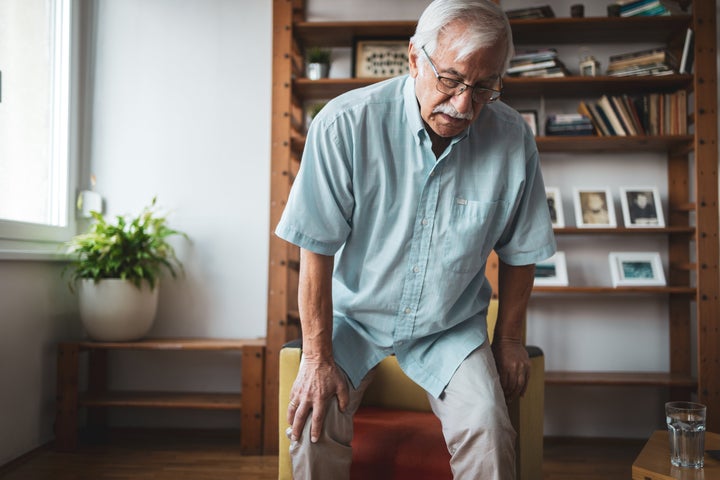

Many of us look for the obvious signs of aging. Gray hair. New wrinkles around the eyes. Do things a little slower than before.
But mobility experts who work with seniors are interested in one particular part of the body: your butt.
Physical rehabilitation specialists monitor your glutes and check whether they can still get you upright stably. More than one in four Americans over the age of 65 falls each year, and fewer than half report it to their doctor. For many people, a fall is the first sign of a change in strength, balance, or mobility.
“The legs are the engine of independence,” said Scott McAfee, an orthopedic physical therapist. They get you out of a chair, help stabilize you when your weight changes, and help you stay upright when you move.
A 2014 study in BMC Geriatrics compared 58 adults over the age of 65 who had fallen in the past year with those who had not. Muscle changes were evident throughout the lower body, but the glutes were most affected. Among people who fell, gluteus maximus fat was twice that of people who didn’t fall. Researchers said such changes may contribute to poorer balance and a greater risk of falls.
To see if this muscle can still do its job, McAfee uses the 30-second chair stand. With your arms crossed, stand up completely and sit down as many times as possible in half a minute. McAfee monitors how customers stand and sit.
The number it counts matters as much as how you do it. “So a fit 62-year-old knocking out 18 is in great shape,” McAfee said. “The same woman who only manages 9 or 10 tells me her risk of falling could increase.”
McAfee added: “If a person has to push their thighs or armrests back to stand, they stop and get a zero. That’s automatically high risk.”
The way back matters too. “A powerful motor lowers under control, while an increasing fall risk drops the last few inches of the seat because the muscles that slow the body are already failing,” he said. “I watch the descent as closely as the climb.”
Priyank Patel, a chiropractor in Brooklyn who sees older people for hip, lower back and gait problems, studies what the trunk and hips do when going uphill. “If they’re moving their torso forward a lot to get momentum, that tells me that their quads and glutes aren’t generating enough force on their own, so the body is borrowing momentum instead,” Patel said.
Asymmetry matters too. “If one hip goes up before the other or the knee wobbles inward as it comes up, that’s an asymmetry I want to explore,” he said.
Getting back up is just one of the glutes’ jobs. They also help stabilize you as your weight shifts from one leg to the other. Austin Misiura, an orthopedic physical therapist, tests both. He asks people to get down on the ground and stand up without hands, then balance on one foot.
This floor elevation test detects something that the chair stand does not detect. “For chair support, there are almost no mobility requirements,” Misiura said.
“The mobility component of floor support is completely ignored by almost all other standardized tests,” he said, “because virtually everyone can be in a standing or sitting position with little or no information about mobility.”
Misiura said the tests reveal much more than just watching someone walk. “People walk in all kinds of ways and change the way they walk based on testing,” he said. The gift comes when they can’t cover it. “Customers won’t even want to come ashore, or they’ll need help immediately,” Misiura said. Standing, the same people move slowly and close to the ground, with “a shuffling gait to try to get their foot on the ground as quickly as possible.”
That same stability matters when someone turns around. Dr. Alexander Acosta, a physician and medical consultant for hospital bed company SonderCare, said a “bend is a movement that causes a person to place a load on one leg for a moment, revealing balance and strength.” He added: “A sicker patient won’t be able to hide this. »
Acosta counts the steps it takes to overcome it. Most healthy adults take three or four, he said. “I start paying more attention when someone needs five or more steps, or when they approach a wall or a chair,” Acosta said. He had a patient who needed six steps and one hand on the wall to do a single turn. “The difference between four and six steps is not subtle once you know what to look for,” he added.

MStudioImages via Getty Images
How to test your glutes at home
Experts say you can try them at home. Keep someone nearby and stop if you feel dizzy or unsteady.
1. Get up from a chair.
Try the 30-second chair stand. On the Centers for Disease Control and Prevention scale, a man in his early 60s should manage at least 14 stalls and a woman at least 12, with that number decreasing each decade. Pay attention to whether you need your arms to help you up and whether you control the descent into the seat.
2. Get down to the ground and step back.
If you can do so safely, get down to the ground and back up without using your hands or furniture.
3. Stand on one foot.
With your eyes open, balance on one foot. Aim for 10 seconds per side. Losing him in the first seconds is worth noting.
4. Make a full circle.
Stand near a door frame, turn around and count your steps. Acosta says it should be done in three or four steps. Five or more, or a hold against the wall, is something he pays close attention to.
A low result is a reason to start working on it, because the muscle responds to training at any age. “A low score should not be discouraging,” McAfee said. “Maybe just a push to see your physical therapist to improve it.”
Gray hair and new lines don’t respond to this kind of boost. The muscle that makes you get up from a chair, off the floor, or turn a corner does it.
The original version of this story was published on HuffPost earlier.
Gn Health