Fact Check: Contrary to Trump’s Claims, There Was No Law Requiring Roger Marshall to Sue His Patients

There was no law requiring Senator Roger Marshall to take legal action against patients whose medical bills were unpaid.
Marshall, a Republican obstetrician-gynecologist who is in a competitive race for reelection in Kansas, came under fire following a New York Times report that he filed hundreds of lawsuits against patients who had unpaid bills and charged them an 18 percent annual interest rate. The Times reported that dozens of Marshall patients were arrested after missing court dates in collections cases.
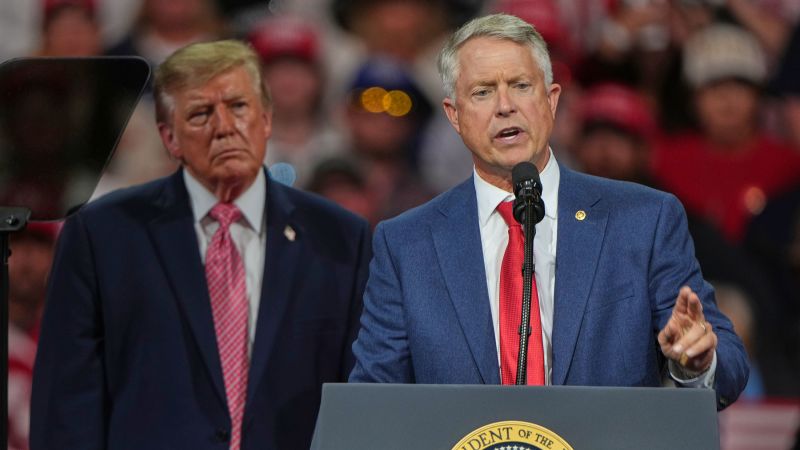
President Donald Trump claimed the law required Marshall to take aggressive steps to collect funds from patients — although Marshall also said he had written off many patients’ bills. Trump even claimed that Marshal He could have been arrested if he hadn’t done what he did.
“He was criticized because he was mandated by law to forcefully demand monies owed to patients. You have no right not to do it. By law, you have to prosecute these people. And they were like, oh, he was kind of a Shylock type guy,” Trump said at a rally in Kansas on Monday, invoking an anti-Semitic trope. “And if he didn’t make these demands, he would be breaking the law, he would have broken a very strict criminal statute, and he would be subject to criminal arrest and criminal liability.”
But federal and state laws give doctors and hospitals wide latitude to choose whether to forgive patients’ debts due to financial hardship or pursue unpaid bills using gentler methods than litigation. Marshall himself told CNN’s Manu Raju last week that “every year our hospital gives out millions of dollars in charity care” and that “we write off hundreds of people’s bills every month.”
Likewise, no law would expose a doctor to possible arrest if he or she chose to write off the bills of patients who have difficulty paying. And there is no law requiring 18% interest on unpaid bills. The Kansas City Star, which also refuted Trump’s claim, found that the 18 percent rate was unusually high in the state, even among Kansas medical practices that chose to sue patients.
Marshall’s campaign did not respond to CNN’s repeated requests to identify the law that was intended to mandate his actions. The White House, in an unsigned email, mentioned two related federal laws, one criminal and the other civil, that require health care providers who serve patients enrolled in federal benefit programs to make a reasonable effort to collect payments from most patients — but the White House did not mention that these laws allow providers to forgive money owed by people who cannot afford to pay.
In fact, one of the articles the White House sent as purported evidence explicitly says that the federal inspector general overseeing health care “has confirmed that it will not enforce (two laws) against providers who waive copayments or deductibles due to genuine financial hardship.” We will discuss this in more detail in the next section of this article.
“I am not aware of any federal or Kansas law that requires doctors to collect money owed by patients and holds them criminally liable if they do not,” Christopher Garmon, associate professor of health administration at the University of Missouri-Kansas City, said in an email. “Physicians and other health care providers have broad discretion in deciding how to charge patients (e.g., how much to set billing fees) and how much to collect in certain situations. It is common for health care providers to provide charity care to low-income, uninsured patients and write off unpaid bills as ‘bad debts’.”
Garmon noted that “there are requirements that health care providers make good faith efforts to collect cost sharing from patients in order to participate in certain health plans or programs (e.g., Medicare).” But he added: “I have never heard of a doctor being jailed for failing to collect money owed by his patients. »
Barak Richman, professor and co-director of the health law program at George Washington University, said in an email: “Unless Kansas is remarkably different from the states I have studied, I can say with certainty that the decision to pursue a patient for unpaid debt is at the discretion of the provider, and it is an action that most providers choose not to take.” »
Trump suggested in his Monday speech that the law he is referring to “is about raising money for the federal government.” Marshall told Raju last week that “when and if this happens – like every other hospital, nonprofit and other doctor’s office – some of these people have to, by law, go to collections. There has to be an effort to go to collections. Or otherwise, CMS (the Centers for Medicare & Medicaid Services), Medicaid, we would be violating that as well.”
The unsigned White House email mentioned a criminal law called the Anti-Kickback Statute, under which doctors can face prison time, and a civil law called the Civil Monetary Penalties Act, under which doctors who violate the Anti-Kickback Statute or other laws can face additional penalties.
But the federal Health Department’s inspector general’s website makes clear that no legislation requires doctors or hospitals to sue patients.
In undated guidance for doctors, the website states: “When the Medicare and Medicaid programs require patients to pay copayments for services, you are generally required to collect that money from your patients. Routinely waiving these copayments could involve the (Anti-Kickback Statute) and you cannot announce that you will forgive the copayments.”
But here’s the key: The advice immediately goes on to say: “However, you are free to waive a copay if you individually determine that the patient cannot afford to pay or if your reasonable collection efforts fail. It is also legal to provide free or discounted services to uninsured individuals.”
Separately, the inspector general’s office explained in 2022 that to meet the “reasonable” standard, a health care provider’s collection efforts must include issuing an invoice and then taking actions “such as subsequent billings, collection letters, telephone calls, or personal contact with the responsible party.” Prosecutions are not on the list of required actions. Additionally, the office said that in cases where a health care professional has determined that a patient is “indigent,” he or she does not have to make the usual reasonable collection efforts.
Marshall is running against Democratic candidate Adam Hamilton, a pastor. Hamilton campaign spokesman Tyson Brody said in an email: “Roger Marshall chose to sue his patients. He chose to charge them 18 percent interest, and he and his personal attorneys chose to file arrest warrants against them. These were not normal business practices – they were extreme and predatory.”
Gn usa