
COLUMBIA, S.C. — The Federal Communications Commission acted Thursday to allow U.S. state prisons to jam cell phone signals smuggled to inmates, as the federal government cracks down on devices that officials say pose the No. 1 security threat in the nation’s correctional facilities.
The vote was unanimous among the commissioners meeting in Washington.
For years, state prison officials have sought the right to jam, arguing that blocking signals from contraband phones would prevent inmates from using the devices to run drug rings, coordinate prison riots and even order acts of violence such as attacks on guards.
Under the new rule, prisons are not required to use jamming technology, they must conduct several tests to ensure cellular signals outside prisons are not affected, and they must notify authorities if jamming devices are moved.
FCC Chairman Brendan Carr, who has spoken in favor of the measure, visited this week with South Carolina officials, whose prison wardens led the effort to obtain permission for jamming.
Cell phones have been smuggled into hollowed-out soccer balls, carried by corrupt employees and sometimes even dropped by drone. Signal jamming technology was already allowed in federal facilities, but it required FCC authorization, due to a nearly century-old communications law, to be available in state prisons.
U.S. Attorney Bryan Stirling, who led the South Carolina Department of Corrections for more than a decade, led efforts by many of his counterparts across the country to use the technology. South Carolina Attorney General Alan Wilson, elected this month as the state’s next governor, organized his fellow prosecutors to pressure Congress to change the law, but without success.
FCC Chairman Says “Ready to Act”
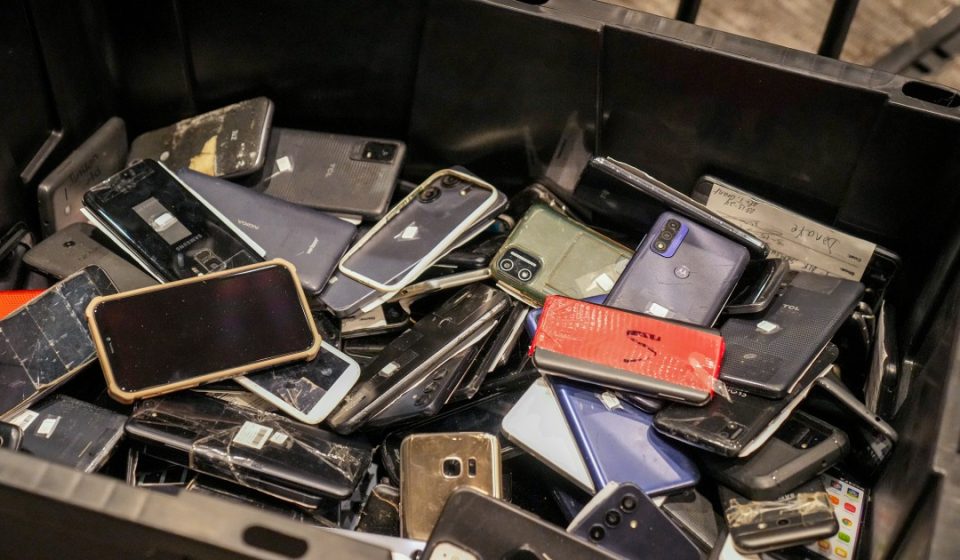
In South Carolina, Carr stood alongside Stirling, Wilson and other South Carolina officials before a display of hundreds of confiscated cellphones and massive drones used to transport contraband over prison fences. He added that many people might not perceive the danger.
“People really don’t understand the threat that this poses,” Carr said, noting that 25,000 cell phones are confiscated each year from state and local prisons nationwide. “We’re going to put a new tool in the hands of law enforcement, and it’s going to make a significant difference.”
Carr cited the case of Robert Johnson, a South Carolina corrections officer who was nearly killed at his home in 2010 in a hit that authorities said was orchestrated by a prisoner using a contraband cellphone.
After nearly three dozen surgeries and now “in pain 24/7,” Johnson said Wednesday that he calls phones “weapons of mass destruction” because of the potential dangers they can be used for. He has testified at previous FCC hearings regarding jamming applications and has often spoken out on the issue.
“No one should have to go through what I went through,” Johnson said. “But I also believe that the Lord chose my wife and me to go through this because someone had to carry the banner, and he chose us to do it.”
South Carolina tested the technology in 2008
South Carolina has been the testing ground for cell phone jamming in state prisons. In 2008, the FCC allowed the state to once test a jamming system at a maximum security prison. A device the size of a briefcase emitted a frequency that immediately turned off cell phones around an auditorium; outside, service was uninterrupted.
Another test took place at another state prison in 2019, a first collaboration between federal and state prison officials. A year earlier, seven South Carolina inmates died in the worst riot in U.S. prisons in 25 years, in what authorities said was a gang brawl staged in part using illegal cellphones.
The FCC has shown its willingness to work toward eradicating cell phones in prisons, holding a 2016 field hearing in South Carolina and holding meetings with members of Congress, prison officials and representatives of the wireless industry.
Inmate rights groups opposed the move, arguing that the high rates inmates must pay to use official prison phones have pushed them to use contraband cell phones just to stay in touch with family. The telecommunications industry has long opposed it as well, saying jamming technology risks interfering with legitimate communications.
Carr said in South Carolina he believes the industry is weakening on jamming, in part because of recognition of the scale of the problem as well as agencies’ experiences with targeted technologies.
“We don’t plan to play outside of this unique context,” Carr said. “Maybe people in the industry aren’t encouraging it, but the opposition has pushed back significantly.”
___
Meg Kinnard can be contacted at http://x.com/MegKinnardAP
Gn headline