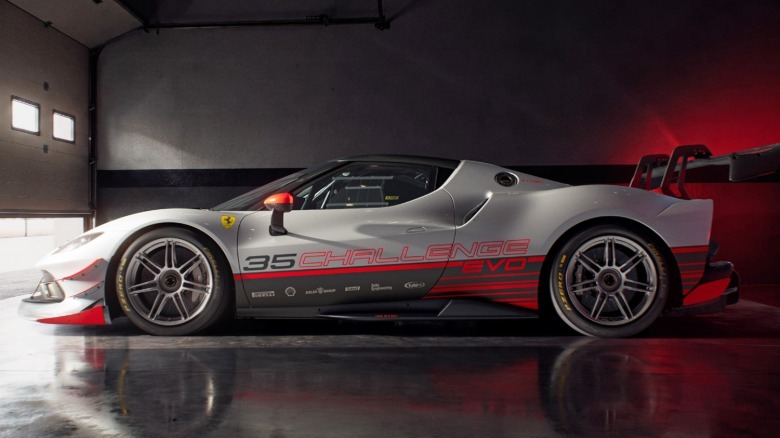
Ferrari ditches the hybrid for the road-legal 296 Challenge Stradale, shedding weight and increasing downforce to create the ultimate track toy.
Ferrari has revived one of the coolest nameplates of its modern era, creating the craziest, most track-focused variant of its entry-level supercar yet. The new 296 Challenge Stradale is a road-going version of the updated 296 Challenge Evo race car, adopting motorsport-inspired aerodynamic and chassis improvements while ditching the plug-in hybrid system for pure V6 power.
The spiritual successor to the 360 Challenge Stradale from the 2000s favors mechanical simplicity, lightness and handling prowess over pure power.
Starting with the exterior, the front is distinguished by the pronounced split, wider ducts on the hood and double canards on the bumper. The tail has also been redesigned with a fixed rear wing, side fins, dual exhaust outlets and a more complex diffuser with integrated spoilers.
According to Ferrari, new aerodynamic components, fully enclosed underbody and five pairs of vortex generators allow the 296 Challenge Stradale to produce 617 kg (1,360 lb) of downforce at 250 km/h (155 mph). This represents an increase of 72% compared to the 296 GTB, and 42% compared to the 296 Speciale.
The first road-legal non-electrified 296
The Challenge Stradale is the first road-going member of the 296 family to feature a non-hybrid powertrain, like its track-only sibling. The electric motor and high-voltage battery are gone, leaving the 3.0-liter twin-turbo V6 to do the work on its own. The dry-sump engine benefits from hardware from the Ferrari Challenge racing program, generating 661 hp (493 kW / 670 hp) and 740 Nm (546 lb-ft) of torque. Power is routed to the rear wheels via an eight-speed F1 dual-clutch gearbox.
Although it can’t match the combined power of the 296 GTB (819 hp) and 296 Speciale (868 hp) plug-in hybrids, the Challenge Stradale is quicker than both on the track. More precisely, it completes Fiorano in 1’18”500, or 2.5 seconds faster than the 296 GTB and 0.5 seconds faster than the 296 Speciale.
Besides the new aero, this is largely due to its power-to-weight ratio of 1.98 kg/hp. Saying goodbye to electrification, the Challenge Stradale reaches a dry weight of 1,330 kg (2,932 lbs), which is 140 kg (309 lbs) less than the 296 GTB and 80 kg (176 lbs) less than the 296 Speciale. Removing the hybrid system was not an easy task, as Ferrari had to design a mechanical air conditioning compressor, a belt starter with alternator and starter functions, and a new transmission.
Of course, they haven’t forgotten about the sound, with a Challenge Stradale-specific exhaust and an optional non-track-legal exhaust system to rival the notoriously loud 360 Challenge Stradale.
Interior and chassis improvements
The regime continues inside the cabin, with one-piece carbon fiber door panels and center console, as well as an optional set of carbon seats borrowed from the SF90 XX Stradale. There is also the option of exposed interior chassis trim which removes the carpets and panels under the seats. Nevertheless, the model retains equipment such as wireless charging, ADAS, dual cameras and Matrix LED headlights.
As for the chassis setup, the suspension features recalibrated semi-active shock absorbers with nearly double spring rates, motorsport-derived auxiliary springs and bespoke Pirelli P Zero R or Trofeo RS tires. Ferrari claims that stability has improved by 34% compared to the 296 GTB, with a 68% reduction in roll slope.
In a similar context, the electronic suite has been revised for the best possible times. The model benefits from a new predictive slip control system optimized for the track, Ferrari Integrated Vehicle Estimator (FIVE) derived from the F80 and Evo ABS operating in all five Manettino modes. Beefier carbon-ceramic brakes measuring 398 mm (15.7 inches) at the front and 380 mm (15 inches) at the rear round out the revisions.
When it comes to straight-line performance, the Challenge Stradale matches the Speciale’s 0-100 km/h (0-62 mph) acceleration in 2.8 seconds. However, it is 0.9 seconds slower in the 0 to 200 km/h (0 to 124 mph) sprint, completing it in 7.9 seconds.
Ferrari hasn’t announced pricing for the Challenge Stradale, but Autocar reports that the price will be about the same as the 296 GTB.
What about the 296 Challenge Evo race car?
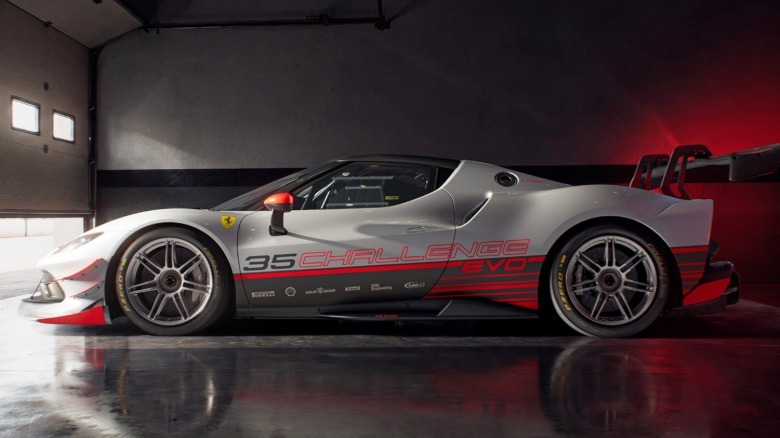
The 296 Challenge Evo is the successor to the racing model initially introduced in 2023. It shares the non-hybrid twin-turbo V6 with its predecessor, producing 690 hp (515 kW / 700 hp) and 740 Nm (546 lb-ft) of torque, mated to a seven-speed dual-clutch gearbox.
The biggest difference in the Evo is the redesigned aerodynamics. The team made modifications to the front splitter, bumper, mirrors, underbody, adjustable rear wing and rear diffuser, allowing the race car to produce 12% more maximum downforce compared to the outgoing 296 Challenge. It is also possible to increase the rear ride height by up to 10 mm (0.4 in) to further increase downforce. In the opposite direction, teams have access to a Low Drag kit for faster tracks, which reduces drag by 4% by removing two hits from the bumper and one nolder from the wheel arch.
 Ferrari
The Challenge Evo rides on 19-inch wheels shod with slick tires and has larger brakes than its road counterpart. Additionally, it features a sleek cabin with a roll bar, racing bucket, removable F1-style steering wheel, custom switches on the center console, and an optional passenger seat for coaching.
According to Ferrari, the 296 Challenge Evo is 0.8 seconds faster than its predecessor on the Mugello circuit. The new race car will debut during the 2027 Ferrari Challenge seasons in Europe and North America before expanding to regional series in 2028.
Gn tech