
Days of easy growth fixed wireless access (FWA) or 5G home internet growth is over in the United States, according to a new Opensignal report. While AT&T, T-Mobile, and Verizon continues to increase its market share, the growth has almost stabilized.
Second quarter results

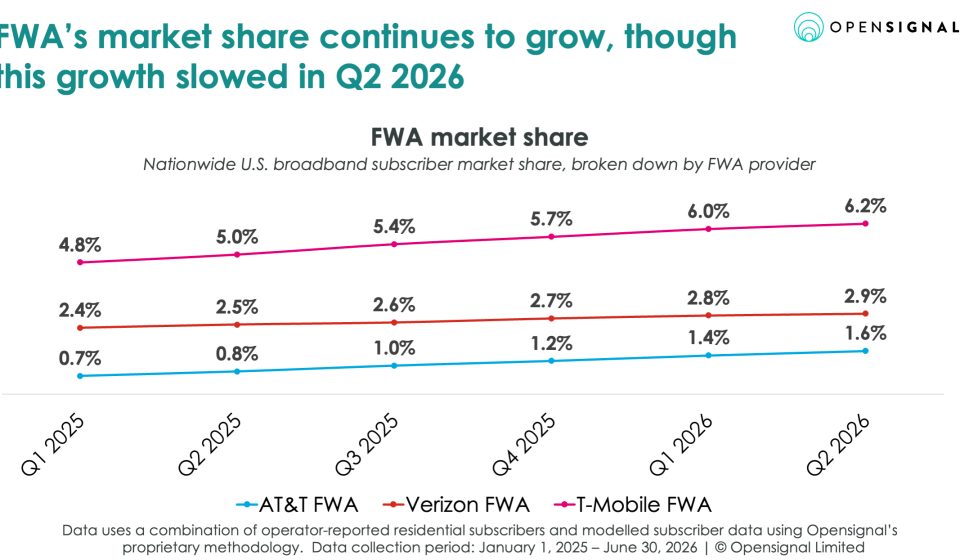
FWA Q2 market share | Image from Opensignal
Operators are using excess capacity in their 5G networks to deliver broadband to homes. 5G Internet isn’t the fastest, but it’s good enough for the average user. At the end of the second quarter, the big three accounted for 10.6% of the residential broadband market, up from 8.4% last year.

T-Mobile dominates every metric. | Image from Opensignal
T-Mobile is the leader in download speed, consistent quality and reliability, with its users enjoying download speeds 24 Mbps (22%) faster than the runner-up AT&T.
According to New Street Research, the three operators can still add 20.6 million subscribers without needing additional spectrum, so the slowdown in growth is not deliberate.
The cable strikes back
Cable companies Comcast and Charter have stepped up promotional efforts to protect their turf. Cable Net Promoter Score, which measures satisfaction and likelihood of recommending a service to others, increased, while FWA decreased in the second quarter. Opensignal believes that cable companies’ promotional pricing has eroded FWA’s pricing advantage because cable connections are faster than 5G internet. In the second quarter, the share of FWA’s new subscribers switching from cable fell from 67% to 64%.
Starlink threat increases
The win-per-loss (WPL) ratio for 5G Internet, or the number of subscribers gained for every subscriber lost, fell from 1.26 to 0.96 compared to satellite providers. This means that the Big Three lost slightly more customers to satellite operators than they gained. Starlink offers an experience comparable to FWA in rural areas. The threat is still low, with FWA market share increasing 3 percentage points to 14%, compared to Starlink’s 2 percentage point increase to 6%. FWA accounted for about 30% of broadband provider switching among rural non-migrants, while Starlink’s share doubled to 7%.
Only 1% of FWA’s new users came from satellite, while 2% of customers leaving FWA switched to satellite providers. Starlink captured the majority of these customers. As Starlink increases its capacity, its impact is likely to grow.
What should AT&T, T-Mobile and Verizon do?
With landline alternatives available at comparable prices, AT&T, T-MobileAnd Verizon Prices would have to be lowered to continue to grow and reduce churn. This should be easy. After all, 5G home Internet only requires fallow network capacity. However, FWA generates a lower return on capacity than postpaid services. The long term solution is to expand their fiber footprint and attract customers looking for faster speeds to their own landline service instead of letting them turn to their competitors.
Check out these related stories:
Gn tech